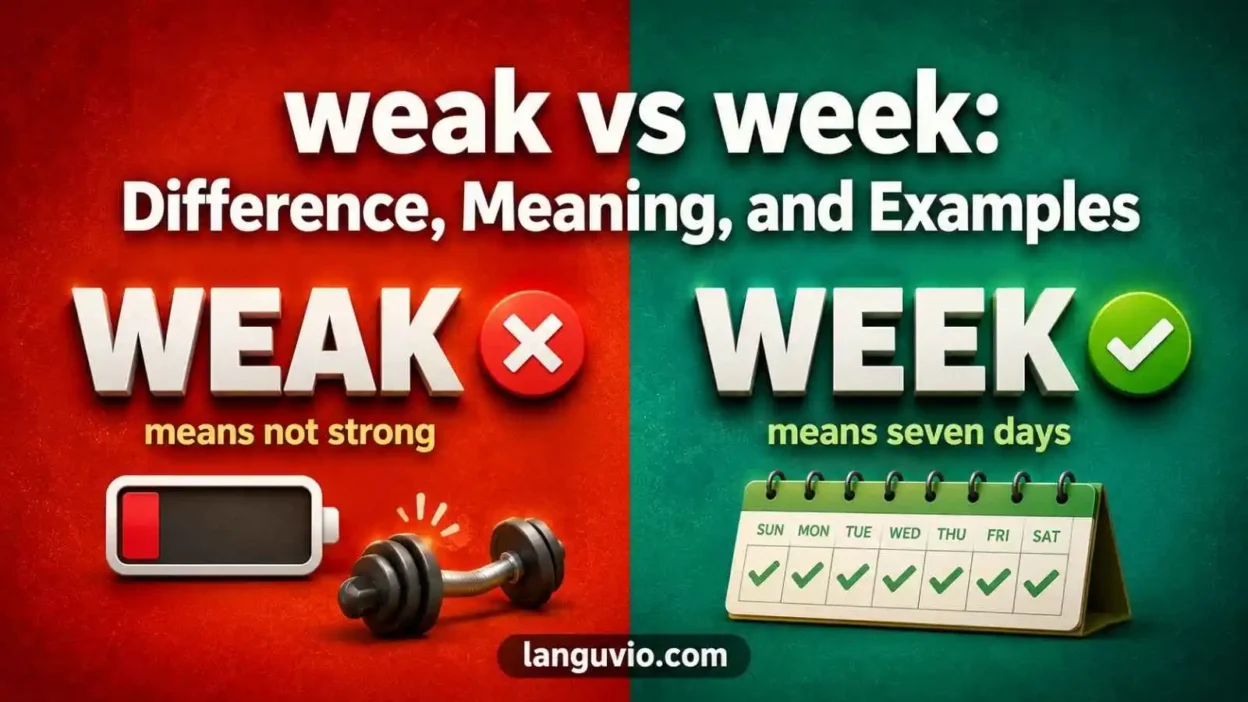
Weak vs week is a common word-choice problem because the two words sound exactly the same. The spelling is close, but the meanings are completely different.
Use weak when you mean not strong, not effective, or lacking power. Use week when you mean a period of seven days.
The easiest way to choose is to ask: “Am I talking about strength or time?” If the sentence is about strength, use weak. If it is about time, use week.
Quick Answer
Weak means not strong.
Week means seven days.
• I felt weak after the flu.
• I will call you next week.
• The Wi-Fi signal is weak.
• The project is due in one week.
They are not interchangeable. A weak plan is a plan that may fail. A week plan would sound wrong unless “week” is part of a compound idea, such as “week plan” in a very unusual schedule label. In normal writing, that is not the meaning readers expect.
Why People Confuse Them
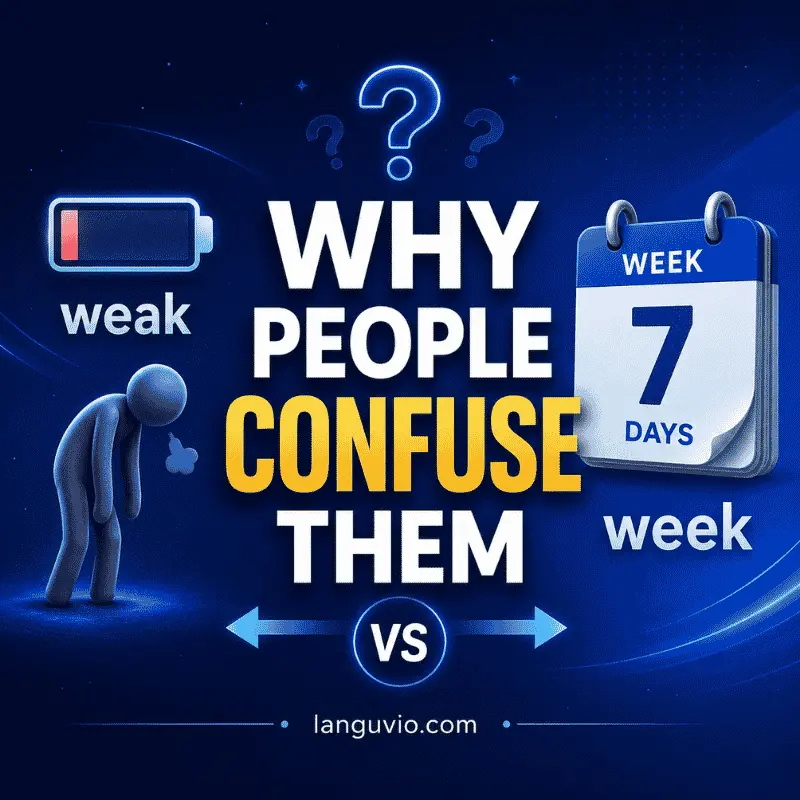
People confuse weak and week because they are homophones. That means they have the same sound but different spellings and meanings.
Both are pronounced like “week.” The vowel sound is the long ee sound, as in see, me, and tree.
The mistake usually happens in writing, not speaking. When someone says, “I felt weak,” and “I’ll see you next week,” the spoken words sound the same. The sentence context tells the listener which meaning is intended.
In writing, spelling matters. Readers can see the difference right away.
Why Is It “This Week” and Not “This Weak”?
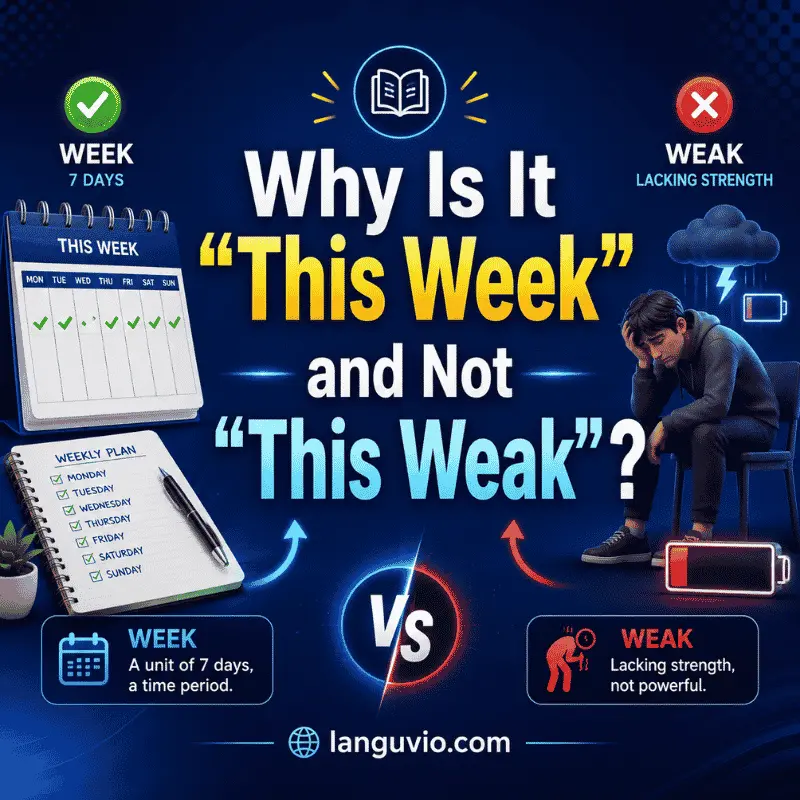
The correct expression is “this week” because week names a period of seven days.
- Correct: “I have two meetings this week.”
- Incorrect: “I have two meetings this weak.”
Use weak when someone or something lacks strength, power, quality, or effectiveness:
- “I feel weak today.”
- “The phone has a weak signal.”
- “That was a weak argument.”
In everyday American English, this week normally appears without the preposition in:
- Natural: “I finished three assignments this week.”
- Less natural: “I finished three assignments in this week.”
The wording in this week may be possible when a speaker strongly emphasizes one particular period, as in “In this week alone, we received 50 applications.” In most ordinary sentences, however, this week is the better choice.
Because week and weak sound identical, people sometimes create jokes involving weekend, weakened, or feeling weak at the end of the week. These are simply examples of wordplay and do not change the meanings or grammatical uses of the words.
Remember the basic rule: use week for time and weak for a lack of strength.
Key Differences At A Glance
| Context | Best Choice | Why |
|---|---|---|
| Physical strength | weak | It describes a person or body that lacks strength. |
| Time period | week | It names seven days. |
| Poor argument | weak | It describes an argument that is not convincing. |
| Calendar planning | week | It refers to a schedule period. |
| Low signal | weak | It describes low power or poor quality. |
| Work or school schedule | week | It refers to days in a repeated time cycle. |
| Thin coffee or tea | weak | It means not strong in taste. |
| Deadline in seven days | week | It names the amount of time. |
Meaning and Usage Difference
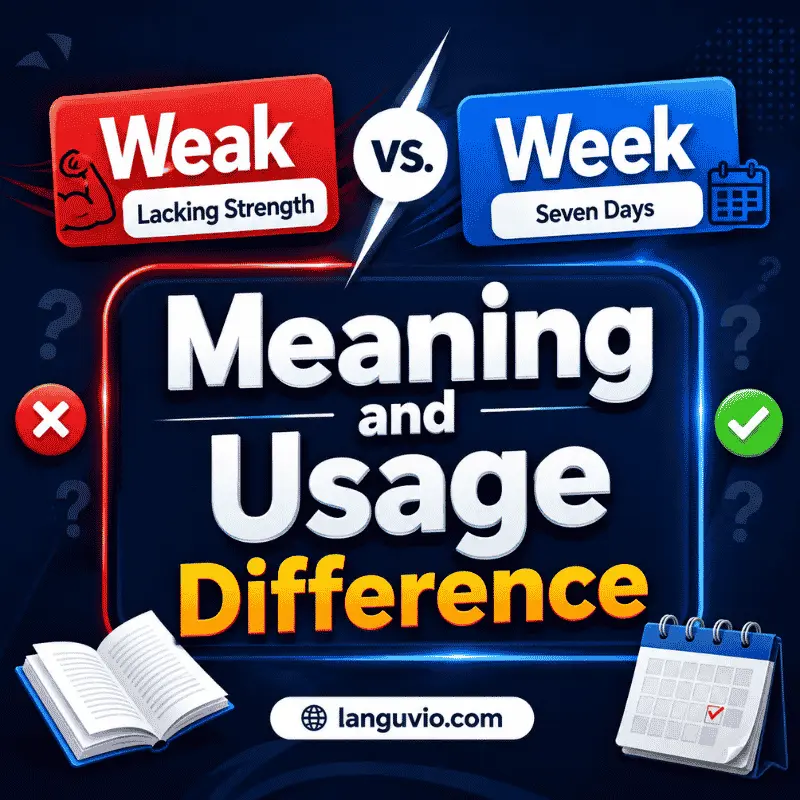
Weak is mostly an adjective. It describes a noun.
You can have a weak person, a weak team, a weak signal, a weak excuse, or a weak cup of coffee. In each case, weak means that something lacks strength, force, quality, power, or effect.
Examples:
• Her voice sounded weak after the long meeting.
• That is a weak reason to miss the deadline.
• The old shelf is too weak to hold those boxes.
Week is a noun. It names a unit of time.
A week can mean seven days in a calendar sense, or any seven-day period. You can say this week, next week, last week, one week, two weeks, or a week from today.
Examples:
• We are leaving next week.
• The course lasts one week.
• I worked four days this week.
The main difference is simple: weak describes condition or quality; week names time.
Tone, Context, and Formality
Both words are standard in American English. Neither word is too formal or too casual.
Weak can sound neutral, critical, or descriptive depending on the sentence.
Neutral:
• The battery is weak.
Critical:
• That was a weak excuse.
Descriptive:
• She felt weak after running in the heat.
Week is usually neutral. It appears in schedules, deadlines, calendars, school plans, work plans, and everyday conversation.
Examples:
• The office is closed next week.
• We meet once a week.
• Rent is due the first week of the month.
The pronunciation is the same for both words, so tone does not help much when speaking. In writing, the sentence meaning must guide the spelling.
Which One Should You Use?
Use weak when the sentence is about strength, power, quality, force, health, taste, skill, or effectiveness.
Use week when the sentence is about time, days, schedules, deadlines, calendars, or repeated events.
Compact comparison:
• weak = not strong, not powerful, not effective
• week = seven days, a calendar period, a time unit
Try this quick test:
If you can replace the word with not strong, use weak.
• The argument was not strong.
• The argument was weak.
If you can replace the word with seven days, use week.
• I will be gone for seven days.
• I will be gone for a week.
When One Choice Sounds Wrong

The wrong choice can make a sentence confusing or funny.
Wrong: I will see you next weak.
Correct: I will see you next week.
Why: The sentence is about time, not strength.
Wrong: He felt week after the workout.
Correct: He felt weak after the workout.
Why: The sentence is about physical condition.
Wrong: The phone has a week signal.
Correct: The phone has a weak signal.
Why: A signal can be strong or weak. It is not a seven-day period.
Wrong: The meeting is in one weak.
Correct: The meeting is in one week.
Why: “One week” means seven days.
Common Mistakes (and Quick Fixes)
Mistake: Using weak for time.
Wrong: I have a test next weak.
Correct: I have a test next week.
Fix: If the word comes after next, last, this, one, or two, you probably need week.
Mistake: Using week for poor strength.
Wrong: The bridge looks week.
Correct: The bridge looks weak.
Fix: If the word means fragile, tired, low, thin, poor, or not convincing, use weak.
Mistake: Confusing plural forms.
Wrong: I waited two weaks.
Correct: I waited two weeks.
Fix: The plural of week is weeks. Do not use weaks for time.
Mistake: Writing “weakend” for “weekend.”
Wrong: I’m busy this weakend.
Correct: I’m busy this weekend.
Fix: Weekend comes from week + end. It is about the end of the week, not weakness.
Everyday Examples
Here are more natural examples that show the difference.
Weak in everyday writing:
• I felt weak after skipping lunch.
• The coffee tasted weak, so I added another shot of espresso.
• Our team had a weak start but finished strong.
• The password is weak because it is too easy to guess.
• The speaker made a weak argument.
• My phone has a weak signal in the basement.
• The chair leg looks weak, so do not sit there.
• He gave a weak smile and walked away.
Week in everyday writing:
• I have three meetings this week.
• We are moving next week.
• She gets paid once a week.
• The package should arrive in a week.
• I spent a week in Chicago.
• The first week of school is always busy.
• Let’s check back in two weeks.
• I meal-prep every week.
Mixed examples:
• I felt weak for a week after the flu.
• The team had a weak performance last week.
• I need one week to fix the weak parts of the report.
• The signal was weak all week.
Dictionary-Style Word Details
Verb
• weak: Not commonly used as a verb in standard modern American English. The usual verb is weaken, as in “The storm may weaken overnight.”
• week: Not commonly used as a verb in standard American English. Use it as a noun for time.
Noun
• weak: Usually an adjective. It can appear in the noun phrase the weak, meaning people who are weak or vulnerable. That use is less common in everyday writing and can sound formal.
Example: The policy should protect the weak.
• week: A common noun meaning a period of seven days.
Example: The job will take one week.
Synonyms
• weak: Closest plain alternatives include feeble, frail, fragile, powerless, ineffective, dilute, and poor, depending on context.
Antonyms for weak include strong, powerful, effective, firm, and sturdy.
• week: There is no exact everyday synonym for week. The closest plain alternative is seven-day period.
A clear antonym for week does not really fit, because it is a time unit, not a quality.
Example Sentences
• weak: The old ladder is too weak to use safely.
• weak: Her argument was weak because it had no clear evidence.
• weak: The tea tasted weak.
• weak: He felt weak after the long hike.
• week: I will finish the report next week.
• week: We go grocery shopping once a week.
• week: The class lasts eight weeks.
• week: It has been a busy week.
Word History
• weak: The word has older Germanic roots connected with yielding or lacking strength. In modern use, the important point is its meaning: not strong, not powerful, or not effective.
• week: The word also comes from older Germanic forms referring to a recurring seven-day period. In modern use, it means a seven-day time unit.
Do not rely on word history to choose between them. Use meaning and sentence role instead.
Phrases Containing
• weak: weak signal, weak argument, weak coffee, weak link, weak spot, weak stomach, weak at the knees, the weak
• week: this week, next week, last week, one week, two weeks, week after week, week by week, week in and week out, workweek, weekend
FAQs
Weak means not strong, not powerful, or not effective. Week means a period of seven days. Use weak for strength or quality, and use week for time.
Yes. Weak and week are pronounced the same way. They both sound like “week.” The difference is in spelling and meaning.
Weak is usually an adjective. It describes someone or something that lacks strength, power, or effectiveness. Example: “The signal is weak.”
Yes. Week is a noun. It means a period of seven days. Example: “I will call you next week.”
Next week is correct. The phrase is about time, so you need week, not weak.
I feel weak is correct. The sentence is about physical condition, so weak is the right word.
No. Weak and week are not interchangeable. They sound the same, but they have different meanings and different uses.
Here is a correct example: “The team gave a weak performance.” In this sentence, weak means not strong or not effective.
Here is a correct example: “We are going on vacation next week.” In this sentence, week means a seven-day time period.
Use this simple trick: weak = not strong and week = seven days. If the sentence is about strength, use weak. If it is about time, use week.
Conclusion
The difference between weak and week is clear once you connect each word to its job.
Use weak for lack of strength, power, quality, or effectiveness. Use week for a seven-day period.
Remember the quick test: weak = not strong and week = seven days. If you are talking about how strong something is, choose weak. If you are talking about time, choose week.