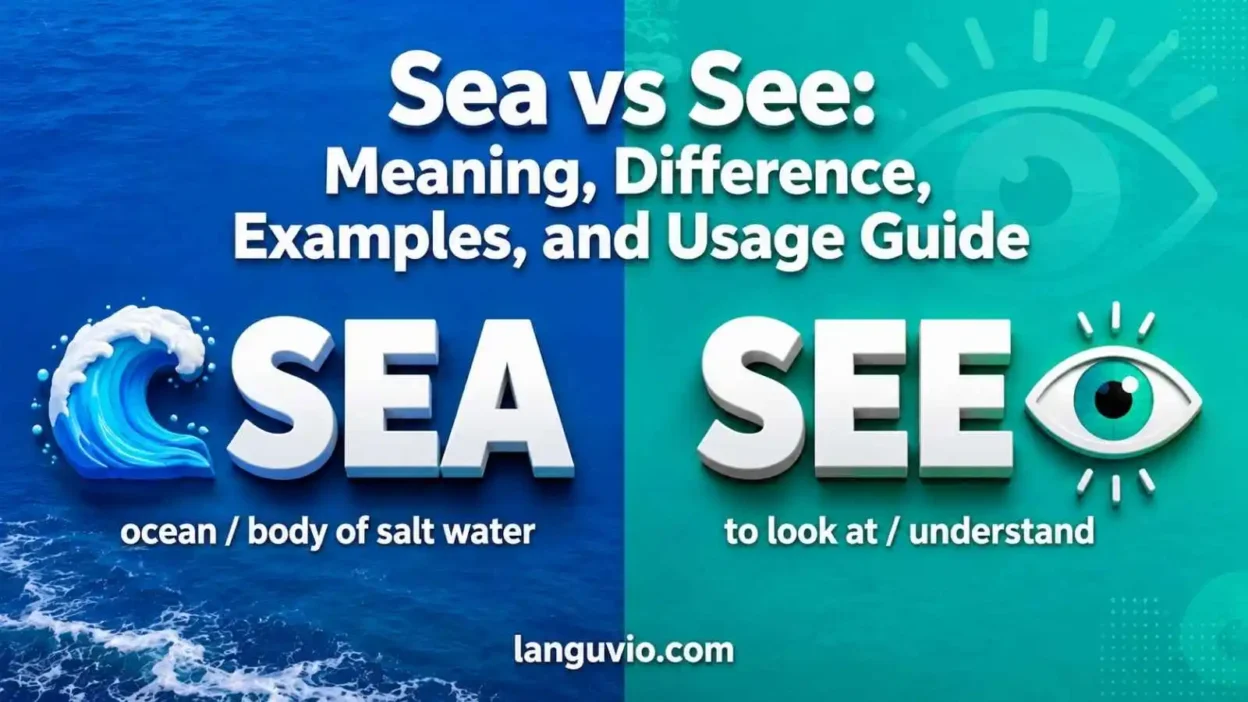
Sea vs see is a common word-choice problem because the two words sound the same. However, they do not mean the same thing.
Use sea when you mean a large body of salt water. Use see when you mean to notice with your eyes, understand, meet someone, check something, or find out.
The difference is not about formality. It is about meaning and grammar.
Quick Answer
Sea is usually a noun.
Example: We walked along the sea at sunset.
See is usually a verb.
Example: I can see the lighthouse from here.
They are homophones, which means they have the same pronunciation but different spellings and meanings. In plain speech, both sound like “see.” In writing, the spelling must match the meaning.
Why People Confuse Them
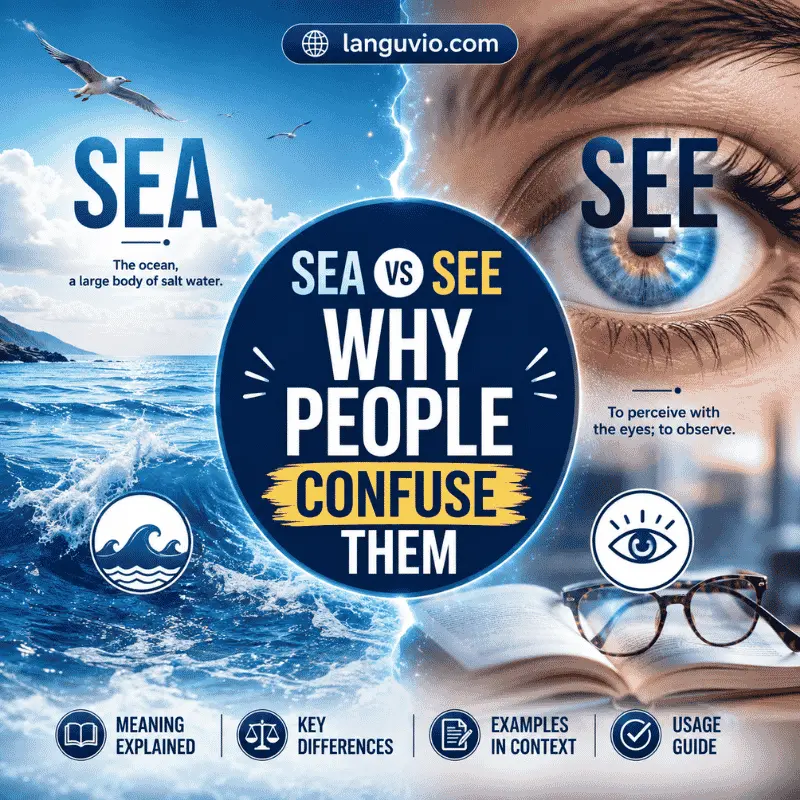
People confuse sea and see because sound does not help. If someone says, “I can see the sea,” both words sound alike.
However, the sentence still makes sense because each word has a different job. See shows the action. Sea names the water.
This is why context matters. Ask yourself: Am I talking about water, or am I talking about noticing, understanding, meeting, or checking?
Key Differences At A Glance
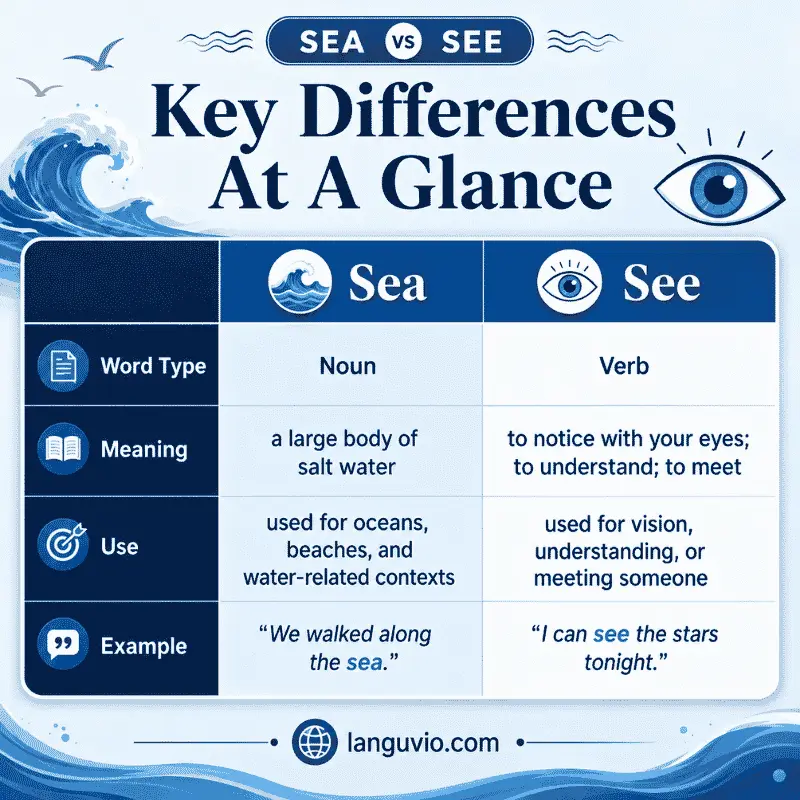
Compact comparison:
• Sea names a place or body of water.
• See shows an action or mental process.
• Sea is mainly a noun.
• See is mainly a verb.
• Sea appears in phrases about water, travel, and marine life.
• See appears in phrases about vision, understanding, visits, checking, and future plans.
• They sound the same, so the only clear difference in writing is spelling and meaning.
Meaning and Usage Difference
Sea means a large area of salt water. It can mean the ocean in a general way, or it can refer to a named body of water, such as the Caribbean Sea or the Mediterranean Sea.
Examples:
I love the smell of the sea.
The boat crossed a rough sea.
They spent the summer near the sea.
See means to notice with your eyes. It can also mean to understand, meet, visit, check, or discover.
Examples:
Did you see my keys?
I see what you mean.
She needs to see a dentist.
Let’s see if the store is open.
The simplest difference is this: sea is water; see is an action.
Tone, Context, and Formality
Neither word is more formal than the other. Both are standard in everyday and professional English.
Sea fits travel writing, geography, weather reports, nature writing, and everyday speech about beaches or ocean water.
Example: The hotel room had a view of the sea.
See fits almost every kind of writing because it has many common meanings.
Example: Please see the attached file before the meeting.
The tone depends on the sentence, not the word itself. “See a doctor” sounds normal and practical. “A stormy sea” sounds descriptive. Both are correct in the right context.
Which One Should You Use?
Use the word that matches the meaning of your sentence.
| Context | Best Choice | Why |
| A beach, ocean, or salt water | sea | It names a body of water. |
| Noticing something with your eyes | see | It shows visual action. |
| Understanding an idea | see | It means understand. |
| Meeting a person | see | It can mean meet or visit. |
| Checking information | see | It can mean find out or confirm. |
| Travel by ship | sea | It refers to travel over water. |
| Marine animals or plants | sea | It works before nouns in terms like sea turtle. |
A quick test helps: If you can replace the word with “ocean,” use sea. If you can replace it with “notice,” “understand,” “meet,” or “check,” use see.
When One Choice Sounds Wrong
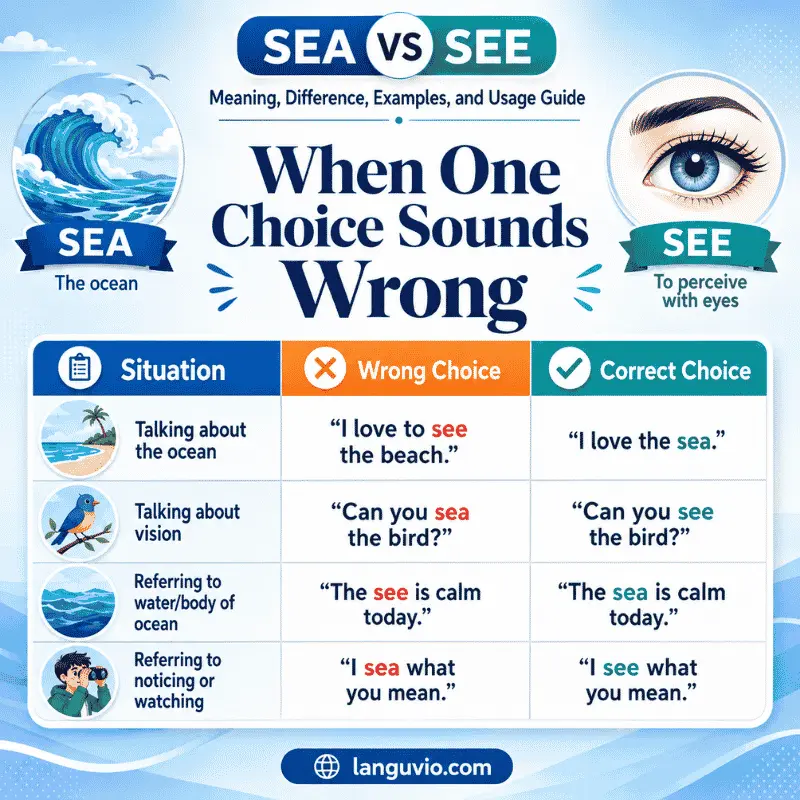
The wrong word usually sounds strange because it gives the sentence the wrong meaning.
Wrong: I can sea the exit sign.
Correct: I can see the exit sign.
Wrong: We swam in the see.
Correct: We swam in the sea.
Wrong: Let’s sea what happens.
Correct: Let’s see what happens.
Wrong: The see was calm this morning.
Correct: The sea was calm this morning.
In each case, the sentence tells you the answer. Exit signs, plans, and checking need see. Water needs sea.
Common Mistakes (and Quick Fixes)
One common mistake is using sea just because the sentence sounds like it has the word “see.” Sound is not enough. Meaning decides the spelling.
Mistake: I want to sea the movie tonight.
Fix: I want to see the movie tonight.
Another mistake is using see for anything near a beach. If the word names the water itself, use sea.
Mistake: The see looked blue from the balcony.
Fix: The sea looked blue from the balcony.
A third mistake happens in phrases.
Correct: lost at sea
Correct: wait and see
Correct: long time no see
Correct: by sea
Correct: see you later
Everyday Examples
I can see the sea from our hotel window.
The kids ran toward the sea after breakfast.
Can you see the red buoy in the water?
We may see dolphins if we leave early.
The captain said the sea would be rough tonight.
I don’t see why we need to cancel the trip.
They shipped the equipment by sea.
You should see a doctor if the pain continues.
The map shows the Black Sea north of Turkey.
Let’s see whether the ferry is still running.
Dictionary-Style Word Details
Verb
• sea: Not commonly used as a verb in standard US English. In normal writing, sea is a noun or appears before another noun in water-related terms.
• see: Common verb. It can mean to notice with the eyes, understand, meet, visit, check, discover, or experience.
Examples:
I see the sign.
I see your point.
We’ll see what happens.
She will see her advisor tomorrow.
Noun
• sea: Common noun. It means a large body of salt water, the ocean in general, rough water, or something vast that resembles the sea.
Examples:
The sea was calm.
A sea of fans filled the stadium.
• see: Not commonly used as a noun in everyday US English. It has specialized noun uses, but those are not the meaning most readers need in this comparison. In normal writing, see is the verb.
Synonyms
• sea: Closest plain alternatives include ocean, waters, salt water, and deep in poetic or descriptive use. These are not always exact. For example, ocean can be broader than sea in geography.
Possible opposite: land, when the contrast is water versus land.
• see: Closest plain alternatives depend on the meaning. For eyesight, alternatives include notice, spot, or view. When expressing understanding, consider understand or realize. To refer to meeting someone, meet or visit works best.
Possible opposites also depend on meaning: miss, overlook, ignore, or misunderstand.
Example Sentences
• sea: The storm made the sea dangerous for small boats.
• sea: We rented a cabin near the sea.
• sea: The artist painted a sea of blue and gray.
• see: I can see your car from the porch.
• see: Now I see why you were worried.
• see: We’re going to see my grandparents this weekend.
Word History
• sea: The word has a long history in English and has been used for large bodies of water for many centuries. Its older forms are related to older Germanic words for sea.
• see: The verb also has a long history in English. Its older forms connect to the basic idea of seeing or perceiving.
The shared sound today does not mean the words share the same meaning. Treat them as separate words that happen to sound alike.
Phrases Containing
• sea: at sea, by sea, sea level, sea breeze, sea turtle, deep sea, high seas, lost at sea, put out to sea, sea of faces.
• see: I see, see you later, wait and see, let’s see, see if, see to it, see through, see eye to eye, long time no see, we’ll see.
These phrases are useful because they show how different the words are. Sea phrases usually connect to water, travel, or size. See phrases usually connect to vision, understanding, checking, or meeting.
FAQs — Sea vs See
Not in standard US English. Sea is mainly a noun referring to salt water or ocean areas. Use see for actions like noticing or understanding.
No. They are homophones, so both sound like /siː/. The meaning is distinguished only by context and spelling.
If you mean to notice, understand, meet, or check something, use see. If you mean a body of water or the ocean, use sea.
Examples include at sea, by sea, sea level, high seas, sea of faces, and lost at sea.
Examples include I see, see you later, wait and see, see if, see to it, see through, and long time no see.
Yes. See covers visual perception (look) and comprehension (understand). Context tells you which meaning applies.
Yes. Unless literally naming water, sea is incorrect in this context. The correct word is see.
Sometimes, but sea is often smaller or part of an ocean. For example, the Caribbean Sea is part of the Atlantic Ocean. Context matters.
Conclusion
Sea and see sound the same, but they are not interchangeable.
Use sea for salt water, ocean areas, marine settings, and water-related phrases. Use see for sight, understanding, meeting, visiting, checking, and finding out.
The easiest rule is simple: if the sentence is about water, choose sea. If the sentence is about noticing, knowing, meeting, or checking, choose see.