Real and reel sound the same, but they do not mean the same thing. The right choice depends on whether you mean something genuine and true, or a spool, video clip, dance, or unsteady movement.
This guide explains the difference in plain English. You will see how each word works, when to use it, and how to avoid common mistakes in everyday writing.
Quick Answer
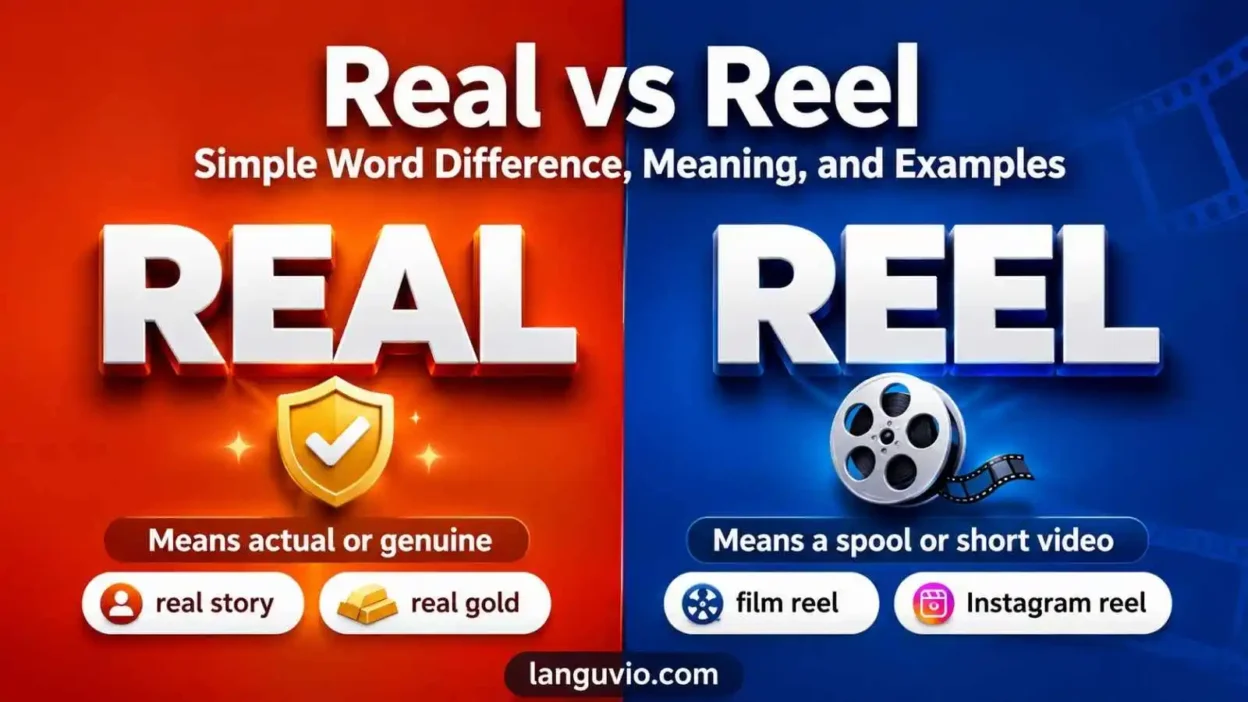
Use real when you mean actual, genuine, true, or not fake. Use reel when you mean a spool for film, thread, or fishing line, a short video clip, a lively dance, or the action of staggering, spinning, or winding something in.
They are homophones, so they sound alike in most American English speech. The spelling changes the meaning.
Why People Confuse Them
People confuse real and reel because they sound almost exactly the same. In speech, “a real story” and “a reel story” may sound alike, but they mean very different things in writing.
The confusion also happens because both words appear in modern media. Real is common in phrases like real life, real problem, and real reason. Reel appears in film, fishing, and short-video contexts.
Spell-check may not catch the mistake because both words are standard English words. The sentence may be spelled correctly but still use the wrong word.
Key Differences At A Glance
Here is the simplest way to remember the difference:
- Real means actual, genuine, true, or not fake.
- Reel usually means a spool, a video clip, a dance, or a movement.
- Real is mainly an adjective.
- Reel is commonly a noun or verb.
- Real answers “Is it true or genuine?”
- Reel answers “Is it wound, filmed, posted, or moving unsteadily?”
Meaning and Usage Difference
Real describes something that exists, is true, or is not artificial. You can talk about a real diamond, a real problem, a real person, or a real reason.
Reel has several meanings, but they connect to movement, winding, or recorded media. A fishing reel holds fishing line. A film reel holds film. A social media reel is a short video. As a verb, reel can mean to stagger, spin, or pull something in.
Pronunciation matters because the two words sound alike. In simple terms, both sound like “reel.” That is why context and spelling matter so much.
Tone, Context, and Formality
Real is common in everyday, academic, business, and formal writing. It is neutral and flexible. You can use it in serious writing, casual speech, and school assignments.
Reel is also standard, but its context is narrower. It fits fishing, film, video, dance, or physical movement. In casual digital writing, reel often means a short video post.
Real can also appear informally before an adjective, as in “real nice” or “real quick.” In polished writing, “really nice” or “really quickly” usually sounds smoother.
Which One Should You Use?
| Context | Best Choice | Why |
| Something true or genuine | real | It means actual or not fake. |
| A short video clip | reel | It names a video format or clip. |
| Fishing equipment | reel | It holds and winds fishing line. |
| Film or tape | reel | It refers to a spool or recorded section. |
| A serious problem | real | It means the problem truly exists. |
| Someone staggering | reel | The verb means to move unsteadily. |
| Something not imaginary | real | It means factual or existing. |
Use real for truth, authenticity, or existence. Use reel for winding objects, video clips, dances, or unsteady movement.
When One Choice Sounds Wrong
Real sounds wrong when the sentence is about fishing, film, a short video, or winding.
Wrong: He bought a new fishing real.
Correct: He bought a new fishing reel.
Reel sounds wrong when the sentence is about truth, facts, or authenticity.
Wrong: That was a reel emergency.
Correct: That was a real emergency.
The easiest test is to ask: “Do I mean genuine?” If yes, choose real. If you mean a spool, clip, dance, or stagger, choose reel.
Common Mistakes (and Quick Fixes)
A common mistake is writing reel life when you mean real life. Real life means actual life, not a movie, game, or imagined situation.
Another mistake is writing real for a video clip. If you mean a short video post, use reel.
Do not write “reel gold” unless you mean gold somehow connected to a reel, which would be unusual. The normal phrase is real gold.
Also avoid using reel just because something feels dramatic. A dramatic event can feel intense, but it is still a real event if it actually happened.
Everyday Examples
I need the real price before I decide.
That movie scene looked real, but it was staged.
She posted a funny reel from the concert.
The fish pulled hard, so he tightened the reel.
The news left him reeling for a few minutes.
This is a real issue for many families.
The editor saved the best clips for the final reel.
Are those flowers real or fake?
Dictionary-Style Word Details
Verb
Real: Not commonly used as a verb in standard US English. Use make real or become real when you need that idea.
Example: Her idea became real after years of work.
Reel: Commonly used as a verb. It can mean to stagger, spin, feel shocked, or wind something in.
Example: The boxer reeled after the hit.
Example: She reeled in the fishing line.
Noun
Real: Not commonly used as a regular everyday noun. In some contexts, it can appear in phrases such as “the real,” meaning reality or the genuine thing, but this is less common than its adjective use.
Example: The story moves between fantasy and the real.
Reel: Commonly used as a noun. It can mean a spool, a roll of film or tape, a short video clip, or a type of dance.
Example: He replaced the reel on his fishing rod.
Synonyms
Real: Closest plain alternatives include actual, genuine, true, authentic, and factual. Clear opposites include fake, false, artificial, and imaginary.
Reel: Exact synonyms depend on the meaning. For the noun, closest plain alternatives include spool, roll, or video clip. For the verb, closest alternatives include stagger, sway, spin, whirl, or wind in. Opposites for the verb can include steady or stabilize when the meaning is physical movement.
Example Sentences
Real: This is a real concern, not a rumor.
Real: The painting turned out to be real.
Reel: The old camera still had a reel of film inside.
Reel: He began to reel after standing up too fast.
Real: She wanted a real answer.
Reel: The brand posted a short reel after the event.
Word History
Real and reel are not spelling variants of the same word. They have different histories and different meanings.
Real is tied to ideas of actuality, truth, and genuineness. Reel is tied to winding, spinning, spools, and movement. Because their histories are separate, you should not treat one as a casual spelling of the other.
Phrases Containing
Real: real life, real estate, real reason, real problem, real time, real deal, for real.
Reel: reel in, reel off, fishing reel, film reel, demo reel, highlight reel, reel-to-reel.
In these phrases, the words are not interchangeable. Real life means actual life. A film reel is a spool or section of film.
FAQs
What is the difference between real and reel?
Real means actual, true, genuine, or not fake. Reel usually means a spool, a short video clip, a film roll, a dance, or the action of moving unsteadily. For example, “a real diamond” means a genuine diamond, while “a fishing reel” means the part of a rod that holds fishing line.
Is it real life or reel life?
The correct phrase is real life. It means actual life, not something imagined, staged, filmed, or shown online. For example, “That looks fun online, but real life is different.” Reel life is not the normal phrase unless someone is making a special pun about movies or videos.
Why do people confuse real and reel?
People confuse real and reel because they sound the same in most American English speech. They are homophones, which means they have the same pronunciation but different spellings and meanings. In writing, the wrong choice can change the sentence completely.
Do you say real or reel for a video?
Use reel when talking about a short video clip, especially on social media. For example, “She posted a reel from her trip.” Use real only if you mean something is genuine or true, as in “The video shows a real event.”
Can real and reel be used interchangeably?
No. Real and reel are not interchangeable. Real is about truth, reality, or authenticity. Reel is about spools, film, videos, dances, or movement. Choose the word that matches the meaning of your sentence.
Conclusion
The difference between real and reel is simple once you connect each word to its meaning. Real means actual, genuine, true, or not fake. Reel refers to a spool, video clip, dance, or the action of staggering, spinning, or winding something in. If the sentence is about truth or authenticity, choose real. If it is about film, fishing, video, dance, or unsteady movement, choose reel.
Real means actual, true, genuine, or not fake. Reel usually means a spool, a short video clip, a film roll, a dance, or the action of moving unsteadily. For example, “a real diamond” means a genuine diamond, while “a fishing reel” means the part of a rod that holds fishing line.
The correct phrase is real life. It means actual life, not something imagined, staged, filmed, or shown online. For example, “That looks fun online, but real life is different.” Reel life is not the normal phrase unless someone is making a special pun about movies or videos.
People confuse real and reel because they sound the same in most American English speech. They are homophones, which means they have the same pronunciation but different spellings and meanings. In writing, the wrong choice can change the sentence completely.
Use reel when talking about a short video clip, especially on social media. For example, “She posted a reel from her trip.” Use real only if you mean something is genuine or true, as in “The video shows a real event.”
No. Real and reel are not interchangeable. Real is about truth, reality, or authenticity. Reel is about spools, film, videos, dances, or movement. Choose the word that matches the meaning of your sentence.