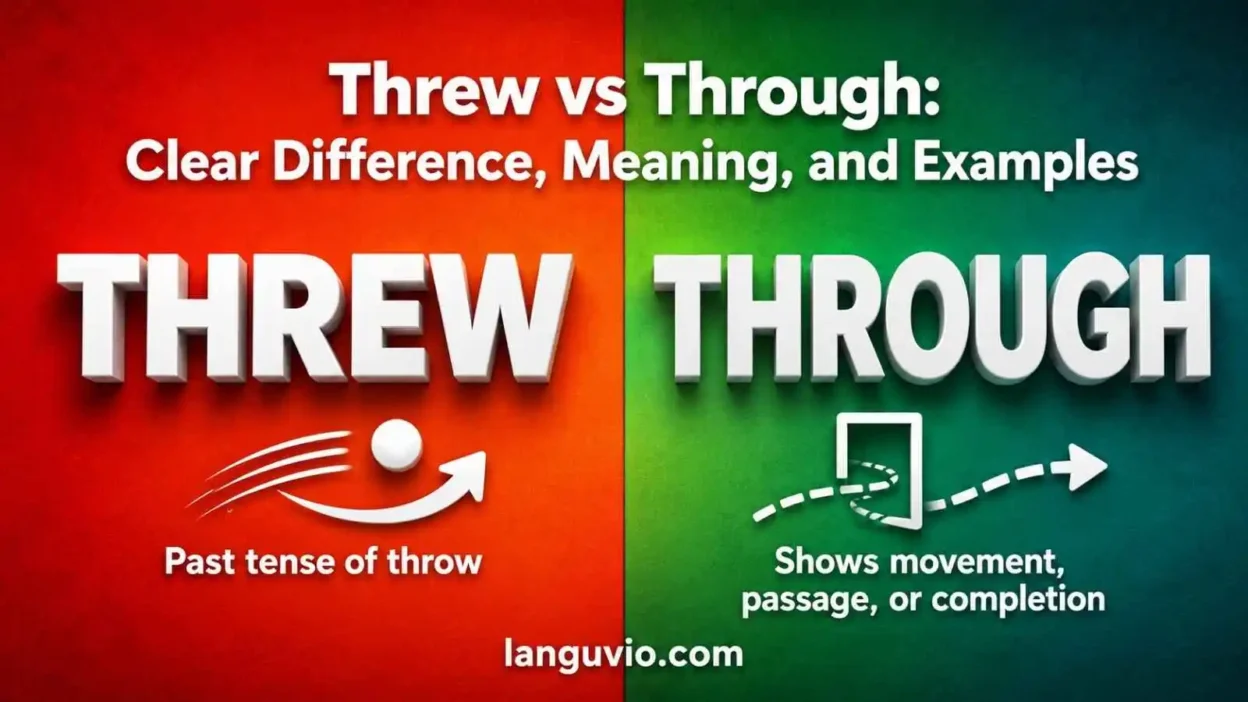
Threw and through sound the same, but they do not mean the same thing. That is why this pair causes so many writing mistakes.
Use threw when you mean someone tossed, launched, caused, or suddenly moved something in the past. Use through when you mean movement from one side to another, progress from start to finish, a time range, a method, or being finished.
The easiest way to remember the difference is this: threw is an action from throw, while through usually shows passage, completion, or connection.
Quick Answer
Threw is the past tense of the verb throw.
Example:
She threw the ball across the yard.
Through is usually a preposition, adverb, or adjective. It often means from one side to the other, from start to finish, by means of, or finished.
Example:
We walked through the park after lunch.
Do not use through when you mean tossed. Do not use threw when you mean passage, time, completion, or method.
Why People Confuse Them
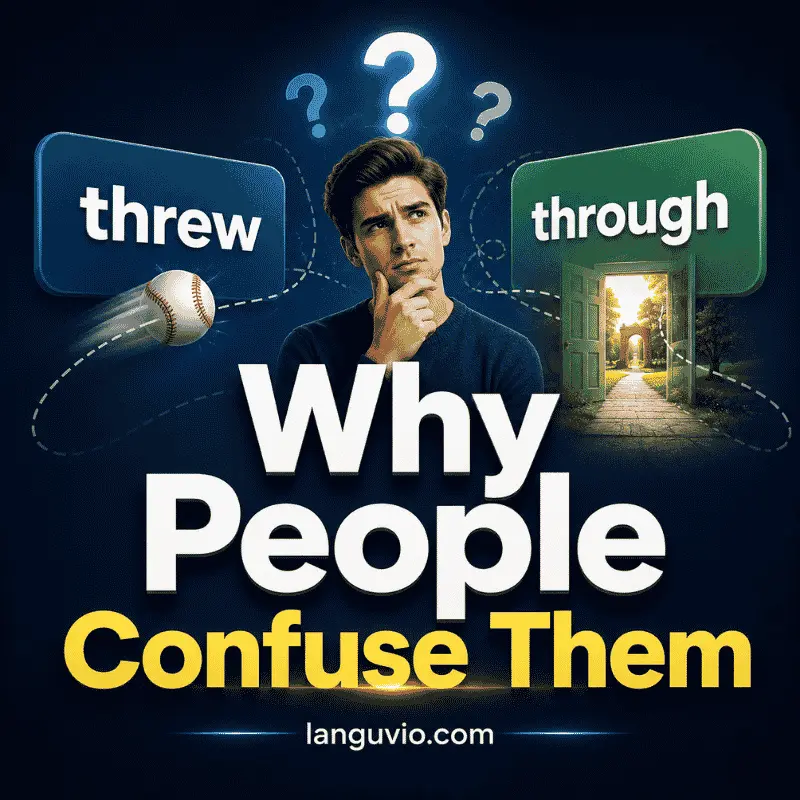
People confuse threw and through because they are pronounced the same in standard American English: throo.
The sound does not tell you which spelling to choose. The sentence meaning does.
If the sentence has a past action related to tossing, moving forcefully, causing, or hosting, use threw. If the sentence shows movement, progress, time, access, or completion, use through.
Compare these two sentences:
She threw the keys on the table.
She walked through the door.
The first sentence needs an action verb. The second sentence needs a word that shows movement from one place to another.
Key Differences At A Glance
| Context | Best Choice | Why |
| A person tossed a ball | threw | It is the past tense of throw. |
| Someone moved from one side to another | through | It shows passage. |
| A task is finished | through | It can mean done or completed. |
| A time range is included | through | It can mean up to and including. |
| A person hosted a party | threw | “Threw a party” is a common verb phrase. |
| A method or source is shown | through | It can mean by means of or because of. |
Meaning and Usage Difference

Threw always connects to the verb throw. It can mean tossed something with the hand, moved something forcefully, caused a sudden state, hosted an event, or rejected something in a phrase like threw out.
Examples:
He threw the paper into the trash.
The news threw everyone into panic.
They threw a party for their daughter.
Through has more roles. It can show movement, time, completion, method, or connection.
Examples:
We drove through the tunnel.
The office is open Monday through Friday.
She got through the exam.
He learned the skill through practice.
Tone, Context, and Formality
Both threw and through are standard words in American English. Neither one is more formal by itself. The correct choice depends on grammar and meaning, not tone.
Threw feels natural in action sentences:
The pitcher threw a fastball.
My brother threw his backpack on the couch.
Through feels natural when the sentence needs movement, access, time, means, or completion:
The hikers moved through the forest.
We worked through the weekend.
The message came through email.
I am finally through with the report.
In careful writing, do not replace through with threw just because they sound alike.
Which One Should You Use?
Use threw if the sentence answers “What did someone do?” and the action is related to throwing, moving, causing, or hosting.
Use through if the sentence answers “Where did it go?”, “How did it happen?”, “How long did it last?”, or “Is it finished?”
Here is a compact comparison:
• Threw: past action — tossed, hurled, flung, hosted, caused.
• Through: passage or completion — across a space, during a time, by a method, all the way, finished.
A quick test helps:
If you can replace the word with tossed, use threw.
If you can replace it with from one side to the other or finished, use through.
When One Choice Sounds Wrong

Threw sounds wrong when the sentence needs a path, place, period, method, or finished state.
Wrong: We walked threw the mall.
Correct: We walked through the mall.
Wrong: I worked threw the night.
Correct: I worked through the night.
Through sounds wrong when the sentence needs the past tense of throw.
Wrong: She through the ball to first base.
Correct: She threw the ball to first base.
Wrong: They through a surprise party.
Correct: They threw a surprise party.
Common Mistakes (and Quick Fixes)
One common mistake is using threw after a movement verb.
Wrong: The dog ran threw the yard.
Correct: The dog ran through the yard.
Another mistake is using through as a past-tense action verb.
Wrong: He through the receipt away.
Correct: He threw the receipt away.
Writers also confuse set phrases.
She threw out the old boxes.
We made it through the storm.
The first draft is finished, so I am through with it.
They threw a big graduation party.
Ask yourself: Is something being thrown, or is something passing, lasting, connecting, or finishing?
Everyday Examples
I threw my jacket over the chair after school.
The kids ran through the sprinkler in the backyard.
Jordan threw the ball too hard.
We drove through heavy rain on the way home.
My parents threw a small dinner for my birthday.
She read through the instructions before starting.
The coach threw his hands up in frustration.
The package came through the mail yesterday.
I am finally through with the garage cleanup.
The shortstop threw the runner out at first base.
Dictionary-Style Word Details
Verb
threw: A verb. It is the simple past tense of throw.
Example: She threw the keys to her roommate.
through: Not commonly used as a verb in standard American English.
Example: Do not write “She through the ball.” Write “She threw the ball.”
Noun
threw: Not commonly used as a noun in standard American English.
through: Not commonly used as a noun in everyday standard American English. It is usually a preposition, adverb, or adjective.
Synonyms
threw: Closest plain alternatives include tossed, hurled, flung, cast, and pitched. The best choice depends on the sentence.
through: Closest plain alternatives include via, by way of, from start to finish, during, or finished, depending on use.
Clear antonyms do not work equally for every meaning. For threw, caught can be an opposite in some sports or physical-action contexts. For through, the opposite depends on the meaning, so it is better not to force one.
Example Sentences
threw: Maya threw the blanket over the couch.
threw: The referee threw a flag during the play.
threw: We threw away the broken lamp.
through: Sunlight came through the curtains.
through: The store is open Monday through Saturday.
through: He got through the interview without losing confidence.
Word History
threw: This word is the past-tense form of throw. Older forms of throw are connected with ideas of twisting, turning, or hurling.
through: This word comes from older English forms connected with passage from one side or point to another.
The exact history is not needed for everyday use. For modern writing, the practical rule is simple: threw belongs to throw, and through belongs to passage, means, time, or completion.
Phrases Containing
threw:
threw away — She threw away the receipt.
threw out — The judge threw out the case.
threw off — The loud noise threw off my focus.
threw in — The seller threw in free delivery.
threw a party — They threw a party after graduation.
through:
go through — We had to go through security.
get through — She will get through this hard week.
through and through — He is honest through and through.
follow through — You need to follow through on your promise.
through with — I am through with that project.
FAQs
What is the difference between threw and through?
Threw is the past tense of throw. It means someone tossed, hurled, or moved something in the past. Through usually means from one side to another, from start to finish, by means of something, or finished.
Is threw the past tense of throw?
Yes. Threw is the simple past tense of throw. For example, “She threw the ball across the yard” means she tossed the ball in the past.
Is through a verb?
In standard everyday English, through is not usually used as a verb. It is most often a preposition, adverb, or adjective. For example, “We walked through the park” uses through to show movement.
Why do people confuse threw and through?
People confuse them because threw and through sound the same. They are homophones, but they have different meanings and spellings. The sentence meaning tells you which one to use.
Do you say walked threw or walked through?
The correct phrase is walked through. Use through when someone moves from one side, place, or stage to another. Example: “We walked through the hallway.”
Is it threw away or through away?
The correct phrase is threw away. It means discarded or got rid of something. Example: “He threw away the old papers.”
How can I remember threw vs through?
Use threw when you mean tossed. Use through when you mean from one side to another, by a method, or finished. Example: “She threw the ball through the hoop.”
Conclusion
The difference between threw and through is clear once you focus on meaning.
Use threw for the past tense of throw: tossed, hurled, caused, hosted, or moved forcefully. Use through for passage, time, method, completion, or movement from one side to another.
They sound the same, so your ear cannot choose the right spelling. Let the sentence choose it for you: threw is an action; through is a path, process, method, time span, or finished state.
Threw is the past tense of throw. It means someone tossed, hurled, or moved something in the past. Through usually means from one side to another, from start to finish, by means of something, or finished.
Yes. Threw is the simple past tense of throw. For example, “She threw the ball across the yard” means she tossed the ball in the past.
In standard everyday English, through is not usually used as a verb. It is most often a preposition, adverb, or adjective. For example, “We walked through the park” uses through to show movement.
People confuse them because threw and through sound the same. They are homophones, but they have different meanings and spellings. The sentence meaning tells you which one to use.
The correct phrase is threw away. It means discarded or got rid of something. Example: “He threw away the old papers.”
Use threw when you mean tossed. Use through when you mean from one side to another, by a method, or finished. Example: “She threw the ball through the hoop.”