Lesson vs lessen is a common word-choice problem because the two words sound the same. Their spelling is close, too. But they do not mean the same thing, and they do not do the same job in a sentence.
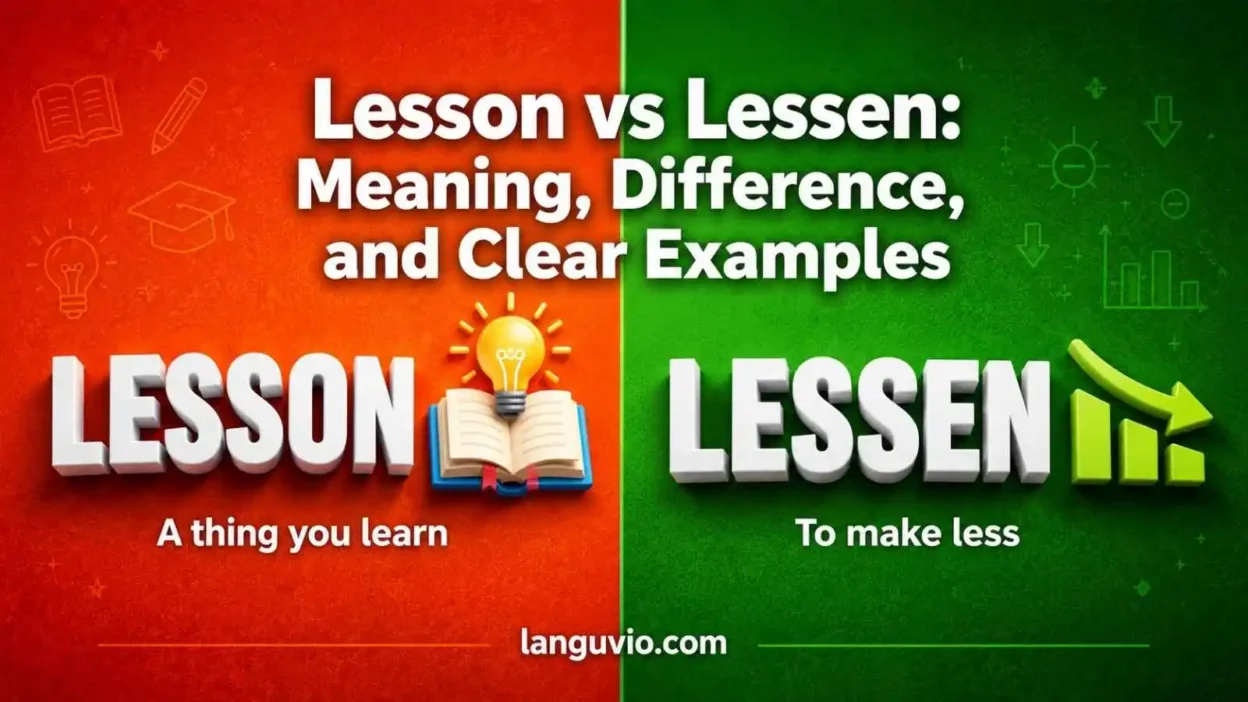
Use lesson when you mean something taught, studied, or learned. Use lessen when you mean to reduce, lower, or make something smaller. Once you connect lesson with learning and lessen with “less,” the difference becomes much easier to remember.
Quick Answer
Lesson is usually a noun. It means a teaching session, a part of a course, or something learned from experience. Lessen is a verb. It means to make something less or to become less. Write “piano lesson,” “math lesson,” or “learned a lesson,” but write “lessen pain,” “lessen stress,” or “lessen the risk.”
Why People Confuse Them
People confuse these words mainly because they are homophones. That means they sound alike in normal speech. In American English, both words are commonly pronounced like LESS-un.
The spelling difference is small: lesson has o, while lessen has e. In fast writing, that one-letter difference is easy to miss. The meanings, however, are not close. One word points to learning. The other points to reduction.
Plural and verb forms can also confuse writers. Lessons means more than one teaching session or learned experience. Lessens means reduces.
Key Differences At A Glance
- Lesson: a thing you learn, study, or are taught.
- Lessen: an action that makes something smaller, weaker, lower, or less serious.
- Lesson: usually works as a noun in modern writing.
- Lessen: works as a verb.
- Lesson example: “The safety lesson took 20 minutes.”
- Lessen example: “The new rule may lessen confusion.”
Meaning and Usage Difference
Lesson names a unit of teaching or learning. You can take a driving lesson, prepare a science lesson, or learn a hard lesson from a mistake. It can be literal, as in school or training, or figurative, as in life experience.
Lessen describes a decrease. You can lessen pain, noise, stress, cost, risk, pressure, or damage. It can be transitive, meaning someone or something reduces another thing: “The update lessened the delay.” It can also be intransitive: “The pain lessened overnight.”
The simplest test is this: if you can replace the word with reduce, you probably need lessen. If you mean teaching or learning, use lesson.
Tone, Context, and Formality
Both words are standard in American English, but they appear in different contexts.
Lesson is common in school, tutoring, training, music, sports, parenting, and personal reflection. It sounds natural in both casual and formal writing: “She has a guitar lesson,” or “The mistake became a lesson in planning.”
Lessen sounds slightly more formal than cut, lower, or reduce, but it is still normal in everyday writing. You might see it in health advice, workplace updates, news writing, or policy language: “The change may lessen the burden on families.”
Neither word is a US-vs-UK spelling issue. The choice depends on meaning.
Which One Should You Use?
Use this table when you are deciding between the two.
| Context | Best Choice | Why |
| A class or teaching session | lesson | It names something taught or studied. |
| Something learned from experience | lesson | It means a takeaway or learning point. |
| Reducing pain, stress, or risk | lessen | It means to make something less. |
| A number, amount, or effect going down | lessen | It describes decrease or reduction. |
| Music, driving, sports, or tutoring | lesson | It refers to instruction. |
| A problem becoming smaller | lessen | It shows that the problem is decreasing. |
When One Choice Sounds Wrong
Some errors are easy to spot once you know the meaning.
Wrong: “The medicine helped lesson the pain.”
Correct: “The medicine helped lessen the pain.”
Wrong: “I learned a hard lessen.”
Correct: “I learned a hard lesson.”
Wrong: “The teacher gave us a grammar lessen.”
Correct: “The teacher gave us a grammar lesson.”
Wrong: “We need to lesson the budget.”
Correct: “We need to lessen the budget.”
In each case, ask whether the sentence is about learning or reducing. That one question usually gives you the right answer.
Common Mistakes (and Quick Fixes)
The most common mistake is using lesson as a verb when the writer means reduce. For example, “lesson the noise” is wrong in standard modern usage. Write “lessen the noise.”
Another common mistake is using lessen as a noun. “A valuable lessen” is wrong. Write “a valuable lesson.”
Be careful with plural forms, too. Lessons are things taught or learned. Lessens means reduces.
Memory tip: lessen starts with less. If the idea is “make it less,” choose lessen. Lesson belongs with learning.
Everyday Examples
I have a Spanish lesson after work.
The coach turned the loss into a lesson about teamwork.
That mistake taught me a lesson I will not forget.
The teacher planned a short lesson on commas.
A quieter room can lessen distractions.
Stretching may lessen muscle tightness after a workout.
The company changed the schedule to lessen overtime.
Lower speed limits can lessen the risk of serious crashes.
Her apology did not lessen the damage right away.
The class ended with a lesson about clear communication.
Dictionary-Style Word Details
Verb
Lesson: Dictionaries may list lesson as a verb meaning to instruct, teach, or rebuke, but this use is not common in everyday modern US English. Most writers should use teach, instruct, or lecture instead.
Lessen: Lessen is a standard verb. It can mean to become less or to make something less. Example: “The headache lessened after lunch.” Example: “The new process lessened wait times.”
Noun
Lesson: Lesson is commonly used as a noun. It can mean a teaching period, a unit of instruction, an assigned part of study, or something learned from experience.
Lessen: Lessen is not commonly used as a noun in standard US English. Use reduction, decrease, or drop when you need a noun.
Synonyms
Lesson: Closest plain alternatives include class, session, unit, instruction, takeaway, and learning experience. The best choice depends on context.
Lessen: Strong alternatives include reduce, decrease, lower, diminish, and ease. Clear antonyms include increase, raise, heighten, and worsen, depending on the sentence.
Example Sentences
A lesson can mean something taught in class: “Today’s lesson covers subject-verb agreement.”
It can also mean something learned from experience: “Missing the deadline was a lesson in time management.”
You can use lesson for a scheduled learning session too: “He takes a tennis lesson every Saturday.”
The verb lessen means to reduce something: “The new signs should lessen confusion at the entrance.”
In another sentence, lessen can describe something becoming weaker: “Her symptoms began to lessen by morning.”
Writers also use lessen when talking about reducing force or damage: “We added padding to lessen the impact.”
Word History
Lesson: The word has roots connected to reading and instruction. That history fits its modern meaning: something read, taught, studied, or learned.
Lessen: The word is built from the idea of less. That connection fits its modern meaning: to make something less or become less.
The histories help explain the difference, but you do not need to memorize them. The practical rule is enough: lesson is about learning; lessen is about reducing.
Phrases Containing
Lesson: Common phrases include learn a lesson, teach someone a lesson, lesson plan, piano lesson, driving lesson, life lesson, and object lesson.
Lessen: Common phrases include lessen the risk, lessen the impact, lessen the pain, lessen the burden, lessen the chance, lessen the pressure, and lessen the effect.
FAQs
What is the difference between lesson and lessen?
Lesson means something taught, studied, or learned. It is usually a noun. Lessen means to reduce, lower, or make something smaller. It is a verb. For example, “I learned a lesson” uses lesson, while “The medicine helped lessen the pain” uses lessen.
Is lesson a noun or a verb?
Lesson is usually a noun in modern American English. It can mean a class, a teaching unit, or something learned from experience. Example: “The lesson was about punctuation.” Some dictionaries list lesson as a verb, but that use is uncommon today.
Is lessen a noun or a verb?
Lessen is a verb. It means to make something less or to become less. Example: “The noise lessened after the windows were closed.” It is not commonly used as a noun in standard American English.
Are lesson and lessen pronounced the same?
Yes. In everyday American English, lesson and lessen are usually pronounced the same: LESS-un. This is why many writers confuse them, even though their meanings and sentence roles are different.
Which is correct: lessen the pain or lesson the pain?
The correct phrase is lessen the pain. Here, you mean “reduce the pain,” so you need the verb lessen. Lesson the pain is incorrect in standard modern usage.
How can I remember lesson vs lessen?
Connect lesson with learning and teaching. Connect lessen with less. If the sentence means “make it less,” use lessen. If the sentence means “something learned or taught,” use lesson.
Conclusion
Lesson and lessen sound the same, but they should not be used the same way. Lesson means something taught, studied, or learned. Lessen means to reduce or become less. Use lesson for learning: “I learned a lesson.” Use lessen for reduction: “We need to lessen the risk.” That simple meaning check will help you choose the correct word in school, work, and everyday writing.
Lesson means something taught, studied, or learned. It is usually a noun. Lessen means to reduce, lower, or make something smaller. It is a verb. For example, “I learned a lesson” uses lesson, while “The medicine helped lessen the pain” uses lessen.
Lesson is usually a noun in modern American English. It can mean a class, a teaching unit, or something learned from experience. Example: “The lesson was about punctuation.” Some dictionaries list lesson as a verb, but that use is uncommon today.
Lessen is a verb. It means to make something less or to become less. Example: “The noise lessened after the windows were closed.” It is not commonly used as a noun in standard American English.
Yes. In everyday American English, lesson and lessen are usually pronounced the same: LESS-un. This is why many writers confuse them, even though their meanings and sentence roles are different.
The correct phrase is lessen the pain. Here, you mean “reduce the pain,” so you need the verb lessen. Lesson the pain is incorrect in standard modern usage.
Connect lesson with learning and teaching. Connect lessen with less. If the sentence means “make it less,” use lessen. If the sentence means “something learned or taught,” use lesson.