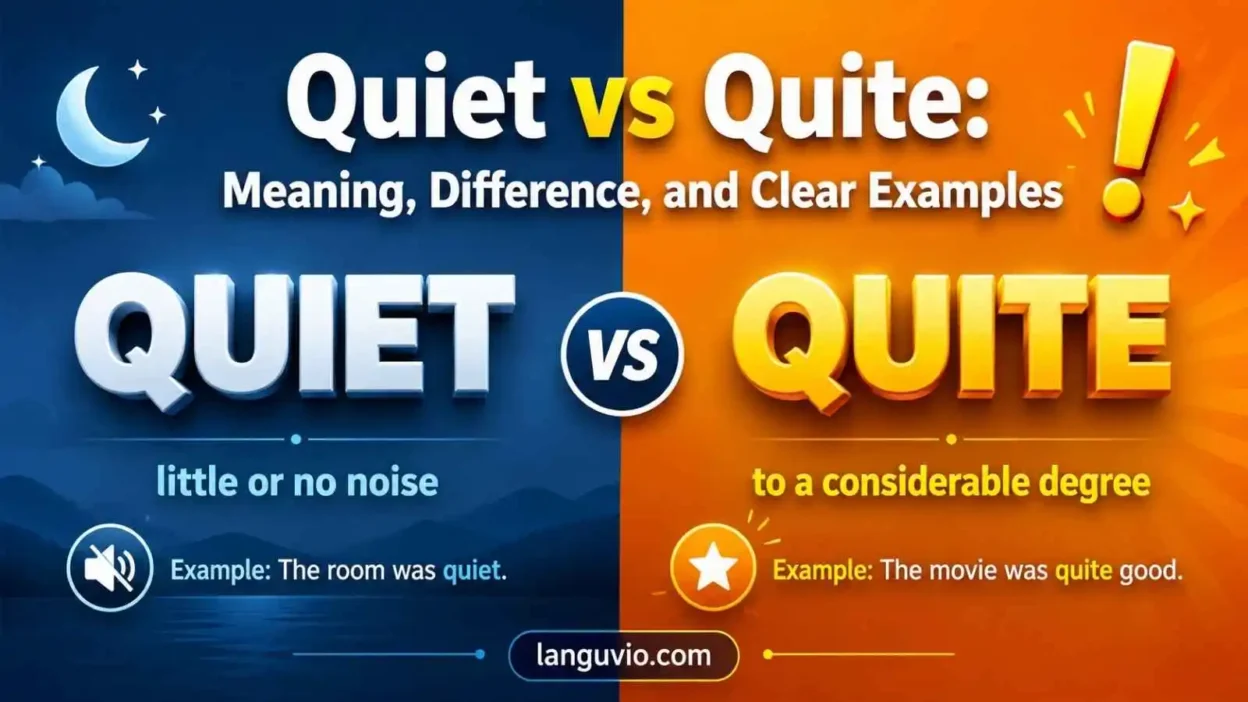
“Quiet” and “quite” are both correct words, but they do not mean the same thing.
Use “quiet” when you mean silent, calm, or not noisy. Use “quite” when you mean very, fairly, completely, or to a degree.
The mistake is easy to make because the words look almost the same. But one extra letter changes the meaning, the sound, and the job of the word in a sentence.
Quick Answer
“Quiet” means not loud or not busy.
Example: The office was quiet after lunch.
“Quite” is an adverb that adds degree or emphasis.
Example: The meeting was quite helpful.
So, if your sentence is about sound, calm, or silence, choose “quiet.” If your sentence is about how much, how strongly, or how completely something is true, choose “quite.”
They are not interchangeable.
Why People Confuse Them
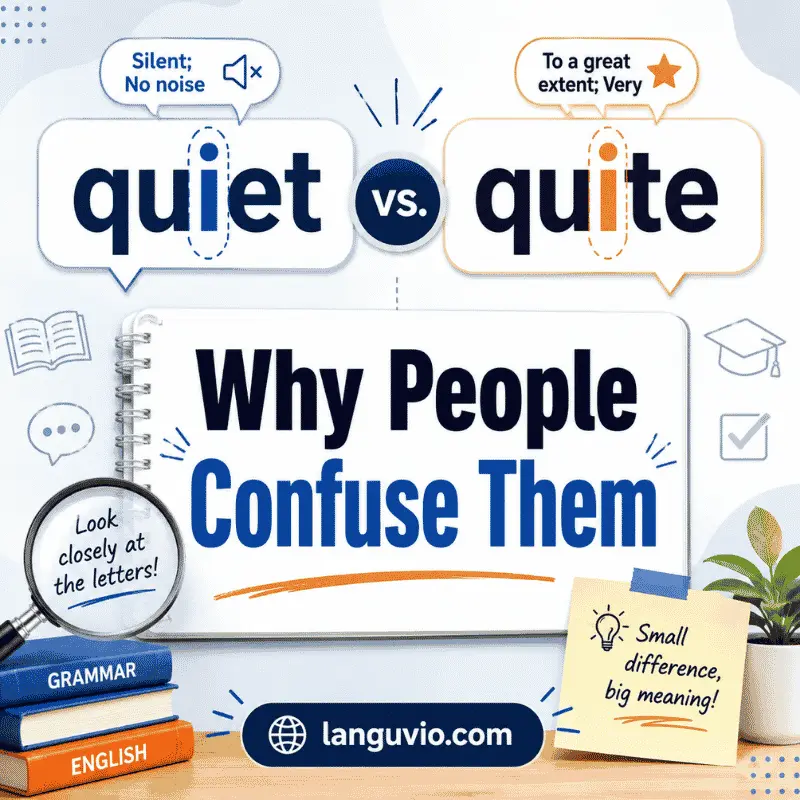
People confuse “quiet” and “quite” because the spelling is very close. Both words use the same letters, except “quiet” has an extra “e” before the “t.”
The pronunciation also matters.
“Quiet” sounds like KWY-it. It has two syllables.
“Quite” sounds like kwite. It has one syllable and rhymes with “right” and “night.”
That sound difference can help you catch the mistake when you read a sentence out loud.
Key Differences At A Glance
| Feature | quiet | quite |
| Main meaning | silent, calm, or low in noise | very, fairly, completely, or to a degree |
| Common sentence job | adjective, noun, or verb | adverb |
| Pronunciation | KWY-it | kwite |
| Example | a quiet street | quite sure |
The main difference is simple: “quiet” describes a state, while “quite” changes the strength of another word.
Meaning and Usage Difference
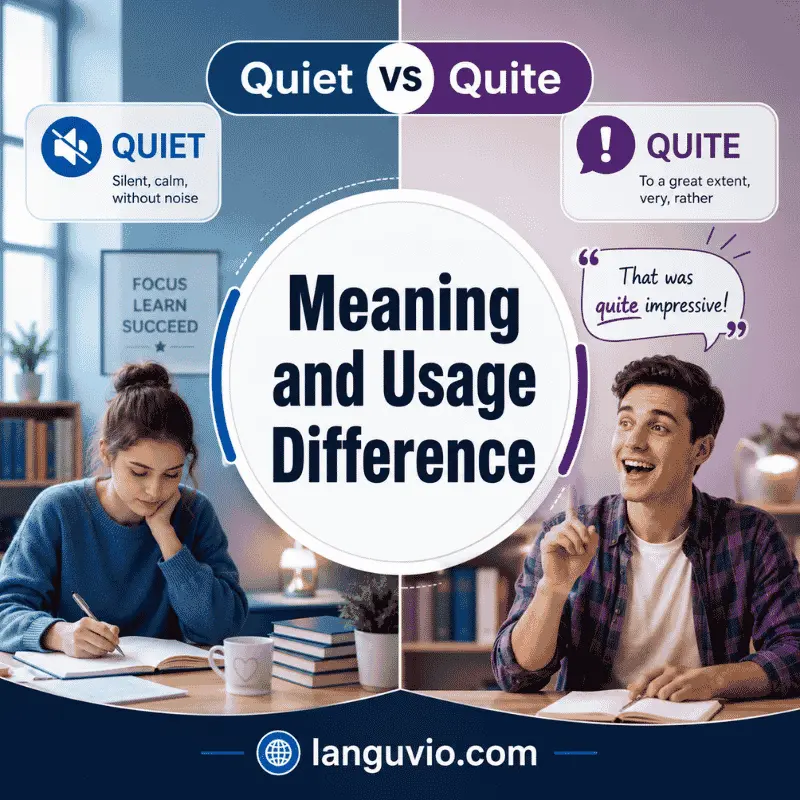
“Quiet” usually describes a person, place, sound, or situation.
You can have a quiet room, a quiet morning, a quiet voice, or a quiet neighborhood. In all of these examples, the word points to low noise, calm, or little activity.
“Quite” does a different job. It usually sits before an adjective or adverb and changes its force.
You can be quite tired, quite sure, quite close, or quite honestly surprised. In these examples, “quite” does not describe silence. It tells the reader the degree of the next idea.
Here is the easiest test:
If you can replace the word with “silent” or “calm,” use “quiet.”
If you can replace it with “very,” “fairly,” or “completely,” use “quite.”
Tone, Context, and Formality
Both words are normal in everyday US English. Neither word is slang.
“Quiet” sounds natural in casual, school, workplace, and formal writing.
Examples:
The room was quiet.
She has a quiet way of speaking.
We need a quiet place to talk.
“Quite” is also standard, but it can sound a little polished in some US sentences. Many Americans may say “very” in casual speech where “quite” would also be correct.
Example:
That movie was quite good.
This means the movie was good to a noticeable degree. In everyday US speech, someone might also say “very good” or “really good.”
Do not use “quite” just to sound more formal. Use it when the sentence needs degree, emphasis, or completeness.
Which One Should You Use?
| Context | Best Choice | Why |
| You mean not noisy | quiet | It describes low sound. |
| You mean calm or peaceful | quiet | It describes a state or mood. |
| You mean someone does not talk much | quiet | It describes behavior. |
| You mean very or fairly | quite | It adds degree to another word. |
| You mean completely or not completely | quite | It can show completeness in phrases like “quite finished” or “not quite done.” |
| You mean to make people stop talking | quiet | It can work as a verb. |
| You need an adverb before an adjective | quite | It modifies the adjective. |
Choose “quiet” for silence. Choose “quite” for degree.
When One Choice Sounds Wrong
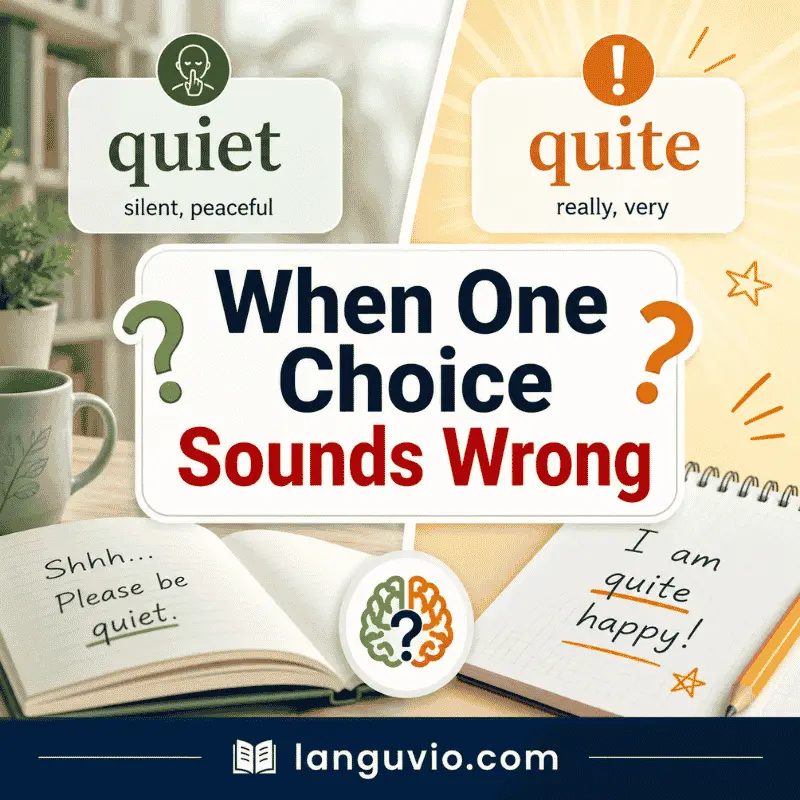
“I’m quiet sure” sounds wrong because “sure” needs a word of degree. The correct sentence is:
I’m quite sure.
“Please be quite” also sounds wrong because the request is about silence. The correct sentence is:
Please be quiet.
“The baby finally quite down” is wrong because the phrase needs the verb “quiet down.”
Correct: The baby finally quieted down.
Correct: The baby finally got quiet.
A good check is to ask what the sentence is really about. If it is about noise, use “quiet.” If it is about how much something is true, use “quite.”
Common Mistakes (and Quick Fixes)
Mistake: The library was quite.
Fix: The library was quiet.
Mistake: I am quiet happy with the result.
Fix: I am quite happy with the result.
Mistake: Keep quite during the test.
Fix: Keep quiet during the test.
Mistake: That answer is quiet good.
Fix: That answer is quite good.
Mistake: The street became quite after midnight.
Fix: The street became quiet after midnight.
Mistake: She was quite all morning.
Fix: She was quiet all morning.
The quick fix is to look at the word after it. If the next word is an adjective like “sure,” “happy,” “ready,” or “close,” “quite” may be right. If the sentence points to silence or calm, “quiet” is usually right.
Everyday Examples
The house was quiet after everyone left for school.
I’m quite sure I locked the front door.
Can we find a quiet table near the back?
That was quite a long line for coffee.
Please keep your phone quiet during the movie.
She gave a quiet laugh and looked away.
The new dishwasher is quite efficient.
The baby is finally quiet.
The instructions were quite clear.
We had a quiet weekend at home.
Dictionary-Style Word Details
Verb
• quiet: Can be used as a verb meaning to make someone or something quiet, or to become quiet.
Example: The teacher quieted the class before the announcement.
• quite: Not used as a verb in standard US English.
Noun
• quiet: Can be used as a noun meaning silence, calm, or a peaceful state.
Example: I need a little quiet before the meeting.
• quite: Not used as a noun in standard US English.
Synonyms
• quiet: Closest plain alternatives include silent, calm, peaceful, still, and low-key. Clear opposites include loud, noisy, and busy when the context is about sound or activity.
• quite: Closest plain alternatives include very, fairly, rather, completely, and entirely. The best replacement depends on the sentence. There is no single exact opposite for “quite” because its meaning changes by context.
Example Sentences
• quiet: The neighborhood is quiet on Sunday mornings.
• quiet: He spoke in a quiet voice so he would not wake the baby.
• quiet: The crowd quieted when the speaker stepped up to the microphone.
• quite: The drive was quite easy after traffic cleared.
• quite: I’m not quite ready to send the email.
• quite: That answer is quite different from what I expected.
Word History
• quiet: The word has long been tied to ideas of calm, rest, and lack of noise. For modern word choice, the useful point is that it still points to silence, peace, or low activity.
• quite: The word has long been tied to ideas of completeness and degree. For modern word choice, the useful point is that it works as an adverb, not as a silence word.
The similar spelling does not mean the two words share the same modern use.
Phrases Containing
• quiet: peace and quiet, keep quiet, quiet down, quiet room, quiet neighborhood, quiet voice, quiet life
• quite: quite a few, quite a bit, quite sure, quite right, not quite, quite the opposite, quite something
These phrases show the difference clearly. “Peace and quiet” is about calm. “Quite a few” is about amount.
FAQs
Is “quiet” or “quite” correct?
Both are correct, but they mean different things. Use “quiet” for silence or calm. Use “quite” for degree, such as “very,” “fairly,” or “completely.”
What is the main difference between quiet and quite?
“Quiet” means not loud, calm, or peaceful. “Quite” is an adverb that changes the strength of another word.
Example:
The room was quiet.
I’m quite sure.
Is it “be quiet” or “be quite”?
The correct phrase is “be quiet.” It means to stop making noise or to stay silent.
Correct: Please be quiet during the movie.
Incorrect: Please be quite during the movie.
Is it “quite sure” or “quiet sure”?
The correct phrase is “quite sure.” It means very sure or fairly sure, depending on the sentence.
Correct: I’m quite sure I sent the file.
Incorrect: I’m quiet sure I sent the file.
Can “quiet” be a verb?
Yes. “Quiet” can be a verb meaning to make someone or something quiet.
Example: The coach quieted the team before the game.
Can “quite” be a noun or verb?
No. In standard US English, “quite” is not used as a noun or verb. It is an adverb.
Why do people mix up quiet and quite?
People mix them up because the spelling is very close. “Quiet” has two syllables and sounds like KWY-it. “Quite” has one syllable and rhymes with “right.”
What is an easy trick to remember quiet vs quite?
Use “quiet” when you mean silence. Use “quite” when you mean very, fairly, or completely.
Quiet = no noise.
Quite = how much.
Conclusion
“Quiet” and “quite” are both correct, but they belong in different sentences.
Use “quiet” for silence, calm, or low noise.
Use “quite” for degree, emphasis, or completeness.
The fastest way to choose is to ask: Is the sentence about sound or about amount? Sound points to “quiet.” Amount or degree points to “quite.”