Passed vs past is a common word-choice problem because the two words sound the same in everyday US English. Their meanings and grammar roles are different, though.
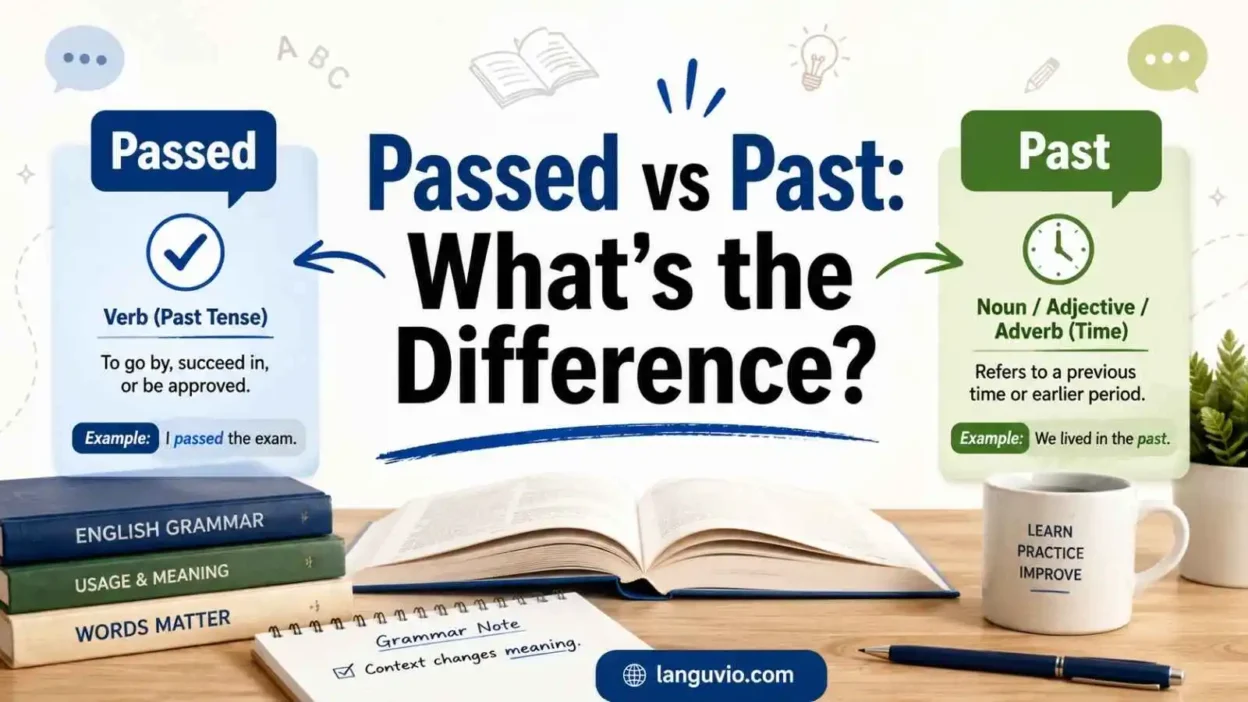
Use passed when you need the past tense of the verb pass. Use past when you mean an earlier time, a position beyond something, or a word that works as a noun, adjective, adverb, or preposition.
The simplest check is this: Do you need an action word? If yes, use passed.
Quick Answer
Passed is a verb. It means moved by, went beyond, succeeded, approved, handed over, or let time go by.
Examples:
- She passed the final exam.
- We passed the exit on the highway.
- Three weeks passed before he replied.
Past is not a verb. It can refer to time before now, something earlier, or movement beyond a point.
Examples:
- She learned from her past mistakes.
- We drove past the school.
- That happened in the past.
In normal US pronunciation, passed and past usually sound the same. Both sound like “past,” rhyming with “last.”
Why People Confuse Them
People confuse passed and past because both words can connect to time or movement.
These two sentences are both correct:
- We passed the bank.
- We walked past the bank.
In the first sentence, passed is the action. In the second sentence, walked is the action, and past tells where the walking happened.
Because the words sound alike, you need to look at how the word works in the sentence.
Key Differences At A Glance
| Context | Best Choice | Why |
| A person moved by something | passed | It is the action verb. |
| A person walked beyond something | past | The verb is already “walked.” |
| A test was completed successfully | passed | It means succeeded. |
| A law was approved | passed | It means approved by vote. |
| A time before now | past | It refers to earlier time. |
| A bill is late | past due | It means beyond the due date. |
| Someone died, stated gently | passed away | It comes from the verb phrase “pass away.” |
| Something is no longer current | in the past | “Past” works as a noun. |
Meaning and Usage Difference
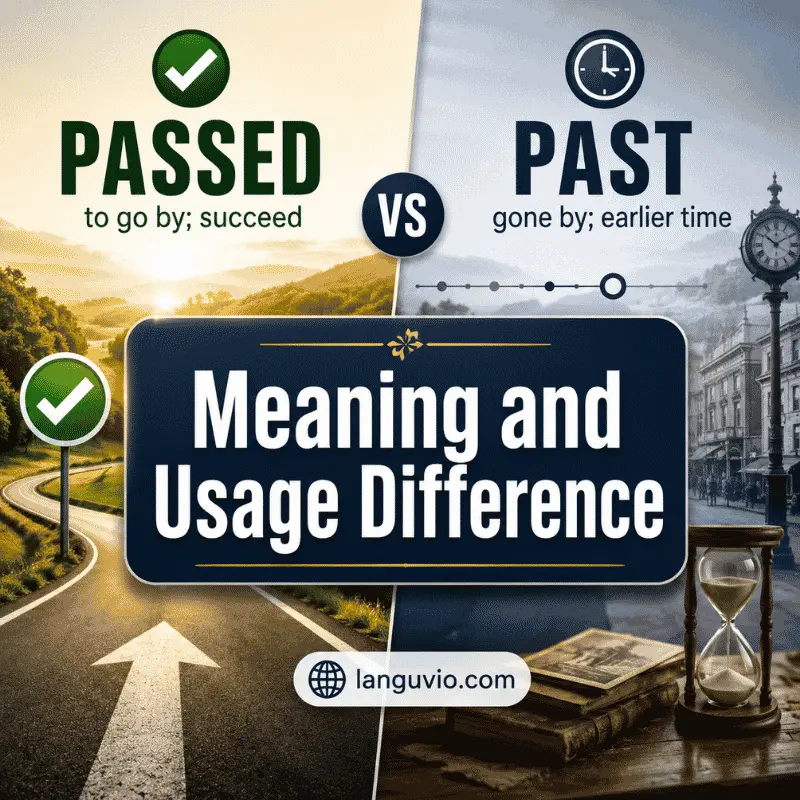
The main difference is simple:
- passed = an action from the verb pass
- past = earlier time or a position beyond something
Use passed when someone or something does the action.
Examples:
- The car passed us on the left.
- Maya passed the interview.
- The storm passed overnight.
- The city council passed the measure.
Use past when the sentence already has another verb, or when you mean time before now.
Examples:
- The car drove past us.
- Maya moved past the first round.
- The storm is in the past now.
- In past years, the event started earlier.
A helpful test is to change the sentence to the future. If the word becomes will pass, use passed for the past tense.
Example:
- Yesterday, we passed the store.
- Tomorrow, we will pass the store.
If the word stays past, use past.
Example:
- Yesterday, we drove past the store.
- Tomorrow, we will drive past the store.
Tone, Context, and Formality
Both passed and past are standard in casual and formal writing. The difference is not about tone. It is about grammar and meaning.
Passed often appears in action-based contexts:
- school: “She passed biology.”
- driving: “He passed the truck.”
- law: “The bill passed.”
- time: “An hour passed.”
- death, gently stated: “He passed away.”
Past often appears in time and position-based contexts:
- time: “in the past”
- experience: “past jobs”
- direction: “right past the entrance”
- lateness: “past due”
- history: “her past”
The phrase passed away is softer than died. That tone belongs to the full phrase, not to passed alone.
Which One Should You Use?
Choose passed when the word is the action.
Examples:
- I passed the coffee to my sister.
- The runner passed two people near the finish line.
- The deadline passed last Friday.
Choose past when another verb is already doing the action.
Examples:
- I walked past the coffee shop.
- The runner moved past two people near the finish line.
- The project is past the deadline.
- Use passed for an action.
- Use past for earlier time.
- Use past for movement beyond something when another verb is already present.
- Use passed in verb phrases like passed away, passed out, and passed by.
When One Choice Sounds Wrong
Past sounds wrong when the sentence needs a verb.
Wrong: She past the exam.
Right: She passed the exam.
Wrong: The truck past us.
Right: The truck passed us.
Wrong: The bill past by one vote.
Right: The bill passed by one vote.
Passed sounds wrong when the sentence needs a direction word or time word.
Wrong: We walked passed the gym.
Right: We walked past the gym.
Wrong: I made mistakes in the passed.
Right: I made mistakes in the past.
Wrong: The invoice is passed due.
Right: The invoice is past due.
Common Mistakes (and Quick Fixes)
Mistake 1: “walked passed”
Wrong: I walked passed your office.
Right: I walked past your office.
Why: Walked is already the verb. Past tells where you walked.
Mistake 2: “past away”
Wrong: Her grandfather past away.
Right: Her grandfather passed away.
Why: The phrase comes from the verb pass away.
Mistake 3: “passed due”
Wrong: The rent is passed due.
Right: The rent is past due.
Why: The due date is now behind you. That calls for past.
Mistake 4: “years past” vs “years passed”
Both can be correct, but they do not mean the same thing.
- The years passed quickly.
Meaning: The years went by. - In years past, we met every summer.
Meaning: In earlier years.
Everyday Examples
- I passed the grocery store but forgot to stop.
- I drove past the grocery store on my way home.
- She passed her nursing exam on the first try.
- He is trying to move past the argument.
- Two months passed before the refund arrived.
- In the past, we kept paper copies of every receipt.
- The deadline has passed, so the form is closed.
- The account is past due.
- A security guard passed by the front desk.
- A security guard walked past the front desk.
- The proposal passed without much debate.
- That decision belongs in the past.
Dictionary-Style Word Details
Verb
- passed: Commonly used as a verb. It is the past tense and past participle of pass.
Example: She has passed every safety check. - past: Not commonly used as a verb in standard US English. Use passed when you need the past-tense verb form of pass.
Example: He passed the exit, not “He past the exit.”
Noun
- passed: Not commonly used as a noun in standard US English for this comparison. The related noun is pass, as in “a hall pass” or “a forward pass.”
- past: Commonly used as a noun meaning the time before now or a person’s earlier life.
Example: The past can teach us, but it should not control us.
Synonyms
- passed: Closest plain alternatives include went by, moved by, succeeded, approved, handed, or elapsed, depending on the sentence.
Clear opposites depend on context. Failed is the opposite of passed a test. Stopped may contrast with passed in movement. - past: Closest plain alternatives include former, earlier, previous, beyond, or history, depending on the sentence.
Helpful opposites include future for time and before in some position-based uses.
Example Sentences
- passed: Lena passed the interview and got the job.
- passed: A few cars passed us during the storm.
- passed: The pain passed after a few minutes.
- passed: The board passed the new rule.
- past: Lena learned from her past interviews.
- past: We drove past the stadium after dinner.
- past: That problem is in the past.
- past: The payment is past due.
Word History
- passed: Comes from the verb pass. In modern use, passed is the past-tense and past-participle form.
- past: Developed from an older form connected with pass, but modern English treats past as its own word with noun, adjective, adverb, and preposition uses. The practical point for today’s writer is function: passed is the verb form; past is not.
Phrases Containing
- passed: passed away, passed out, passed by, passed down, passed over, passed through, passed the test, passed the law, time passed
- past: in the past, past due, past tense, past experience, walk past, drive past, move past, half past, a thing of the past, blast from the past
FAQs
Is it “passed the deadline” or “past the deadline”?
Both can work, but the structure changes the meaning.
Use passed when the deadline is the thing that went by.
Example:
The deadline has passed.
Use past when something is beyond the deadline.
Example:
The application is past the deadline.
Is it “walked past” or “walked passed”?
Use walked past.
Example:
She walked past my office.
Walked is already the verb. Past shows where she walked.
Is it “passed away” or “past away”?
Use passed away.
Example:
His grandmother passed away last year.
Passed away is a verb phrase. Past away is incorrect in standard English.
Is it “passed the test” or “past the test”?
Use passed the test.
Example:
He passed the driving test.
Here, passed means succeeded. Past does not work as a verb.
Is it “years passed” or “years past”?
Both are correct in different sentences.
Example:
The years passed quickly.
Meaning: The years went by.
Example:
In years past, we traveled more often.
Meaning: In earlier years.
Can “past” ever be a verb?
No, past is not commonly used as a verb in standard US English.
Wrong:
She past the store.
Right:
She passed the store.
Also correct:
She walked past the store.
Why do “passed” and “past” sound the same?
In everyday US English, passed and past are usually pronounced the same. That is why you should choose based on grammar and meaning, not sound.
What is the easiest way to remember passed vs past?
Ask whether the sentence needs the verb pass.
If yes, use passed.
Example:
We passed the exit.
If the sentence already has a verb and means “beyond,” use past.
Example:
We drove past the exit.
Is it “past due” or “passed due”?
Use past due.
Example:
The bill is past due.
The phrase means the due date is already behind you.
Is it “passed by” or “past by”?
Use passed by when it is a verb phrase.
Example:
A police car passed by our house.
Use past after another verb.
Example:
A police car drove past our house.
Conclusion
Use passed when you need the past tense of pass. It is the right word for actions like moving by, succeeding, approving, handing over, or time going by.
Use past for earlier time, previous experience, position beyond something, or phrases like in the past and past due.
The fastest check is this: if the sentence needs an action word, choose passed. If the sentence already has a verb or points to earlier time, choose past.