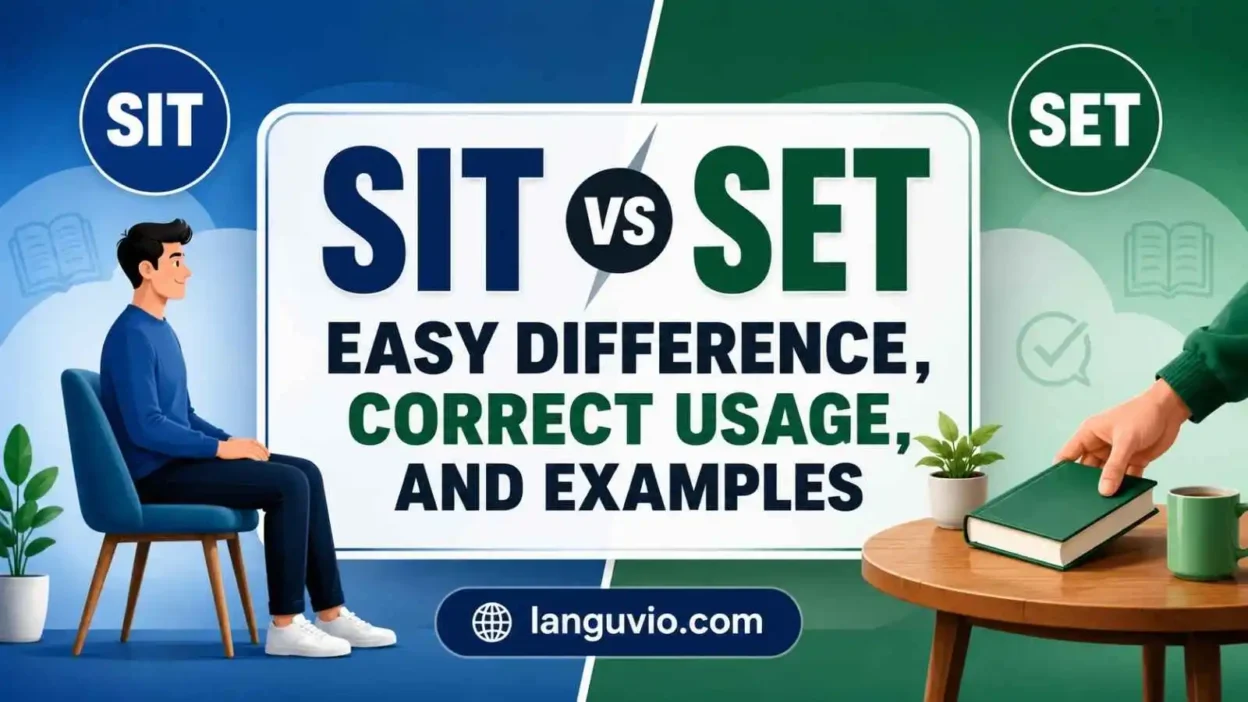
Sit vs set is a common word-choice problem because the words look and sound close. They are not usually interchangeable.
The simple choice is this: use sit when someone or something is in a seated or resting position. Use set when someone places, arranges, adjusts, fixes, or schedules something.
Quick Answer
Use sit when the subject takes or holds a seated position.
Example:
Please sit by the window.
Use set when the subject puts something somewhere or makes something ready.
Example:
Please set the keys on the counter.
A quick sound tip also helps: sit rhymes with hit. Set rhymes with bet.
Why People Confuse Them
People confuse sit and set for three main reasons.
First, both are short, common verbs. Second, both can involve position. Third, some regional speech uses them loosely, especially in casual talk.
The safest standard choice is still clear. A person usually sits. A person sets a thing somewhere.
Still, do not push that rule too far. A thing can also sit somewhere when it rests in a place.
Example:
The lamp sits on the nightstand.
That sentence is correct because no one is placing the lamp at that moment. The sentence describes where the lamp rests.
Key Differences At A Glance
Compact comparison:
- sit: be seated, take a seat, stay in a position, rest in a place
- set: put, place, arrange, adjust, schedule, fix in position
- sit changes form: sit, sat, sitting
- set stays the same in present and past: set, set, setting
- sit is most often about position
- set is most often about action done to something
Meaning and Usage Difference
Sit often means to rest with your body supported by a chair, bench, floor, or other surface.
Examples:
I like to sit near the front.
The kids sat on the rug during story time.
Set often means to put something in a place or position.
Examples:
She set her backpack by the door.
He set the phone on silent before the meeting.
Set also works when you choose or adjust something.
Examples:
We set the meeting for Friday.
I set the oven to 350 degrees.
They set a clear deadline.
That is why set has a wider range than sit. But in the most common mix-up, the choice is about seated position versus placing something.
Tone, Context, and Formality
Both sit and set are normal in casual, school, business, and formal writing. Neither word is more polished by itself.
The difference is not tone. The difference is meaning and sentence structure.
In everyday US English, these are natural:
Please sit down.
Please set your bag by the wall.
These sound standard in any setting. A teacher, manager, parent, or friend could use them.
Be more careful in writing than in speech. In casual speech, someone may say “set down” when they mean “sit down,” but standard written English keeps those uses apart.
Which One Should You Use?
| Context | Best Choice | Why |
| A person takes a seat | sit | The person is becoming seated. |
| A person remains in a chair | sit | The person is in a seated position. |
| You put an object somewhere | set | You are placing something. |
| You arrange a table for dinner | set | You are making the table ready. |
| You choose a date or time | set | You are deciding or scheduling it. |
| You adjust a device | set | You are changing it to a chosen level. |
| The sun goes below the horizon | set | This fixed phrase uses set. |
| A thing rests in a place | sit | The thing is located there, not being placed now. |
Use sit for “be seated.” Use set for “put or make ready.” That rule covers most everyday choices.
When One Choice Sounds Wrong
Some mistakes sound wrong right away.
Wrong: I need to set on the couch.
Right: I need to sit on the couch.
Wrong: Please sit the groceries on the table.
Right: Please set the groceries on the table.
Wrong: She sitted next to me.
Right: She sat next to me.
Wrong: I sat the alarm for 6:30.
Right: I set the alarm for 6:30.
One tricky point: sit can take an object in some standard uses.
Example:
She sat the baby in the high chair.
That means she helped the baby into a seated position. This does not mean “placed an object.” It still connects to sitting.
Common Mistakes (and Quick Fixes)
Mistake 1: Using set for your own body
Wrong: I’m going to set by the window.
Correct: I’m going to sit by the window.
Use sit when you mean your body is taking a seat.
Mistake 2: Using sit for an object you place
Wrong: Sit the mug on my desk.
Correct: Set the mug on my desk.
Use set when your hand places something somewhere.
Mistake 3: Using sat as the past tense of set
Wrong: I sat the folder on your chair.
Correct: I set the folder on your chair.
The past tense of set is set.
Mistake 4: Forgetting that things can sit
Correct: The book sits on the shelf.
Correct: The old truck sat in the driveway all winter.
Here, sit means “rest” or “remain in a place.”
Everyday Examples
Please sit here while I check your order.
I set your coffee on the counter.
The cat likes to sit in the sunny spot by the door.
She set the baby monitor on the dresser.
We sat in traffic for almost an hour.
He set a reminder to call his mom.
The vase sits on the entry table.
They set the table before everyone arrived.
I sat with my team during lunch.
The coach set a new practice schedule.
Dictionary-Style Word Details
Verb
- sit: A verb meaning to be seated, take a seat, remain in a place, or rest in a position.
Example: I will sit in the back row. - set: A verb meaning to put, place, arrange, adjust, schedule, or fix something.
Example: I will set the folders on your desk.
Forms:
sit, sat, sitting
set, set, setting
Noun
- sit: A noun in limited use. It can mean an act or period of sitting.
Example: This chair passed the sit test. - set: A common noun meaning a group, collection, stage area, device, or part of a match.
Example: We bought a new set of dishes.
Synonyms
- sit: closest plain alternatives include be seated, take a seat, rest, and remain.
Helpful opposite in the seated-position sense: stand. - set: closest plain alternatives include put, place, position, arrange, schedule, adjust, and fix.
Opposites depend on meaning. For “set the alarm,” an opposite might be turn off or unset. For “set the cup down,” a natural contrast is pick up.
Example Sentences
- sit: Please sit wherever you feel comfortable.
- sit: The dog sat by the front door.
- sit: The laptop sits on the kitchen counter.
- set: Please set the package inside the door.
- set: We set the appointment for Monday morning.
- set: The concrete needs time to set.
Word History
- sit: The word comes from older English forms tied to the idea of being seated.
- set: The verb is historically related to the idea of causing something to sit or be placed.
That history explains why the words look related, but modern usage keeps the everyday meanings separate.
Phrases Containing
- sit: sit down, sit up, sit tight, sit out, sit in, sit through, sit still
- set: set down, set aside, set up, set the table, set a date, set in motion, all set
Notice the difference between sit down and set down:
Please sit down.
Please set down the box.
FAQs
What is the main difference between sit and set?
Sit means to rest your body on a chair, seat, or surface.
Set means to place or put something somewhere.
Example:
- Please sit on the chair.
- Please set the book on the table.
Is it correct to say “set down” instead of “sit down”?
Usually, no. For people, use sit down.
Correct: Sit down and relax.
Incorrect: Set down and relax.
However, set down can mean “place something down.”
Example: Set down the bag before you hurt your back.
Can animals “sit”?
Yes. Animals can sit when they lower their body into a sitting position.
Example: The dog learned how to sit.
When should I use set?
Use set when someone places an object somewhere.
Example:
- She set the glass on the counter.
- He set his keys by the door.
What is the past tense of sit?
The past tense of sit is sat.
Example:
- I sit here every morning.
- Yesterday, I sat here for an hour.
What is the past tense of set?
The past tense of set is also set.
Example:
- I set the plate on the table.
- Yesterday, I set the plate on the table.
Is “I set in the chair” correct?
No. The correct sentence is:
I sat in the chair.
Use sat because you are talking about a person resting in a seated position.
Is “I sat the book on the table” correct?
In standard English, set is better.
Correct: I set the book on the table.
Incorrect: I sat the book on the table.
How can I remember the difference between sit and set?
Use this simple rule:
People and animals sit. Objects are set.
Example:
- The child sat on the floor.
- The child set the toy on the floor.
Are “sit” and “set” commonly confused
Yes. They sound similar and are both short verbs, so many learners mix them up. The easiest way to avoid mistakes is to remember that sit usually does not take an object, while set usually does.
Example:
- I sit.
- I set something down.
Conclusion
The choice between sit and set is usually simple.
Use sit when someone is seated, takes a seat, or something rests in a place.
Use set when someone places, arranges, adjusts, schedules, or fixes something.
So you sit in a chair, but you set your phone on the table. You sat by the window yesterday, but you set the keys on the counter yesterday.