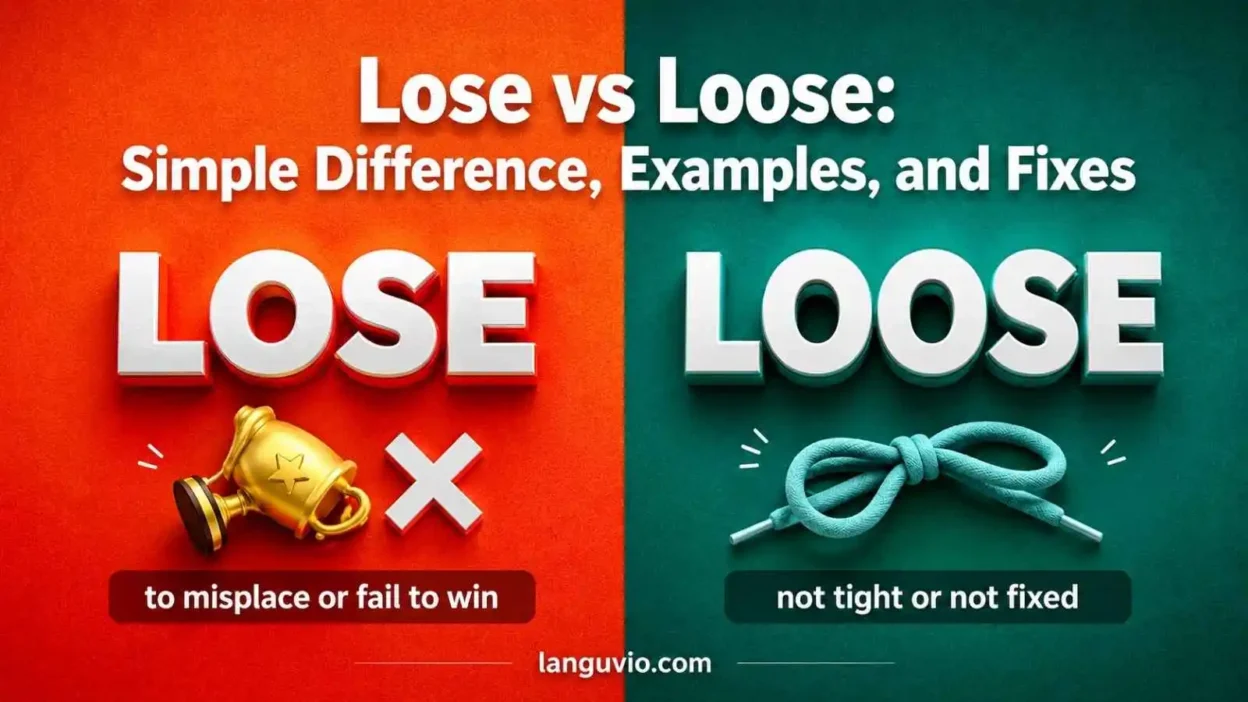
Lose vs loose is a common mix-up because the words look almost the same. They are not the same word, and they are not interchangeable.
Use lose when you mean misplace something, fail to keep something, or fail to win. Use loose when something is not tight, not fixed, or not under control.
The extra “o” matters.
Quick Answer
Lose is usually a verb. It means to no longer have something, to fail to keep something, or to be defeated.
Examples:
- Don’t lose your phone.
- The team might lose tonight.
- I’m trying to lose weight.
Loose is usually an adjective. It means not tight, not attached firmly, or free.
Examples:
- This shirt is too loose.
- The dog got loose.
- There is a loose screw in the chair.
Pronunciation helps too. Lose rhymes with choose. Loose rhymes with goose.
Why People Confuse Them
People confuse lose and loose because they differ by only one letter. The sound also causes trouble. Many readers expect lose to sound like close, but it does not.
The meaning difference is bigger than the spelling difference.
Lose is about not having, not keeping, or not winning.
Loose is about fit, attachment, control, or freedom.
That is why lose weight is correct, but loose weight is not. Weight is something you reduce or no longer have. It is not something “not tight.”
Key Differences At A Glance
| Feature | lose | loose |
|---|---|---|
| Most common role | Verb | Adjective |
| Basic meaning | To misplace, fail to keep, or fail to win | Not tight, not secure, or free |
| Pronunciation | Rhymes with choose | Rhymes with goose |
| Common phrase | lose your keys | loose pants |
| Common mistake | “loose weight” | “the screw is lose” |
Meaning and Usage Difference
Lose shows an action or result. You can lose a wallet, lose a game, lose confidence, lose time, or lose your place in a book.
It often answers: “What did someone fail to keep, find, hold, or win?”
Loose describes a condition. A shirt can be loose. A tooth can be loose. A dog can be loose in the neighborhood. A rule can be loose if it is not strict.
It often answers: “Is it tight, secure, fixed, or controlled?”
A helpful test:
- If you need an action, choose lose.
- If you need a describing word for something not tight or not secure, choose loose.
This test covers most everyday writing.
Tone, Context, and Formality
Both words are normal in casual and formal US English. The difference is not about politeness or style. It is about meaning and grammar.
Lose fits emails, reports, sports writing, health writing, and everyday speech:
- We cannot afford to lose customers.
- Did you lose the receipt?
Loose fits descriptions of fit, safety, structure, rules, and control:
- Wear loose clothing after the procedure.
- The railing feels loose.
One detail matters: loose can be a verb meaning “to release” or “set free,” but that use sounds formal, old-fashioned, or literary in most modern US contexts. In everyday writing, people usually choose release, free, or loosen instead.
Which One Should You Use?
| Context | Best Choice | Why |
|---|---|---|
| You cannot find your keys | lose | You no longer have them or cannot find them |
| Your pants do not fit tightly | loose | The word describes fit |
| Your team is defeated | lose | It means fail to win |
| A screw is not secure | loose | The word describes attachment |
| You want to reduce body weight | lose | You are having less of something |
| A dog is running free | loose | It means not restrained |
| You become angry | lose | The phrase is “lose your temper” |
| A rule is not strict | loose | It means relaxed or not exact |
When One Choice Sounds Wrong
Use lose in these phrases:
- lose weight
- lose money
- lose your keys
- lose your job
- lose your temper
- lose track
- lose interest
- lose the game
Use loose in these phrases:
- loose pants
- loose tooth
- loose screw
- loose papers
- loose change
- on the loose
- let loose
- loose rules
The phrase loose change is correct because the coins are not fixed or bundled. The phrase lose change would mean to misplace coins.
Common Mistakes
Incorrect: I don’t want to loose my job.
Correct: I don’t want to lose my job.
Incorrect: She wants to loose weight before summer.
Correct: She wants to lose weight before summer.
Incorrect: The handle is lose.
Correct: The handle is loose.
Incorrect: Don’t loose your place in line.
Correct: Don’t lose your place in line.
Incorrect: My jeans are too lose.
Correct: My jeans are too loose.
A quick fix is to replace the word in your head.
If you mean misplace, fail to keep, or fail to win, write lose.
If you mean not tight, not secure, or free, write loose.
Everyday Examples
I always lose my earbuds when I travel.
The screws on the desk are loose.
The Lakers can still lose if they stop defending.
This hoodie is supposed to fit loose.
Please don’t lose the parking ticket.
The neighbor’s dog got loose again.
You might lose service in the mountains.
Tie that bag tighter so nothing comes loose.
I started to lose interest after the third episode.
The teacher keeps a loose schedule on Fridays.
Dictionary-Style Word Details
Verb
- lose: Commonly used as a verb. It means to misplace, no longer have, fail to keep, fail to win, or have less of something.
Example: We may lose power during the storm. - loose: Can be a verb, but it is not the everyday choice in standard US English. It means to release, set free, or make loose.
Example: The rider loosed the reins.
In most modern sentences, released, freed, or loosened will sound more natural.
Noun
- lose: Not commonly used as a noun in standard US English. Use loss for the noun.
Example: The company reported a loss. - loose: Rare as a noun in everyday US English. Most writers use it as an adjective. In common use, you are far more likely to see it in phrases like on the loose than as a stand-alone noun.
Synonyms
- lose: Closest plain alternatives include misplace, drop, forfeit, surrender, fail to win, or be deprived of, depending on the sentence.
Clear antonyms include find, keep, gain, and win. - loose: Closest plain alternatives include slack, unfastened, unattached, free, baggy, relaxed, or not tight, depending on context.
Clear antonyms include tight, secure, attached, fixed, and strict.
Example Sentences
- lose: If you lose the receipt, the store may not accept the return.
- lose: We cannot lose another hour in traffic.
- lose: The candidate could lose by a small margin.
- loose: The baby’s shoe came loose in the stroller.
- loose: Keep loose papers away from the fan.
- loose: The plan is still loose, but we have the main idea.
Word History
- lose: The word has long been used for no longer having, failing to keep, or being defeated. Its past tense and past participle are lost.
- loose: The word has long been connected with being free, unbound, or not tight. It is related in meaning to ideas like release and looseness. Exact word history can get technical, so the safest practical point is this: the two words have different modern meanings and should not be swapped.
Phrases Containing
- lose: lose weight, lose money, lose your temper, lose sleep, lose track, lose heart, lose your way, lose interest, lose count, win some, lose some.
- loose: loose change, loose ends, loose tooth, loose screw, loose clothing, on the loose, let loose, cut loose, hang loose, play fast and loose.
FAQs
What is the difference between lose and loose?
Lose is usually a verb. It means to misplace something, fail to keep something, have less of something, or fail to win. Loose is usually an adjective. It means not tight, not secure, not fixed, or free.
Is it “lose weight” or “loose weight”?
The correct phrase is lose weight. Weight is something you reduce or have less of, so lose is the right word. Loose weight is incorrect.
Is it “loose pants” or “lose pants”?
The correct phrase is loose pants. Pants that are not tight are described as loose.
How do you pronounce lose and loose?
Lose rhymes with choose.
Loose rhymes with goose.
Is lose a verb or adjective?
Lose is usually a verb. For example: “Don’t lose your keys.”
Is loose a verb or adjective?
Loose is usually an adjective. For example: “This shirt is too loose.” It can also be used as a verb meaning “to release,” but that use is less common in everyday English.
Which is correct: “I don’t want to lose my job” or “I don’t want to loose my job”?
The correct sentence is: I don’t want to lose my job.
Here, lose means to no longer have something.
Which is correct: “The screw is loose” or “The screw is lose”?
The correct sentence is: The screw is loose.
A screw that is not tight or secure is loose.
What is an easy way to remember lose vs loose?
Use lose when you mean an action, such as misplace, fail to keep, or fail to win. Use loose when you describe something that is not tight, not fixed, or free.
Can lose and loose be used interchangeably?
No. Lose and loose have different meanings and should not be swapped. For example, lose weight and loose pants are correct, but loose weight and lose pants are usually incorrect.
Conclusion
The choice between lose vs loose is simple once you focus on meaning.
Use lose for an action: misplace, fail to keep, have less of, or fail to win.
Use loose for a description: not tight, not secure, free, or relaxed.
So write lose weight, lose your keys, and lose the game. Write loose pants, loose change, and a loose screw.
When in doubt, remember the sound: lose rhymes with choose; loose rhymes with goose.