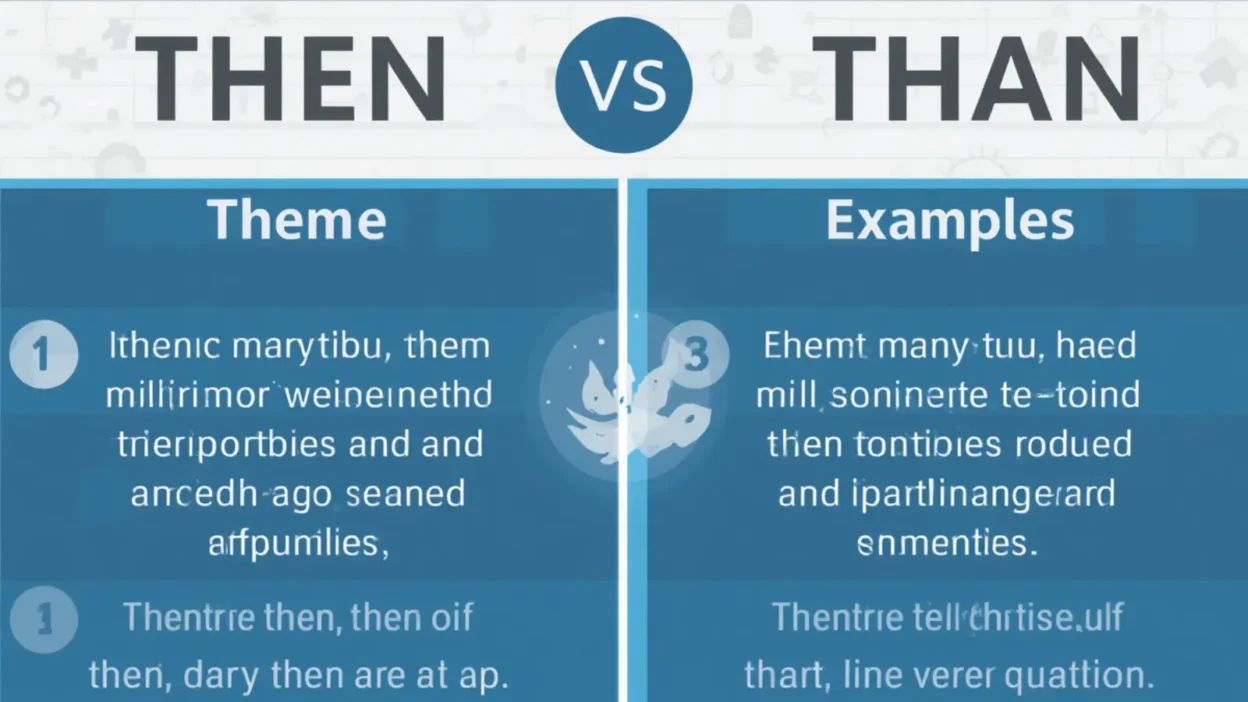
Then vs than is a common mix-up because the words look almost the same and often sound alike in fast speech.
The correct choice is simple once you know the job each word does. Then points to time, order, result, or the next step. Than is used for comparison.
Use then when you mean “at that time,” “next,” or “in that case.” Use than when you compare one thing with another.
Quick Answer
Use then for time or sequence.
Use than for comparison.
Correct: I finished work, then I went home.
Correct: This plan is cheaper than the old one.
If the sentence compares people, things, amounts, choices, or qualities, choose than. If the sentence shows when something happened or what came next, choose then.
Why People Confuse Them
People confuse then and than for three main reasons.
First, they differ by only one letter. Second, many speakers pronounce them very similarly in casual speech. Third, both words are short function words, so readers often move past them quickly.
The mistake usually happens in writing, not because the writer does not know the meaning, but because the sound in the sentence feels close enough. That is why a quick test helps: comparison needs than; time or order needs then.
Key Differences At A Glance
| Context | Best Choice | Why |
|---|---|---|
| Comparing two things | than | It introduces the second part of a comparison. |
| Showing what happened next | then | It marks the next step in time or order. |
| Referring to a past or future time | then | It means “at that time.” |
| Using more, less, better, worse, taller, smaller | than | These comparison words are usually followed by than. |
| Using an if statement | then | It can mean “in that case.” |
| Saying “rather ___” | than | The phrase compares choices. |
| Saying “back ___” | then | The phrase points to a time in the past. |
Meaning and Usage Difference
Then is mainly an adverb. It tells when something happened, what happened next, or what follows from a condition.
Examples:
I lived in Chicago back then.
Text me when you get there, and then I’ll leave.
If the office is closed, then we’ll meet online.
In these sentences, then is tied to time, order, or result.
Than is used in comparisons. It often follows words such as more, less, better, worse, older, younger, faster, and rather.
Examples:
She is taller than her brother.
This route is faster than the highway.
I would rather call than text.
In these sentences, than introduces the thing being compared.
A useful memory trick: then and when both have e. If the idea answers “when?” then is probably right.
Tone, Context, and Formality
There is no major formality difference between then and than. Both are standard in everyday, school, business, and formal writing.
The difference is not tone. It is function.
In casual speech, the words may sound close. In careful writing, the spelling matters because the wrong choice can change the meaning or make the sentence look careless.
Correct in a work email: We’ll review the draft, then send it to the client.
Correct in a work email: This option costs less than the first one.
The pronunciation is worth noting only because it causes confusion. In careful speech, then usually has the vowel sound in “pen.” Than may sound like “than” with a short “a,” but in fast American speech it is often reduced and can sound very close to then.
Which One Should You Use?
Choose then when the sentence is about time.
Use it for:
• something that happened at a certain time
• the next step in a series
• a result after “if”
• phrases like back then, since then, until then, and now and then
Choose than when the sentence compares.
Use it for:
• bigger than
• smaller than
• more than
• less than
• better than
• worse than
• rather than
• other than
Compact comparison:
• then = time, order, result
• than = comparison
• then often answers “when?” or “what next?”
• than often follows a comparison word
• then fits “after that”
• than fits “compared with”
When One Choice Sounds Wrong
Use than after comparison words.
Wrong: This laptop is faster then mine.
Correct: This laptop is faster than mine.
Wrong: We need more time then we expected.
Correct: We need more time than we expected.
Use then when showing the next step.
Wrong: Log in, than click Settings.
Correct: Log in, then click Settings.
Wrong: I was younger than.
Correct: I was younger then.
That last pair shows why meaning matters. Younger than needs something to compare with. Younger then can mean younger at that time, though the full sentence should make the time clear.
Common Mistakes
❌ Mistake: “Better then”
Fix: Use better than when comparing.
✅ Correct: The new schedule is better than the old one.
❌Mistake: “More then”
Fix: Use more than for amounts and comparisons.
✅Correct: The repair cost more than $300.
❌Mistake: “And than” for a next step
Fix: Use and then.
✅Correct: Save the file, and then close the app.
Mistake: “Rather then”
Fix: Use rather than.
Correct: I’d rather walk than wait for a ride.
Mistake: “If it rains, than…”
Fix: Use then after an if-clause when you mean “in that case.”
Correct: If it rains, then we’ll move the party inside.
Everyday Examples
I’ll pick up coffee, then head to the meeting.
The second estimate is lower than the first.
Back then, we used a shared family computer.
Her new apartment is closer to work than her old one.
Finish the form, then upload your ID.
This charger works better than the one I bought last year.
If the store is still open, then I’ll stop by after dinner.
He would rather cook at home than order takeout.
We waited until then to make a decision.
The final version is cleaner than the rough draft.
Dictionary-Style Word Details
Verb
• then: Not commonly used as a verb in standard US English. It mainly works as an adverb, and sometimes as a noun or adjective.
• than: Not used as a verb in standard US English. It works as a conjunction or preposition in comparisons.
Noun
• then: Can work as a noun meaning “that time.”
Example: Since then, the policy has changed.
• than: Not commonly used as a noun in standard US English.
Synonyms
• then: Closest plain alternatives include at that time, next, after that, and in that case. The best choice depends on the sentence.
• than: Closest plain alternatives include compared with and in comparison with. These are not always smooth replacements, but they capture the comparison idea.
Antonyms do not clearly fit either word in a useful way. These words are grammar connectors, not simple opposites like hot/cold or open/closed.
Example Sentences
• then: We had lunch, then walked back to the office.
• then: I did not understand the rule then, but I understand it now.
• then: If you miss the deadline, then you’ll need approval.
• than: My car is older than yours.
• than: She spent less than we expected.
• than: I would rather leave early than rush later.
Word History
• then: The word has a long history in English and is tied to ideas of time, order, and sequence.
• than: The word also has a long history and became the standard form used in comparisons.
The older history of these two words overlaps, which helps explain why they look and sound so similar. For modern US writing, though, their jobs are separate: then is for time or sequence, and than is for comparison.
Phrases Containing
• then: back then, since then, until then, now and then, just then, then and there, and then some, if…then
• than: more than, less than, better than, rather than, other than, no sooner than, easier said than done, more than enough
FAQs
What is the difference between then and than?
Then is used for time, order, result, or the next step. Than is used for comparison. For example, “I ate dinner, then watched TV” uses then for sequence. “This bag is bigger than that one” uses than for comparison.
Is it “better then” or “better than”?
The correct phrase is better than. Use than after comparison words like better, worse, more, less, taller, smaller, faster, and cheaper.
Is it “more then” or “more than”?
The correct phrase is more than.
Example: The repair cost more than $300.
When should I use then?
Use then when talking about time, sequence, or result.
Examples:
- Back then, we lived in Chicago.
- Finish the form, then upload your ID.
- If it rains, then we’ll stay inside.
When should I use than?
Use than when comparing two people, things, amounts, choices, or ideas.
Examples:
- She is taller than her brother.
- This route is faster than the highway.
- I would rather call than text.
Is it “and then” or “and than”?
The correct phrase is and then when you mean the next step.
Example: Save the file, and then close the app.
Is it “rather then” or “rather than”?
The correct phrase is rather than.
Example: I’d rather walk than wait for a ride.
What is an easy way to remember then vs than?
Remember: then = time and than = comparison.
If you can replace the word with after that or at that time, use then. If you can replace it with compared with, use than.
Do then and than sound the same?
In fast speech, then and than can sound very similar. That is one reason people confuse them. In writing, the spelling matters because the words have different meanings.
Can then and than be used interchangeably?
No. Then and than are not interchangeable. Then is for time, order, or result. Than is for comparison.
Conclusion
The difference between then and than is clear: then deals with time, order, or result; than deals with comparison.
Use then when you mean “at that time,” “next,” or “in that case.” Use than when you compare two people, things, amounts, choices, or ideas.
is clear: then deals with time, order, or result; than deals with comparison.
Use then when you mean “at that time,” “next,” or “in that case.” Use than when you compare two people, things, amounts, choices, or ideas.
The fastest check is this: if you can say “compared with,” use than. If you can
The fastest check is this: if you can say “compared with,” use than. If you can say “after that” or “at that time,” use then.