
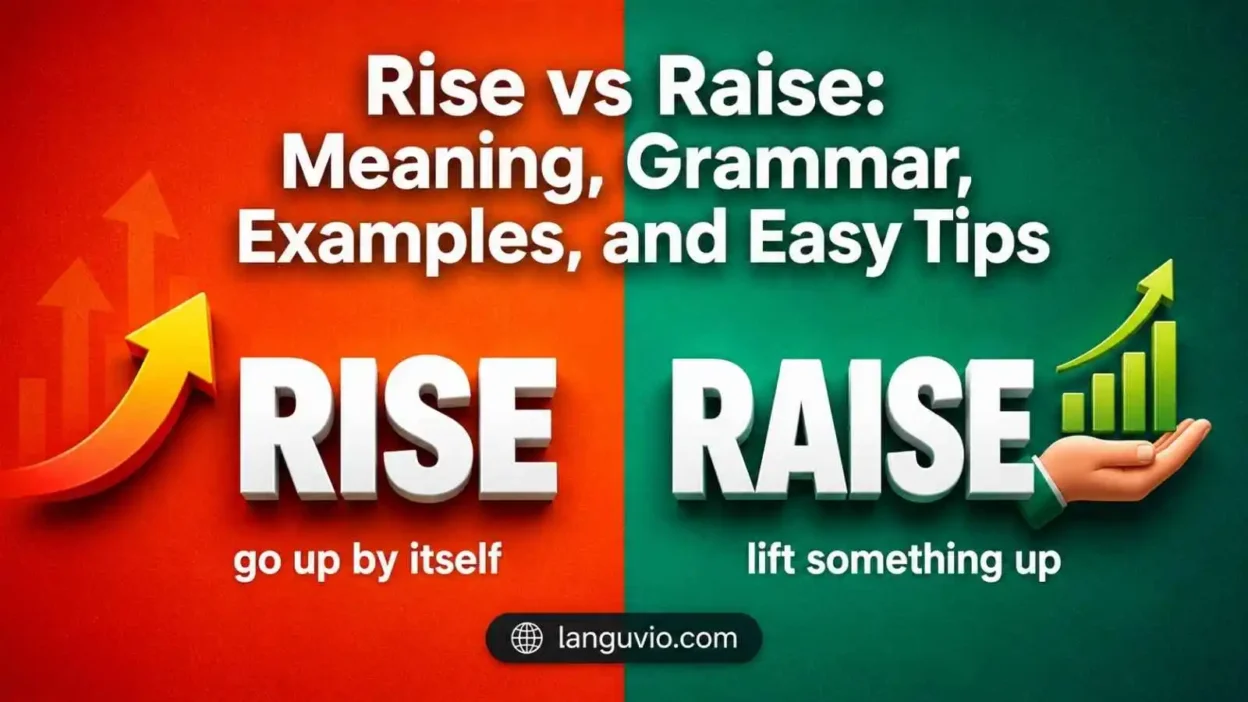
Rise and raise are easy to confuse because both words often describe upward movement or an increase. Prices can go up, a hand can go up, the sun can go up, and emotions can go up. But English uses rise and raise in different ways.
The main difference is grammar. Rise happens by itself. Raise happens when someone or something causes another thing to go up.
That means you can say prices rise, but you should say a company raises prices. You can say the sun rises, but you should say raise your hand.
Once you learn the object test, the choice becomes much easier.
2. Quick Answer
Use rise when something goes up, increases, or becomes higher by itself.
Examples:
- The sun rises in the east.
- Prices rose last month.
- Smoke is rising from the fire.
- Tensions have risen in the room.
Use raise when someone or something lifts, increases, collects, mentions, or brings up something else.
Examples:
- Please raise your hand.
- The store raised its prices.
- We are raising money for the trip.
- She raised an important question.
Simple rule:
Rise = go up by itself.
Raise = make something go up.
3. Why People Confuse Them
People confuse rise and raise because both words can involve upward movement or increase.
For example, these two sentences are closely related:
- Prices rise.
- Stores raise prices.
Both are about prices going up, but the sentence structure is different. In the first sentence, prices are the subject, and they go up by themselves in the sentence. In the second sentence, stores cause the increase, and prices are the object.
The same pattern appears in many everyday examples:
- The temperature rises.
- The heater raises the temperature.
- The balloon rises.
- The child raises the balloon.
- Rent rose.
- The landlord raised the rent.
The meaning is similar, but the grammar is not. Rise does not take a direct object. Raise needs one.
4. Key Differences At A Glance
| Word | Main Meaning | Needs an Object? | Verb Forms | Example |
|---|---|---|---|---|
| Rise | To go up, increase, or become higher by itself | No | rise, rose, risen, rising | Prices rose. |
| Raise | To lift, increase, or cause something to go up | Yes | raise, raised, raised, raising | The store raised prices. |
Use rise when the subject itself goes up:
- The sun rises.
- The river rose after the rain.
- The cost of food has risen.
- Steam is rising from the cup.
Use raise when the subject acts on something else:
- Raise your hand.
- They raised the flag.
- The company raised wages.
- We are raising awareness.
The easiest test is to ask, “Raise what?” If you can answer that question, raise is probably the right verb.
- Raise what? Your hand.
- Raise what? Prices.
- Raise what? Money.
- Raise what? A question.
5. Meaning and Usage Difference
Rise means to move upward, increase, stand up, become stronger, or come into view. It does not need an object because the subject does the rising by itself.
Examples:
- The sun rises every morning.
- The bread dough will rise in a warm place.
- Water levels rose after the storm.
- Her confidence has risen since the presentation.
In each sentence, nothing is being lifted by someone else. The sun, dough, water levels, and confidence are the things going up.
Raise means to lift, move something higher, increase something, collect something, mention something, or bring someone up. It needs an object because something is being acted on.
Examples:
- Please raise the window.
- The school raised money for new books.
- The manager raised the issue in the meeting.
- They raised three children in Chicago.
In each sentence, something receives the action: window, money, issue, children.
Compare these two sentences:
- The flag rose above the building.
- The guard raised the flag above the building.
In the first sentence, the flag goes up. In the second sentence, the guard makes the flag go up.
6. Tone, Context, and Formality
Both rise and raise are common in everyday English, business writing, academic writing, and news-style sentences. The difference is not about formality. It is about sentence structure.
Rise often appears when discussing numbers, levels, emotions, and natural movement.
Examples:
- Inflation rose during the year.
- Temperatures are rising this week.
- Public interest has risen sharply.
- Fear rose as the storm approached.
Raise often appears when someone causes an increase, brings up a topic, collects money, or lifts something.
Examples:
- The bank raised interest rates.
- The teacher raised a concern.
- The group raised funds for the event.
- She raised her voice to be heard.
There is also a noun difference worth knowing. In American English, a salary increase is usually called a raise.
Example:
- He got a raise at work.
In British English, people often say pay rise for the same idea. Since this guide uses natural US English, pay raise is the better everyday choice for American readers.
7. Which One Should You Use?
To choose between rise and raise, ask two simple questions.
First, ask: Is something going up by itself?
If yes, use rise.
Examples:
- The sun rises early in summer.
- Prices rose again.
- The number of visitors has risen.
- Smoke is rising from the chimney.
Second, ask: Is someone or something making another thing go up?
If yes, use raise.
Examples:
- The company raised prices.
- Please raise your hand.
- The charity raised $5,000.
- The speaker raised an important point.
Also remember the verb forms:
Rise is irregular:
- rise
- rose
- risen
- rising
Raise is regular:
- raise
- raised
- raised
- raising
That means you should say:
- Prices rose last year.
- Prices have risen this year.
- The company raised prices last year.
- The company has raised prices this year.
8. When One Choice Sounds Wrong
Some sentences clearly need raise, not rise.
Incorrect:
- Please rise your hand.
Correct:
- Please raise your hand.
Why? Because you are moving your hand upward. The hand is the object.
Incorrect:
- The company rose prices.
Correct:
- The company raised prices.
Why? Because the company caused prices to increase.
Incorrect:
- We need to rise money for the trip.
Correct:
- We need to raise money for the trip.
Why? Because money is being collected.
Other sentences clearly need rise, not raise.
Incorrect:
- Prices are raising again.
Correct:
- Prices are rising again.
Why? Because prices are going up in the sentence. No object follows the verb.
Incorrect:
- The sun raises at 6 a.m.
Correct:
- The sun rises at 6 a.m.
Why? Because the sun comes up by itself in standard English.
Incorrect:
- Smoke raised from the fire.
Correct:
- Smoke rose from the fire.
Why? Because smoke moved upward by itself.
9. Common Mistakes (and Quick Fixes)
Mistake 1: Using “raise” without an object
Incorrect:
- The cost of gas raised.
Correct:
- The cost of gas rose.
Better with an object:
- The station raised the cost of gas.
Mistake 2: Using “rise” with an object
Incorrect:
- The teacher asked us to rise our hands.
Correct:
- The teacher asked us to raise our hands.
Mistake 3: Mixing up “rose” and “raised”
Incorrect:
- The company rose wages.
Correct:
- The company raised wages.
Also correct:
- Wages rose.
Use raised when someone caused the increase. Use rose when the subject increased.
Mistake 4: Forgetting “risen”
Incorrect:
- Prices have rose.
Correct:
- Prices have risen.
Use risen after has, have, or had.
Examples:
- The water has risen.
- Costs have risen.
- The sun had already risen.
Mistake 5: Confusing noun uses
In American English, use raise for a salary increase.
Correct:
- She got a raise.
You can use rise as a noun for an increase in amount, level, or movement.
Correct:
- There was a rise in prices.
- We noticed a rise in demand.
10. Everyday Examples
Here are simple examples showing rise and raise in real sentences.
Rise
- The sun rises before 6 a.m. in June.
- Smoke rose from the campfire.
- The price of eggs has risen.
- The balloon rose into the sky.
- The river rises after heavy rain.
- Her confidence is rising.
- Tensions rose during the debate.
- The bread dough should rise for one hour.
Raise
- Please raise your hand before speaking.
- The landlord raised the rent.
- The charity raised money for the hospital.
- She raised a good question.
- He raised his voice in the noisy room.
- They raised three children.
- The workers raised the heavy door.
- The campaign is raising awareness.
Side-by-side examples
- The temperature rose quickly.
- The heater raised the temperature quickly.
- The flag rose in the wind.
- The soldier raised the flag.
- Prices rose overnight.
- The store raised prices overnight.
- A concern rose during the meeting.
- She raised a concern during the meeting.
These pairs show the main pattern: rise happens; raise causes something to happen.
11. Dictionary-Style Word Details
Verb
Rise is an intransitive verb. That means it does not take a direct object. It can mean to move upward, increase, get out of bed, become stronger, or come into notice.
Forms of rise:
- Present: rise
- Past: rose
- Past participle: risen
- Present participle: rising
Examples:
- The sun rises in the east.
- The crowd rose to cheer.
- Costs have risen this year.
- Steam is rising from the soup.
Raise is a transitive verb. That means it takes a direct object. It can mean to lift, move higher, increase, collect, mention, bring up, grow, or cause something to rise.
Forms of raise:
- Present: raise
- Past: raised
- Past participle: raised
- Present participle: raising
Examples:
- Please raise the blinds.
- They raised the price.
- We have raised enough money.
- She is raising a serious issue.
Noun
Rise can be a noun. As a noun, it often means an increase, upward movement, slope, or growth.
Examples:
- There was a rise in sales.
- The hill has a steep rise.
- The report showed a rise in demand.
Raise can also be a noun, especially in American English. It most often means an increase in pay.
Examples:
- He asked for a raise.
- She received a raise after her promotion.
Keep noun use separate from verb use. As verbs, rise and raise follow different grammar rules.
Synonyms
For rise, close alternatives include:
- go up
- increase
- climb
- ascend
- grow
- get higher
Examples:
- Prices rose.
- Prices increased.
- Smoke rose.
- Smoke ascended.
For raise, close alternatives include:
- lift
- increase
- elevate
- heighten
- collect
- bring up
- mention
- rear
Examples:
- Raise your hand.
- Lift your hand.
- Raise money.
- Collect money.
- Raise a question.
- Mention a question.
Choose the synonym that matches the meaning. Raise can mean more than physical lifting.
Example Sentences
Examples with rise:
- The sun will rise at dawn.
- The moon rose over the trees.
- Prices have risen since January.
- Steam is rising from the pot.
- The crowd rose to its feet.
- Anxiety rose before the exam.
Examples with raise:
- Please raise your hand.
- The company raised its fees.
- We raised money for new uniforms.
- She raised the issue during lunch.
- They raised chickens on the farm.
- The teacher is raising the standard for the class.
Word History
Rise carries the older basic idea of moving upward or becoming higher. It is irregular, which is why its forms are rise, rose, and risen.
Raise works like a causative partner to rise. In simple terms, to raise something is to cause it to rise. Unlike rise, raise is regular, so its past forms are raised and raised.
This connection explains why the words feel similar, but the grammar keeps them separate.
Phrases Containing
Common phrases with rise include:
- rise and shine
- rise above
- rise to the occasion
- rise in price
- rise from the ashes
- give rise to
- on the rise
Examples:
- It is time to rise and shine.
- She tried to rise above the criticism.
- Sales are on the rise.
Common phrases with raise include:
- raise your hand
- raise prices
- raise money
- raise a question
- raise awareness
- raise children
- raise the roof
- raise an eyebrow
Examples:
- Please raise your hand if you know the answer.
- The event helped raise awareness.
- His strange comment made everyone raise an eyebrow.
These phrases are useful because they show how each word behaves naturally. Rise often describes something going up or growing. Raise often shows someone causing action, collecting something, or bringing something forward.
12. FAQ
Is it “prices rise” or “prices raise”?
Use prices rise when prices go up by themselves in the sentence.
Correct:
- Prices rose last month.
Use raise prices when someone causes the increase.
Correct:
- The company raised prices last month.
Is it “raise your hand” or “rise your hand”?
Use raise your hand.
Correct:
- Please raise your hand.
Your hand is the object being lifted.
What is the difference between “rose” and “raised”?
Rose is the past tense of rise.
Example:
- The sun rose at 6 a.m.
Raised is the past tense of raise.
Example:
- She raised the flag.
Is it “the sun rises” or “the sun raises”?
Use the sun rises.
Correct:
- The sun rises in the east.
The sun is not raising an object. It is coming up by itself.
Is it “pay rise” or “pay raise”?
In American English, use pay raise.
Example:
- He got a pay raise.
In British English, pay rise is common.
Does “raise” always need an object?
Yes, when raise is used as a verb, it normally needs an object.
Examples:
- Raise your hand.
- Raise the price.
- Raise money.
- Raise a question.
Does “rise” take an object?
No. Rise does not take a direct object.
Correct:
- The balloon rose.
Incorrect:
- She rose the balloon.
Correct:
- She raised the balloon.
What are the forms of “rise”?
The main forms are:
- rise
- rose
- risen
- rising
Example:
- Costs have risen.
What are the forms of “raise”?
The main forms are:
- raise
- raised
- raised
- raising
Example:
- The city has raised parking fees.
13. Conclusion
The difference between rise and raise is simple once you focus on who or what is doing the action.