
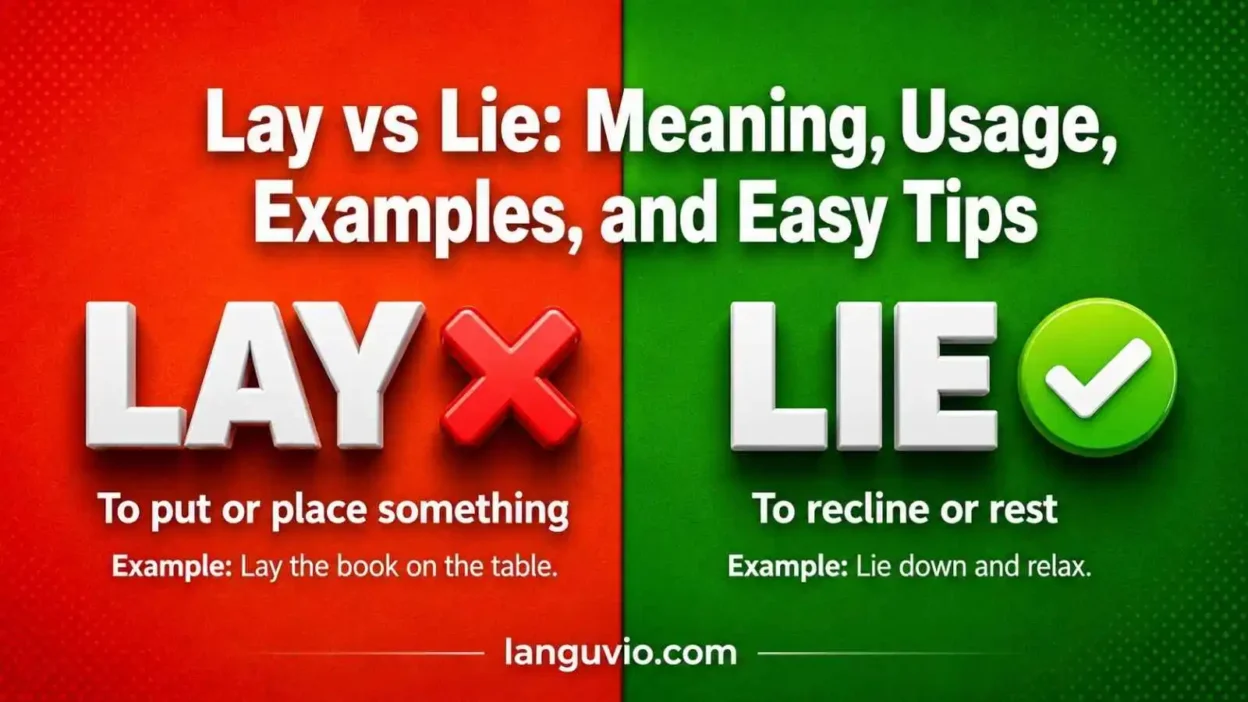
Lay and lie are two of the most confusing verbs in English. Even confident writers pause over sentences like “I need to lay down” or “I need to lie down.” The confusion is understandable because the words look similar, sound similar, and share one especially tricky form: lay can be the present tense of one verb and the past tense of another.
The good news is that the basic rule is simple.
Use lay when someone puts or places something somewhere. Use lie when someone or something reclines, rests, or stays in a position by itself.
Once you learn to ask one question — “Is there an object being placed?” — the difference becomes much easier.
2. Quick Answer
Use lay when the sentence has a direct object. That means someone is putting something somewhere.
Examples:
- Please lay the book on the table.
- She laid the baby in the crib.
- They are laying the tiles in the kitchen.
Use lie when the subject reclines, rests, or is in a flat position. It does not take a direct object.
Examples:
- I need to lie down.
- The dog is lying on the rug.
- He lay awake for hours last night.
The easiest memory tip:
Lay means “put something down.”
Lie means “rest or recline by yourself.”
3. Why People Confuse Them
People confuse lay and lie for a few reasons.
First, both words are short, common, and related to position. A person can lie on a bed, and a person can lay a blanket on a bed. The situations often happen in the same place, so the verbs get mixed up.
Second, casual speech often uses lay where careful writing expects lie.
For example, many people say:
- I’m going to lay down.
In standard edited English, the more careful form is:
- I’m going to lie down.
Third, the past tense creates real confusion. The past tense of lie is lay.
That means this sentence is correct:
- Yesterday, I lay down after lunch.
But this sentence is also correct for a different reason:
- Today, I lay the book on the desk.
In the first sentence, lay is the past tense of lie. In the second sentence, lay is the present tense of the verb meaning “put or place.”
That overlap is the main reason this pair feels so difficult.
4. Key Differences At A Glance
| Verb | Main Meaning | Needs an Object? | Present | Past | Past Participle | -ing Form |
|---|---|---|---|---|---|---|
| Lay | To put or place something down | Yes | lay | laid | laid | laying |
| Lie | To recline, rest, or be in a flat position | No | lie | lay | lain | lying |
Examples with lay:
- Lay the keys on the counter.
- She laid the blanket on the bed.
- He has laid the papers on my desk.
- They are laying bricks.
Examples with lie:
- I want to lie down.
- She lay on the couch yesterday.
- He has lain there all morning.
- The cat is lying in the sun.
The biggest difference is the object. If you can answer “Lay what?” the verb is probably lay.
- Lay what? The keys.
- Lay what? The baby.
- Lay what? The blanket.
If no object is being placed, use lie.
5. Meaning and Usage Difference
Lay means to put or place something somewhere. It is a transitive verb, which means it needs an object.
That object is the thing being placed.
Examples:
- I lay the phone on the charger every night.
- She laid the towel on the chair.
- Please lay your coat across the bed.
- The workers are laying carpet in the hallway.
In each sentence, something is being placed: phone, towel, coat, carpet.
Lie means to recline, rest, or be located in a position. It is an intransitive verb, which means it does not take a direct object.
Examples:
- I need to lie down.
- The child is lying on the floor.
- The town lies near the river.
- He lay awake for most of the night.
In these sentences, the subject is not placing an object. The subject is resting, reclining, or being located somewhere.
Compare these two sentences:
- She laid the blanket on the bed.
- She lay on the bed.
In the first sentence, she placed the blanket. In the second sentence, she rested on the bed herself.
6. Tone, Context, and Formality
In casual conversation, many people use lay in place of lie, especially in phrases like “lay down” or “laying in bed.” You will hear these forms often in everyday speech.
Casual:
- I’m going to lay down for a while.
- I was laying in bed all morning.
In polished writing, schoolwork, professional communication, and edited articles, the standard forms are:
- I’m going to lie down for a while.
- I was lying in bed all morning.
This does not mean everyone will notice the difference in speech. But in writing, using lie correctly makes your sentence cleaner and more precise.
The word lain is correct, but it can sound formal or old-fashioned to some readers.
Correct:
- She has lain awake for hours.
More common in everyday wording:
- She has been lying awake for hours.
Both can be correct, but the second sentence may feel more natural in ordinary modern writing.
7. Which One Should You Use?
To choose between lay and lie, ask one simple question:
Is someone putting something somewhere?
If yes, use lay.
Examples:
- Lay the laptop on the desk.
- She laid the baby in the crib.
- He is laying the cards on the table.
Now ask:
Is the subject resting, reclining, or staying in place by itself?
If yes, use lie.
Examples:
- I need to lie down.
- The baby is lying in the crib.
- He lay on the couch after work.
Notice the difference:
- She laid the baby in the crib.
- The baby lay in the crib.
In the first sentence, she placed the baby. In the second sentence, the baby rested there.
That is the heart of the difference: lay places something; lie rests somewhere.
8. When One Choice Sounds Wrong
Some uses are clearly wrong in standard edited English.
Incorrect:
- Please lie the book on the table.
Correct:
- Please lay the book on the table.
Why? Because the book is being placed. You need lay.
Incorrect:
- I need to lay down.
Correct:
- I need to lie down.
Why? Because you are not placing an object. You are reclining.
Incorrect:
- I lied down after work.
Correct:
- I lay down after work.
Why? Because lied is the past tense of lie meaning “to tell an untruth.” It is not the past tense of lie meaning “to recline.”
Incorrect:
- I have laid here all day.
Correct:
- I have lain here all day.
Why? Because no object is being placed. The subject is resting in a place.
However, lay down can be correct when there is an object.
Correct:
- Lay down your pencil.
- She laid down the rules.
- He laid down the baby gently.
In these examples, something is being placed or set down.
9. Common Mistakes (and Quick Fixes)
Mistake 1: Using “laying” when you mean “lying”
Incorrect:
- I am laying in bed.
Correct:
- I am lying in bed.
Use lying when the subject is resting or reclining.
Mistake 2: Using “lie” with an object
Incorrect:
- Lie the folder on my desk.
Correct:
- Lay the folder on my desk.
Use lay when something is being placed.
Mistake 3: Using “lied” for reclining
Incorrect:
- He lied on the couch after dinner.
Correct:
- He lay on the couch after dinner.
Use lied only when someone told an untruth.
Example:
- He lied about being late.
Mistake 4: Using “laid” when no object exists
Incorrect:
- She has laid in bed all morning.
Correct:
- She has lain in bed all morning.
A more natural rewrite:
- She has been lying in bed all morning.
Mistake 5: Forgetting that “lay” can be correct
Some writers become so worried about lay that they avoid it even when it is right.
Incorrect:
- Please lie the blanket over the chair.
Correct:
- Please lay the blanket over the chair.
If someone is placing something, lay is the correct verb.
10. Everyday Examples
Here are simple sentence examples you can use as models.
Lay
- Please lay the plates on the table.
- I always lay my phone beside my bed.
- She laid the baby in the crib.
- He laid the keys on the counter.
- The workers are laying bricks in the driveway.
- We are laying a rug in the living room.
- He has laid the documents on your desk.
Lie
- I need to lie down for a few minutes.
- The dog likes to lie near the door.
- She is lying on the couch.
- He lay awake all night.
- The cat lay in the sun yesterday.
- The town lies between two hills.
- She has lain there quietly since noon.
Side-by-side examples
- I laid the blanket on the grass.
- I lay on the blanket.
- She is laying the baby in the crib.
- The baby is lying in the crib.
- He laid the book beside him.
- He lay beside the book.
These pairs show the object rule clearly. If something is being placed, use lay. If the subject is resting, use lie.
11. Dictionary-Style Word Details
Verb
Lay is mainly a verb meaning to put or place something down. It needs a direct object.
Forms of lay:
- Present: lay
- Past: laid
- Past participle: laid
- Present participle: laying
Examples:
- I lay the notebook on the desk.
- She laid the flowers by the door.
- They have laid the foundation.
- He is laying the tools on the bench.
Lie is a verb meaning to recline, rest, or be in a flat position. It does not take a direct object.
Forms of lie meaning “recline”:
- Present: lie
- Past: lay
- Past participle: lain
- Present participle: lying
Examples:
- I want to lie down.
- He lay on the floor yesterday.
- She has lain awake for hours.
- The dog is lying by the window.
There is also another verb lie, meaning to tell an untruth. Its forms are different:
- Present: lie
- Past: lied
- Past participle: lied
- Present participle: lying
Example:
- He lied about where he was.
That separate meaning is why “I lied down” is incorrect when you mean reclining.
Noun
Lay is not commonly used as a noun in this word-choice issue. It has other uses in English, but they are not central to the difference between lay and lie.
Lie can be a noun when it means an untrue statement.
Example:
- That was a lie.
This noun meaning is separate from lie meaning “to recline.”
Compare:
- I need to lie down.
- That story was a lie.
The spelling is the same, but the meanings are different.
Synonyms
For lay, close alternatives include:
- put
- place
- set
- position
Examples:
- Lay the book on the table.
- Place the book on the table.
- Set the book on the table.
For lie meaning “recline,” close alternatives include:
- recline
- rest
- be positioned
- be situated
Examples:
- I need to lie down.
- I need to rest.
- She was lying on the sofa.
- She was reclining on the sofa.
For lie meaning “an untruth,” close alternatives include:
- falsehood
- untrue statement
- deception
Example:
- His excuse was a lie.
- His excuse was a falsehood.
Choose the synonym that matches the exact meaning. Lay and lie are not synonyms in standard use.
Example Sentences
Examples with lay:
- Please lay your bag on the chair.
- She laid the clean towels on the shelf.
- He is laying the papers in neat piles.
- The hen laid an egg.
- They laid the groundwork for the project.
Examples with lie:
- I need to lie down before dinner.
- She lay on the beach for an hour.
- The dog is lying under the table.
- He has lain awake since 4 a.m.
- The village lies at the base of the mountain.
Examples with lie meaning “tell an untruth”:
- Do not lie about your mistake.
- She lied to avoid trouble.
- He has lied before.
Word History
The confusion between lay and lie is not new. English speakers have mixed them up for a very long time, partly because their forms overlap.
The most confusing point is this:
- Lay is the present tense of the verb meaning “put or place.”
- Lay is also the past tense of lie meaning “recline.”
That means both of these sentences are correct:
- Today, I lay the book on the table.
- Yesterday, I lay on the couch.
The spelling is the same, but the grammar is different.
In modern standard writing, the safest rule is still clear: lay needs an object, and lie does not.
Phrases Containing
Common phrases with lay include:
- lay down the law
- lay the table
- lay the groundwork
- lay an egg
- lay something aside
- lay something on the table
- lay a hand on
- lay the blame on
Examples:
- The coach had to lay down the law.
- The team helped lay the groundwork for success.
- Please lay the papers on the table.
Common phrases with lie include:
- lie down
- lie awake
- lie in bed
- lie low
- lie around
- lie ahead
- lie in wait
Examples:
- I’m going to lie down for a few minutes.
- She lay awake thinking about the test.
- Several challenges lie ahead.
These phrases are useful because they show natural patterns. Lay often has something being placed or established. Lie often describes resting, staying, or existing in a position.
12. FAQ
Is it “lay down” or “lie down”?
Use lie down when someone reclines or rests.
Correct:
- I need to lie down.
Use lay down when someone places something down.
Correct:
- Please lay down your pencil.
Is it “lying in bed” or “laying in bed”?
Use lying in bed in standard English.
Correct:
- She is lying in bed.
Use laying only when something is being placed.
Correct:
- She is laying the blanket on the bed.
Why is “Yesterday I lay down” correct?
Because lay is the past tense of lie meaning “to recline.”
Present:
- Today, I lie down.
Past:
- Yesterday, I lay down.
Is “I lied down” correct?
No. Lied is the past tense of lie meaning “to tell an untruth.”
Incorrect:
- I lied down.
Correct:
- I lay down.
Is “I have laid here all day” correct?
In standard English, no. Since no object is being placed, use lain.
Correct:
- I have lain here all day.
A more natural version is:
- I have been lying here all day.
Does “lay” always need an object?
Yes, when lay means “put or place,” it needs an object.
Correct:
- Lay the book on the shelf.
The object is the book.
Does “lie” ever need an object?
No, not when lie means “recline” or “rest.” The subject lies by itself.
Correct:
- The dog is lying on the rug.
What is the past tense of “lay”?
The past tense of lay is laid.
Example:
- She laid the keys on the counter.
What is the past tense of “lie”?
The past tense of lie meaning “recline” is lay.
Example:
- He lay on the couch yesterday.
The past tense of lie meaning “tell an untruth” is lied.
Example:
- He lied about the meeting.
13. Conclusion
The difference between lay and lie comes down to one simple idea: lay needs an object, and lie does not.