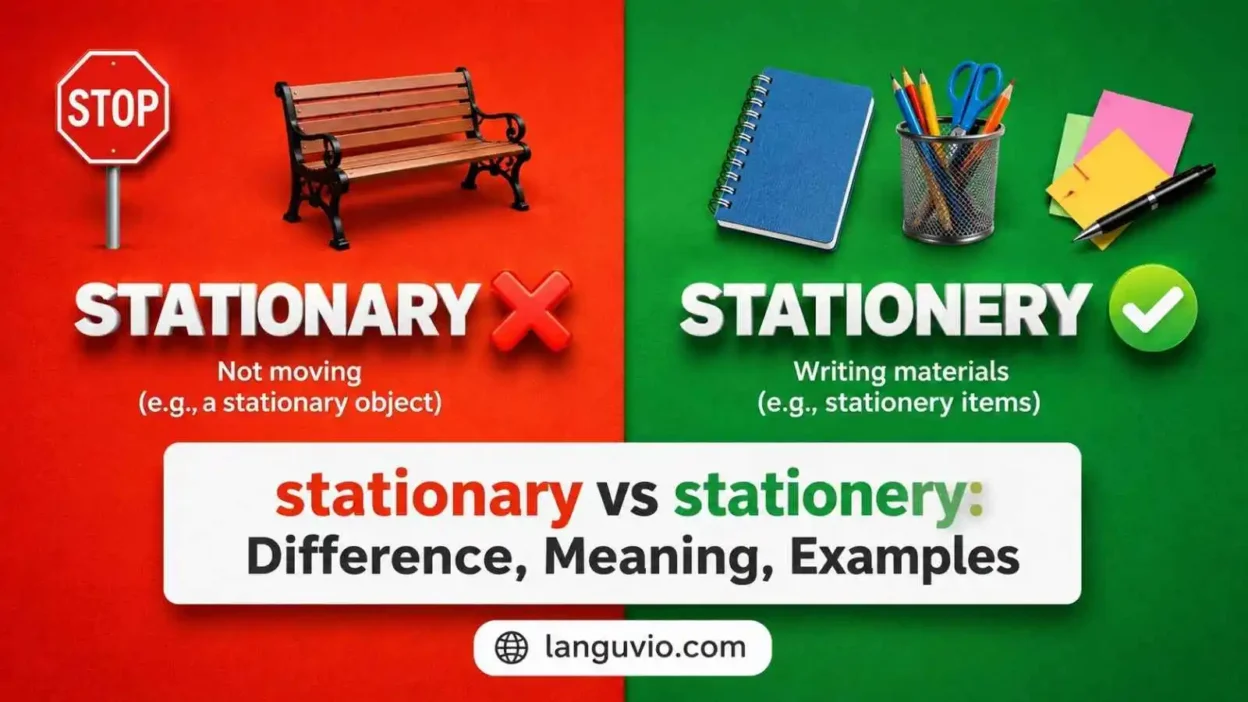
Both words are correct, but they do not mean the same thing. Stationary means not moving or not changing. Stationery means paper and other writing materials.
So the right choice depends on what you mean. A parked car can be stationary. A box of letter paper is stationery.
Quick Answer
Use stationary when something is still, fixed, or not moving.
Use stationery when you mean writing paper, envelopes, cards, or related office supplies.
A simple way to remember it: stationery has e, like envelope.
Why People Confuse Them
People mix up stationary and stationery because they look almost the same. Only one letter changes: a or e.
They also sound the same in normal US English: stay-shuh-nair-ee. Because pronunciation does not help, the spelling has to come from meaning.
The mistake is easy to make in writing, especially in office, school, and business settings.
Key Differences At A Glance
| Context | Best Choice | Why |
| A car is not moving | stationary | It describes no movement. |
| A bike used indoors for exercise | stationary | The bike stays in one place. |
| Paper for letters | stationery | It names writing paper. |
| Envelopes and note cards | stationery | These are writing materials. |
| A camera held still | stationary | It describes a fixed position. |
| Company letterhead | stationery | It refers to branded paper. |
| A weather front not moving | stationary | It describes lack of movement. |
| A store selling pens and paper | stationery | It refers to writing supplies. |
Meaning and Usage Difference
Stationary is an adjective. It describes a person, object, condition, or situation that is not moving or not changing.
Examples:
- The train remained stationary for ten minutes.
- Keep the camera stationary while recording.
- Prices stayed stationary through the spring.
Stationery is a noun. It names writing paper and related materials, such as envelopes, cards, pens, or office supplies.
Examples:
- I bought new stationery for thank-you notes.
- The office ordered branded stationery.
- Her wedding stationery matched the invitations.
Compact comparison:
- Stationary = still, fixed, not moving.
- Stationery = paper, envelopes, writing materials.
- Stationary describes a condition.
- Stationery names a thing or category.
Tone, Context, and Formality
Stationary sounds a little more precise than “still” or “not moving.” It works well in reports, directions, safety notices, traffic updates, and technical writing.
In casual speech, people often say “still” instead:
- Casual: The car was still.
- More precise: The car was stationary.
Stationery is neutral. It fits everyday, school, office, retail, and event-planning contexts. It can sound slightly polished when used for nice paper, wedding cards, or business letterhead.
Neither word is slang. Neither word is mainly British or mainly American in this comparison. The choice is about meaning.
Which One Should You Use?
Choose stationary when you are describing something that does not move.
Choose stationery when you are talking about paper or writing materials.
Ask yourself this quick question:
Can I replace the word with “still” or “not moving”? If yes, use stationary.
Can I replace it with “paper,” “letter paper,” or “writing supplies”? If yes, use stationery.
When One Choice Sounds Wrong
Stationary sounds wrong when you mean paper.
Wrong: I bought new stationary for my desk.
Right: I bought new stationery for my desk.
Stationery sounds wrong when you mean still or fixed.
Wrong: The truck was stationery at the red light.
Right: The truck was stationary at the red light.
A sentence can include both words correctly:
The stationery stayed stationary on the desk when the fan was off.
That sentence is unusual, but it shows the difference clearly.
Common Mistakes (and Quick Fixes)
Mistake 1: Using stationary for writing paper.
Fix: Use stationery for paper, cards, envelopes, and letterhead.
Mistake 2: Using stationery for something that is not moving.
Fix: Use stationary for still objects, vehicles, people, cameras, and conditions.
Mistake 3: Treating stationery like a regular plural noun.
Fix: In standard US writing, say “some stationery,” “a set of stationery,” or “stationery supplies,” not “many stationeries.”
Mistake 4: Letting pronunciation decide the spelling.
Fix: Ignore the sound. Check the meaning.
Everyday Examples
- The bus was stationary while passengers boarded.
- Please keep your phone stationary during the scan.
- The treadmill is stationary, but it still gives you a workout.
- Traffic was stationary near the exit ramp.
- I ordered stationery for my home office.
- She picked blue stationery for her thank-you notes.
- The company updated its stationery after the logo change.
- We need envelopes, cards, and other stationery for the event.
- A stationary bike does not move across the room.
- A stationery store sells paper, pens, cards, and envelopes.
Dictionary-Style Word Details
Verb
- stationary: Not commonly used as a verb in standard US English. Use it mainly as an adjective.
- stationery: Not used as a verb in standard US English. It is a noun.
Noun
- stationary: Not commonly used as a noun in everyday standard US English. In normal writing, it works as an adjective.
- stationery: A noun, usually uncountable. Say “some stationery,” “a stationery set,” or “stationery supplies.”
Synonyms
- stationary: closest plain alternatives include still, motionless, fixed, immobile, and unmoving. Clear opposites include moving and mobile.
- stationery: closest plain alternatives include writing paper, letter paper, note cards, and writing materials. A true antonym does not clearly fit.
Example Sentences
- stationary: The police report said the car was stationary when it was hit.
- stationary: Hold the ladder stationary while I step down.
- stationery: I keep extra stationery in the top drawer.
- stationery: The hotel gave guests branded stationery for notes.
Word History
- stationary: The history is tied to the idea of standing, fixed position, or lack of movement. In modern use, the key meaning is “not moving” or “not changing.”
- stationery: The history is connected with stationer, a person or business selling paper and related writing materials. For modern readers, the useful point is simple: stationery names writing materials.
Phrases Containing
- stationary: stationary bike, stationary object, stationary vehicle, stationary front, remain stationary.
- stationery: stationery store, stationery supplies, wedding stationery, business stationery, personalized stationery.
FAQs
Is stationary or stationery correct?
Both are correct, but they mean different things. Stationary means not moving. Stationery means writing paper, envelopes, cards, or related supplies.
What is the difference between stationary and stationery?
Stationary is usually an adjective. It describes something still or fixed. Stationery is a noun. It names paper and writing materials.
Is it a stationary bike or stationery bike?
The correct phrase is stationary bike. The bike stays in one place while you use it.
Is it stationery store or stationary store?
The correct phrase is stationery store. It means a store that sells paper, pens, cards, envelopes, and similar supplies.
How do I remember stationary vs stationery?
Use stationery with e for envelope. If you mean paper or writing supplies, choose stationery. If you mean not moving, choose stationary.
Can stationery be plural?
In normal US English, stationery is usually uncountable. Say some stationery, a set of stationery, or stationery supplies instead of stationeries.
Are stationary and stationery pronounced the same?
Yes. In everyday US English, they are usually pronounced the same: stay-shuh-nair-ee. The spelling depends on the meaning.
What is an example of stationary?
“The car was stationary at the red light.”
Here, stationary means the car was not moving.
What is an example of stationery?
“She bought new stationery for thank-you notes.”
Here, stationery means writing paper or note cards.
Conclusion
Stationary and stationery are both correct words, but they belong in different sentences.
Use stationary for something still, fixed, or not moving. Use stationery for paper, envelopes, cards, and writing materials.
The easiest memory trick is this: stationery has e, like envelope. When motion is the issue, choose stationary. When paper is the issue, choose stationery.