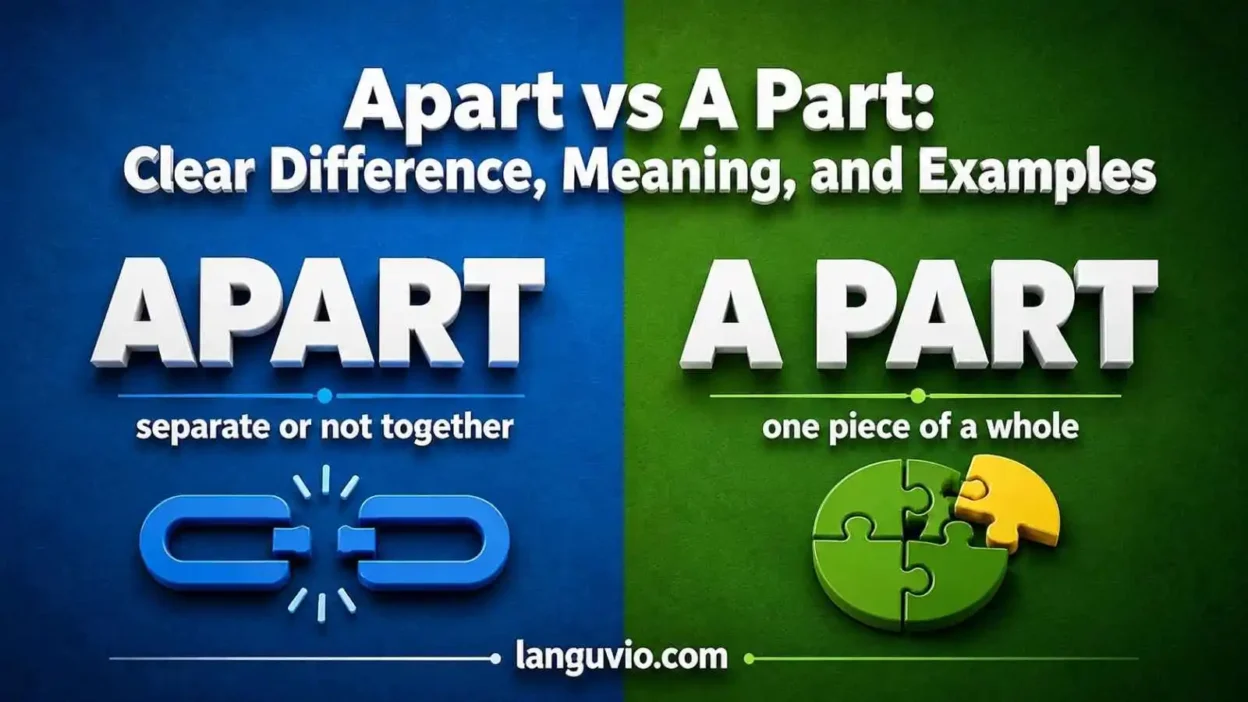
Apart and a part look almost the same, but they do opposite jobs in a sentence. One points to separation. The other points to belonging, membership, or one piece of a larger whole.
This is why the mistake is so common in everyday writing. A single space changes the meaning. Once you understand that space, apart vs a part becomes much easier to use correctly.
Quick Answer
Use apart when you mean separated, away from each other, or into pieces. Use a part when you mean one piece, role, share, or member of something larger. Write “The desks are apart,” but write “She is a part of the team.”
Why People Confuse Them
People confuse apart and a part because they look nearly identical. The only visible difference is the space after a.
They can also sound very similar in speech. In normal conversation, apart and a part are often heard like “uh-PART.” Because the sound is so close, writers may choose the wrong form when they move from speech to writing.
The meanings, however, are not the same. Apart pulls things away from each other. A part connects one thing to a larger whole.
Key Differences At A Glance
| Context | Best Choice | Why |
| Two people are not together | apart | It shows separation. |
| One item belongs to a larger object | a part | It means one piece of the whole. |
| Someone belongs to a group | a part | It means a member of the group. |
| Something breaks into pieces | apart | It describes separation into pieces. |
| Someone has a role in a plan | a part | It means a role, share, or involvement. |
A quick way to remember the difference is simple: apart means separate; a part means one part of something.
Meaning and Usage Difference
Apart is one word. It usually works as an adverb, which means it describes how something is placed, separated, broken, or considered.
Examples:
The chairs are six feet apart.
The phone came apart when it hit the floor.
The two ideas are worlds apart.
In some sentences, apart can also work like an adjective after a linking verb.
Example:
They have been apart for three months.
A part is two words: the article a plus the noun part. It means one piece, portion, member, role, or share of something larger.
Examples:
A part of the roof needs repair.
She is a part of the design team.
He played a part in the school musical.
The difference is not about formal style. It is about sentence meaning. If the sentence means “separate,” choose apart. If it means “one piece or member,” choose a part.
| Feature | apart | a part |
| Word form | One word | Two-word noun phrase |
| Main meaning | Separated or away | One piece, role, or member |
| Common pattern | apart from, miles apart, fall apart | a part of, play a part, a part in |
| Grammar role | Usually adverb; sometimes adjective | Article + noun |
Tone, Context, and Formality
Both apart and a part are standard in American English. Neither one is more formal by itself.
You can use apart in casual writing, school essays, business messages, and professional writing.
Examples:
The meetings are two hours apart.
The new policy sets this case apart from the others.
You can also use a part in the same kinds of writing.
Examples:
Each intern is a part of the training program.
Budget review is a part of the planning process.
The context decides the right choice. Formality does not.
Which One Should You Use?
Use apart when the sentence is about distance, separation, difference, or breaking into pieces.
Choose apart for sentences like these:
The twins live apart now.
Keep the wet boxes apart from the dry ones.
The old binder fell apart in my backpack.
Use a part when the sentence is about one thing within a larger thing.
Choose a part for sentences like these:
This chapter is a part of the final exam.
Jenna is a part of our sales team.
That small screw is a part of the desk frame.
Here is a useful test. Ask yourself, “Can I mean separated?” If yes, use apart. Ask, “Can I mean one piece, member, or role?” If yes, use a part.
When One Choice Sounds Wrong
The most common wrong choice is apart of when the writer means belonging.
Incorrect: I am apart of the club.
Correct: I am a part of the club.
In the incorrect sentence, apart suggests separation. That makes the meaning awkward because the writer wants to say they belong to the club.
Another common mistake is a part from when the writer means separation or exception.
Incorrect: A part from the parking issue, the trip went well.
Correct: Apart from the parking issue, the trip went well.
Use apart from when you mean “except for,” “besides,” or “separate from.” Use a part of when you mean “one piece or member of.”
Correct:
Apart from the rain, the event was great.
The rain was a part of the problem.
These two sentences do not mean the same thing. The first sets the rain aside. The second says the rain was included in the problem.
Common Mistakes (and Quick Fixes)
Mistake: Writing apart of for membership.
Fix: Use a part of when someone or something belongs to a group.
Incorrect: He wants to be apart of the project.
Correct: He wants to be a part of the project.
Mistake: Writing a part when distance is meant.
Fix: Use apart when people or things are separated.
Incorrect: The two stores are a part.
Correct: The two stores are apart.
Mistake: Writing a part from for “except for.”
Fix: Use apart from.
Incorrect: A part from one typo, the report is ready.
Correct: Apart from one typo, the report is ready.
Mistake: Using apart when the meaning is “role.”
Fix: Use a part in phrases about playing a role.
Incorrect: She played apart in the decision.
Correct: She played a part in the decision.
Mistake: Treating the space as a small style choice.
Fix: Remember that the space changes the grammar and the meaning.
Everyday Examples
The two apartments are only one block apart.
A missing part delayed the bike repair.
Mia and her brother live far apart now.
Mia is a part of the neighborhood cleanup group.
The teacher asked the students to stand apart.
The worksheet is a part of today’s lesson.
The zipper came apart during the trip.
A broken zipper was a part of the problem.
The new design sets the brand apart.
The logo is a part of the new design.
Our birthdays are three days apart.
The birthday video was a part of the surprise.
Dictionary-Style Word Details
Verb
apart: Not used as a verb in standard American English. You would not say “to apart something” in normal writing.
a part: The full phrase a part is not a verb. However, the word part by itself can be a verb in other sentences, as in “The curtains parted.” That is a different structure from a part.
Noun
apart: Not commonly used as a noun in standard American English. It mainly works as an adverb and sometimes as an adjective.
a part: A noun phrase. It means one piece, portion, role, share, or member of a larger whole.
Examples:
A part of the machine is missing.
She became a part of the leadership team.
He played a part in the final scene.
Synonyms
apart: Closest plain alternatives include separate, separately, away, aside, and distant. The clearest opposite is together.
a part: Closest plain alternatives include a piece, a portion, a section, a component, a member, or a role, depending on the sentence. The opposite can be the whole when the meaning is a piece of something.
Example Sentences
apart:
The dogs sleep apart because they fight over the blanket.
The shelves should be placed eight inches apart.
After the move, the friends felt far apart.
The old chair came apart when we lifted it.
a part:
This receipt is a part of your tax records.
Carlos is a part of the weekend support team.
A small part of the trail is closed for repairs.
She played a part in organizing the fundraiser.
Word History
apart: The word developed from older forms connected with the idea of being at the side or separate. Its modern use keeps that separation meaning.
a part: This is not one special combined word. It is the article a plus the noun part. The noun part has long been used for a piece, share, role, or portion of something.
History helps explain why the forms look related, but modern usage is what matters most: apart separates, while a part belongs to a whole.
Phrases Containing
apart:
apart from
fall apart
take apart
set apart
come apart
tell apart
worlds apart
miles apart
a part:
a part of
a part in
be a part of
play a part
take part as a part of a group
a small part
a major part
a missing part
FAQs
Is it apart or a part?
Both are correct, but they mean different things. Use apart when you mean separated or away from something. Use a part when you mean one piece, role, or member of a larger whole. For example, “The chairs are apart” means they are separated. “She is a part of the team” means she belongs to the team.
What is the main difference between apart and a part?
The main difference is meaning. Apart shows separation. A part shows connection to something larger. A simple memory trick is this: apart pulls things away, while a part belongs to something.
Is “apart of” correct?
Usually, apart of is incorrect when you mean belonging. The correct phrase is a part of. Write “I am a part of the group,” not “I am apart of the group.” The word apart means separate, so “apart of the group” does not fit that meaning.
When should I use apart?
Use apart when people, objects, ideas, or places are separated. For example, “The houses are far apart,” “The phone fell apart,” and “Their opinions are worlds apart” all use apart correctly.
When should I use a part?
Use a part when you mean one piece, section, role, or member. For example, “This screw is a part of the chair,” “She played a part in the decision,” and “He is a part of our class” are correct.
Can apart and a part ever be interchangeable?
No, they are not interchangeable in standard writing. The space changes the grammar and meaning. Apart means separate. A part means one part of something larger. Choosing the wrong form can make the sentence confusing or incorrect.
Conclusion
The difference between apart and a part is clear once you focus on meaning. Apart means separated, away, or into pieces. A part means one piece, role, share, or member of something larger.
Use apart when things are separate. Use a part when something belongs to a whole. That one-space difference changes the sentence, so it is worth checking before you publish, submit, or send your writing.
Both are correct, but they mean different things. Use apart when you mean separated or away from something. Use a part when you mean one piece, role, or member of a larger whole. For example, “The chairs are apart” means they are separated. “She is a part of the team” means she belongs to the team.
The main difference is meaning. Apart shows separation. A part shows connection to something larger. A simple memory trick is this: apart pulls things away, while a part belongs to something.
Usually, apart of is incorrect when you mean belonging. The correct phrase is a part of. Write “I am a part of the group,” not “I am apart of the group.” The word apart means separate, so “apart of the group” does not fit that meaning.
Use apart when people, objects, ideas, or places are separated. For example, “The houses are far apart,” “The phone fell apart,” and “Their opinions are worlds apart” all use apart correctly.
Use a part when you mean one piece, section, role, or member. For example, “This screw is a part of the chair,” “She played a part in the decision,” and “He is a part of our class” are correct.
No, they are not interchangeable in standard writing. The space changes the grammar and meaning. Apart means separate. A part means one part of something larger. Choosing the wrong form can make the sentence confusing or incorrect.