
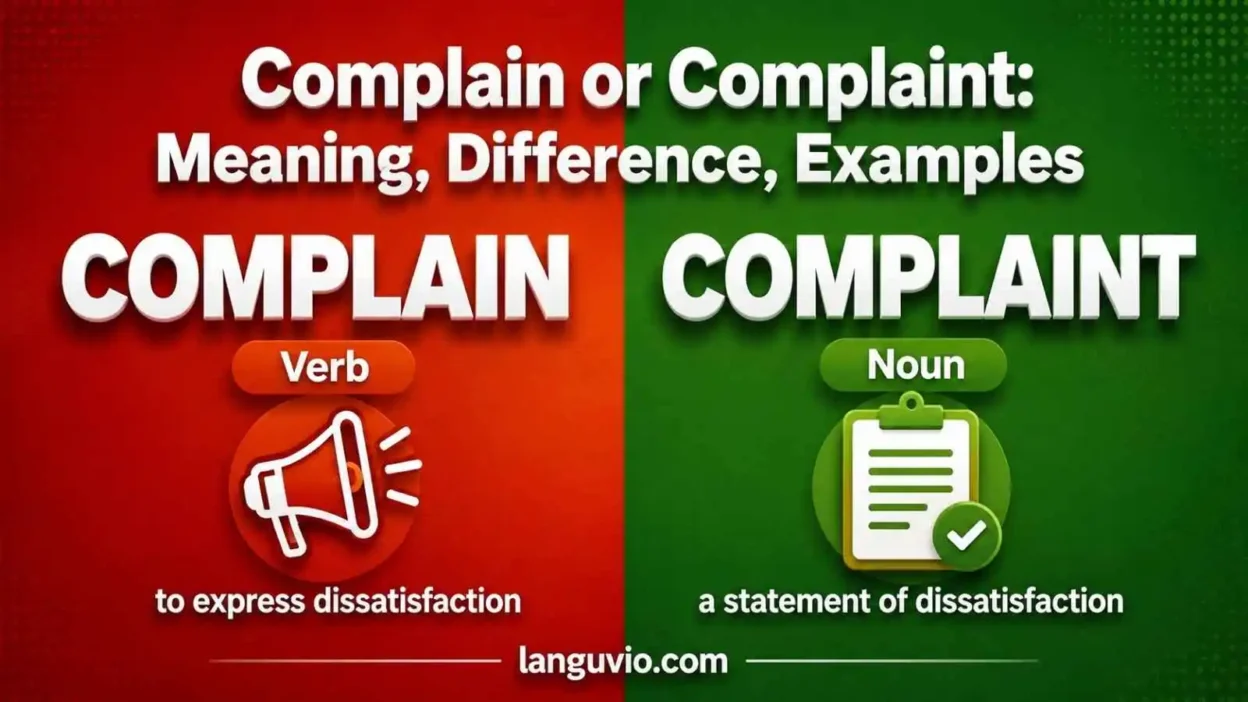
Both complain and complaint are correct words, but they do different jobs in a sentence. The confusion happens because the words look almost the same and both connect to speaking up about a problem.
The simple difference is this: complain is the action, and complaint is the thing. You complain about slow service. You make a complaint about slow service. Once you see the sentence job, the choice becomes much easier.
Quick Answer
Use complain as a verb when someone says something is wrong, unfair, painful, or unsatisfactory. Use complaint as a noun when you mean the problem, report, statement, or grievance itself. Say “I want to complain,” but say “I have a complaint.” The two words are related, but they are not interchangeable.
Why People Confuse Them
People confuse complain and complaint because both words point to dissatisfaction. They also appear in the same real-life settings, such as customer service, school, work, medical visits, and legal forms.
The ending is the key clue. Complain has no final t and works as an action word. Complaint ends in t and names the issue or report.
That is why these sentences sound different:
Correct: I want to complain about the bill.
Correct: I have a complaint about the bill.
The first sentence tells what someone wants to do. The second sentence names what the person has.
Key Differences At A Glance
| Context | Best Choice | Why |
| I want to ___ about the noise. | complain | The sentence needs a verb. |
| I filed a ___ with the company. | complaint | The sentence needs a noun. |
| She will ___ to the manager. | complain | The word shows an action. |
| His main ___ was the long wait. | complaint | The word names the issue. |
| Customers often ___ about delays. | complain | The subject is doing something. |
| The office received a written ___. | complaint | The word names a document or report. |
Meaning and Usage Difference
Complain means to say that something is wrong, unfair, painful, or not good enough. It is a verb, so it usually follows a subject.
Examples:
I need to complain about the refund delay.
They complained that the room was too cold.
The patient complained of chest pain.
Complaint means a statement, problem, grievance, report, or cause for dissatisfaction. It is a noun, so it can follow words like a, the, my, your, this, or several.
Examples:
I made a complaint about the refund delay.
Their complaint was handled quickly.
The doctor asked about her main complaint.
A helpful test is to replace the word with say something is wrong or problem. If “say something is wrong” fits, use complain. If “problem” fits, use complaint.
Tone, Context, and Formality
Complain often sounds direct and conversational. It works well when you describe the act of speaking up.
Example: I do not want to complain, but the order is missing two items.
Complaint often sounds more official, especially in business, legal, medical, and customer service writing. It works well when the issue is recorded, reviewed, filed, or answered.
Example: Please submit your complaint through the support form.
The difference is not American vs British English. In standard US English, the main difference is grammar. Complain is the verb. Complaint is the noun.
Pronunciation can help a little. Complain sounds like “kum-PLAIN.” Complaint sounds like “kum-PLAINT.” The final t in complaint helps mark the noun.
Which One Should You Use?
Use complain when the sentence tells what someone does.
Good uses:
I want to complain about the service.
She complained to the front desk.
They complain whenever the app crashes.
Use complaint when the sentence names the issue, message, or formal report.
Good uses:
I have a complaint about the service.
She filed a complaint with the front desk.
The company tracks every customer complaint.
Here is the easiest memory tip: You complain about a complaint.
When One Choice Sounds Wrong
Complain sounds wrong when the sentence needs a noun.
Wrong: I have a complain.
Correct: I have a complaint.
Wrong: The office received my complain.
Correct: The office received my complaint.
Complaint sounds wrong when the sentence needs a verb.
Wrong: I want to complaint about the food.
Correct: I want to complain about the food.
Wrong: She complaint to the manager yesterday.
Correct: She complained to the manager yesterday.
The sentence frame usually tells you the answer. After want to, use the base verb complain. After a, the, my, or your, use the noun complaint.
Common Mistakes (and Quick Fixes)
Mistake 1: Using complain after “a”
Wrong: I have a complain about my bill.
Correct: I have a complaint about my bill.
Quick fix: After a, use the noun complaint.
Mistake 2: Using complaint after “to”
Wrong: I need to complaint about this charge.
Correct: I need to complain about this charge.
Quick fix: After to in this structure, use the verb complain.
Mistake 3: Forgetting the past tense
Wrong: She complain yesterday.
Correct: She complained yesterday.
Quick fix: Use complained for the past action.
Mistake 4: Saying “complain for”
Weak: He complained for the broken heater.
Better: He complained about the broken heater.
Quick fix: Use complain about for the problem. Use complain to for the person or office.
Everyday Examples
I hate to complain, but my package arrived damaged.
Her complaint was clear, polite, and specific.
Several customers complained about the new fee.
The manager read the complaint before calling back.
You can complain to support if the charge is wrong.
My only complaint is that the parking lot is too small.
He complained that the instructions were confusing.
The school received a complaint from a parent.
Patients sometimes complain of headaches after the procedure.
The clinic records each complaint in the patient notes.
| Feature | Complain | Complaint |
| Part of speech | Verb | Noun |
| Main job | Shows the action | Names the issue |
| Common pattern | complain about something | make/file a complaint |
| Example | They complain about delays. | They filed a complaint. |
Dictionary-Style Word Details
Verb
Complain: Commonly used as a verb in standard US English. It means to express dissatisfaction, pain, grief, or concern.
Example: We complained about the loud music.
Complaint: Not commonly used as a verb in standard US English. Use complain for the verb.
Correct: I want to complain.
Incorrect: I want to complaint.
Noun
Complain: Not commonly used as a noun in standard US English. Do not say “a complain.”
Correct: I have a complaint.
Complaint: A noun meaning a statement of dissatisfaction, a grievance, a reported problem, a mild ailment, or, in legal use, a formal charge or filing.
Example: The complaint was resolved by the billing team.
Synonyms
Complain: Closest plain alternatives include object, protest, grumble, speak up, and raise a concern. These are not always exact matches because tone changes by context.
Complaint: Closest plain alternatives include grievance, objection, concern, claim, report, or issue. In legal or medical settings, choose carefully because the meaning can become more specific.
Clear opposites are context-dependent. For complain, possible opposites include praise or approve. For complaint, possible opposite ideas include praise, compliment, or approval, but they do not fit every sentence.
Example Sentences
Complain:
I do not want to complain, but the order is wrong.
She complained to the landlord about the heat.
Employees complained that the schedule changed too often.
Complaint:
I submitted a complaint about the order.
Her complaint was about the lack of heat.
The office reviewed three complaints this morning.
Word History
Complain: The word has older roots connected with expressing grief or lamenting. In modern US English, it works as the verb form.
Complaint: The word is historically related to complain and developed as the noun form. The useful modern point is simple: complain names the action, while complaint names the thing said, filed, or reported.
Phrases Containing
Complain:
complain about the service
complain to the manager
complain of pain
complain that something is wrong
cannot complain
Complaint:
make a complaint
file a complaint
submit a complaint
customer complaint
formal complaint
letter of complaint
grounds for complaint
noise complaint
FAQs
Is it complain or complaint?
Both words are correct, but they are used differently. Complain is a verb, which means to say that something is wrong or unsatisfactory. Complaint is a noun, which means the problem, report, or statement itself. Say “I want to complain,” but say “I have a complaint.”
What is the difference between complain and complaint?
The main difference is grammar. Complain shows an action. Complaint names a thing. For example, “Customers complain about slow service” uses the verb. “The company received a complaint about slow service” uses the noun.
Is “I have a complain” correct?
No. The correct sentence is “I have a complaint.” After words like a, the, my, or your, you usually need a noun. Since complaint is the noun, it fits this sentence.
Is “I want to complaint” correct?
No. The correct sentence is “I want to complain.” After want to, you need the base form of a verb. Complain is the verb, so it is the right choice.
Can I say “make a complaint”?
Yes. Make a complaint is correct and common in standard English. You can also say file a complaint, submit a complaint, or send a complaint, especially in business, customer service, school, or legal settings.
What preposition goes with complain?
The most common pattern is complain about something. For example, “She complained about the noise.” You can also complain to a person or office. For example, “He complained to the manager about the bill.”
What is an easy way to remember the difference?
Use this simple tip: You complain about a complaint. If you mean the action, use complain. If you mean the issue, report, or problem, use complaint.
Conclusion
The choice between complain and complaint depends on grammar, not preference. Use complain when someone is doing the action of speaking up. Use complaint when you mean the problem, report, grievance, or formal statement itself.
A quick final test helps: if the sentence needs an action, choose complain. If it needs a thing, choose complaint.
Both words are correct, but they are used differently. Complain is a verb, which means to say that something is wrong or unsatisfactory. Complaint is a noun, which means the problem, report, or statement itself. Say “I want to complain,” but say “I have a complaint.”
The main difference is grammar. Complain shows an action. Complaint names a thing. For example, “Customers complain about slow service” uses the verb. “The company received a complaint about slow service” uses the noun.
No. The correct sentence is “I have a complaint.” After words like a, the, my, or your, you usually need a noun. Since complaint is the noun, it fits this sentence.
No. The correct sentence is “I want to complain.” After want to, you need the base form of a verb. Complain is the verb, so it is the right choice.
Yes. Make a complaint is correct and common in standard English. You can also say file a complaint, submit a complaint, or send a complaint, especially in business, customer service, school, or legal settings.
The most common pattern is complain about something. For example, “She complained about the noise.” You can also complain to a person or office. For example, “He complained to the manager about the bill.”
Use this simple tip: You complain about a complaint. If you mean the action, use complain. If you mean the issue, report, or problem, use complaint.