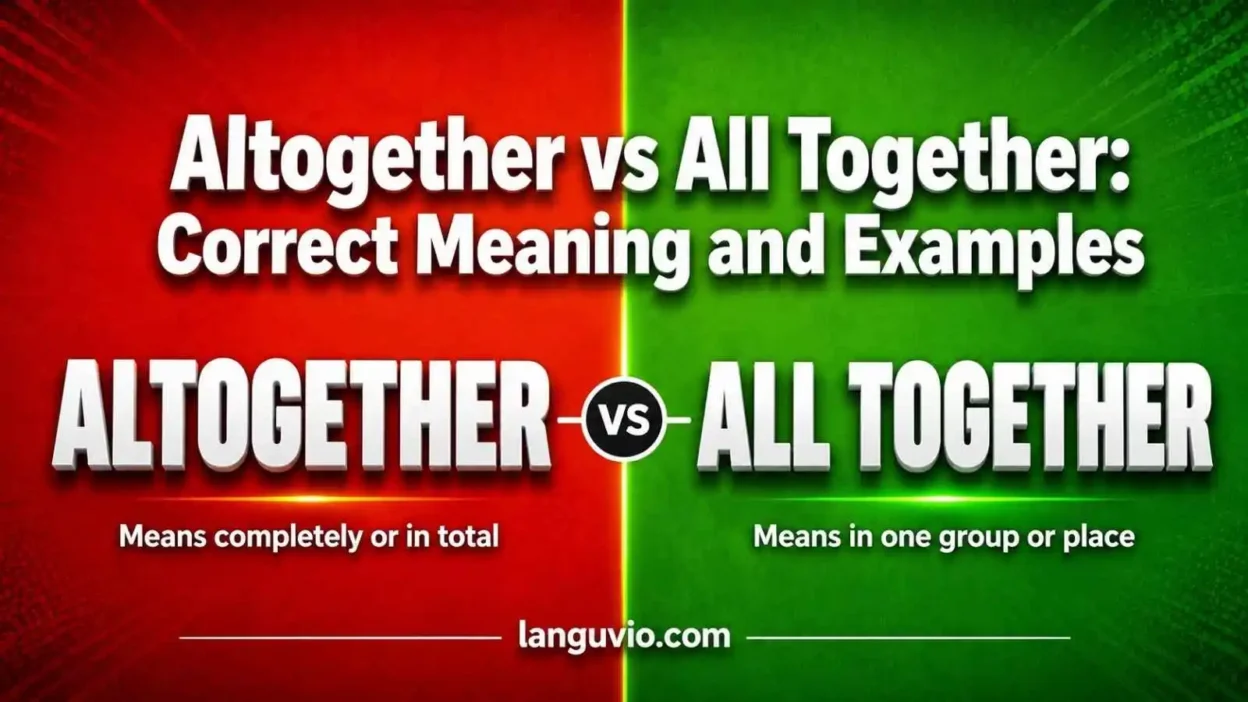
Altogether and all together are both correct, but they do not mean the same thing. The space changes the meaning.
Use altogether when you mean “completely,” “in total,” or “on the whole.” Use all together when you mean “everyone or everything together,” “in one group,” “in one place,” or “at the same time.”
Quick Answer
Altogether is one word and usually means completely, in total, or overall. All together is two words and means as a group, in one place, or at the same time. Write “The trip cost $500 altogether,” but “The kids sat all together.”
Why People Confuse Them
People confuse these forms because they look almost the same and sound the same in normal speech. The only visible difference is the space.
That small space matters. Altogether works as a single adverb. All together is a two-word phrase made from all and together.
A helpful test is to replace the words.
If you can replace the term with completely, entirely, in total, or overall, use altogether.
If you can replace it with together, as a group, or in one place, use all together.
Key Differences At A Glance
| Context | Best Choice | Why |
| Meaning “completely” | altogether | It modifies the whole idea or action. |
| Meaning “in total” | altogether | It gives the full amount or sum. |
| Meaning “on the whole” | altogether | It introduces an overall judgment. |
| People in one group | all together | It describes people being together. |
| Objects in one place | all together | It describes things gathered together. |
| Actions happening at the same time | all together | It means the group acts as one. |
Meaning and Usage Difference
Altogether is a one-word adverb. It can mean completely.
Example:
The office stopped using paper forms altogether.
Here, altogether means the office completely stopped using them.
It can also mean in total.
Example:
The repairs cost $850 altogether.
Here, altogether means the full amount was $850.
It can also mean on the whole or when everything is considered.
Example:
Altogether, the meeting was useful.
Here, the speaker gives an overall judgment.
All together is a two-word phrase. It means people or things are together as a group, in one place, or at the same time.
Example:
The guests arrived all together.
This means the guests arrived as one group or at the same time.
Example:
Put the receipts all together in one folder.
This means the receipts should be gathered in one place.
Both forms are pronounced the same in everyday speech: all-tuh-GEH-thur. Because they sound alike, the written space is what shows the difference.
Tone, Context, and Formality
Both forms are standard in American English. Neither is slang. The difference is not about formal versus informal style. It is about meaning and sentence structure.
Altogether can sound slightly more polished when it means on the whole.
Example:
Altogether, the proposal is strong.
This works well in school, business, and everyday writing.
All together sounds natural when you are talking about people, items, or actions being grouped.
Example:
Let’s take the photo all together.
This fits casual speech, family plans, classroom directions, and workplace instructions.
The key point is simple: choose the form that matches the idea, not the tone.
Which One Should You Use?
Use altogether when you mean:
- completely
- entirely
- in total
- overall
- all things considered
Examples:
The app crashed and stopped working altogether.
We spent $120 altogether.
Altogether, it was a good weekend.
Use all together when you mean:
- together as a group
- in one place
- at the same time
- with each other
Examples:
The team waited all together in the lobby.
Keep the documents all together.
The class read the final line all together.
Here is a compact comparison:
| Feature | Altogether | All Together |
| Form | One word | Two words |
| Main role | Adverb | Phrase |
| Core meaning | Completely, in total, overall | In a group, in one place, at the same time |
| Best test | Replace with “completely” or “in total” | Replace with “together” |
| Example | The plan failed altogether. | We worked all together. |
When One Choice Sounds Wrong
Some sentences sound wrong because the meaning points clearly to only one form.
Wrong:
The team stood altogether near the entrance.
Correct:
The team stood all together near the entrance.
The team was standing in one group, so the two-word phrase is correct.
Wrong:
The plan was all together unrealistic.
Correct:
The plan was altogether unrealistic.
The meaning is “completely unrealistic,” so the one-word adverb is correct.
Wrong:
We paid $300 all together.
Correct:
We paid $300 altogether.
The sentence gives the full amount, so altogether is the better choice.
However, context can change the answer.
Example:
We sang all together.
This means everyone sang as one group.
Example:
We stopped singing altogether.
This means we completely stopped singing.
Common Mistakes (and Quick Fixes)
Mistake 1: Using all together for “completely”
Incorrect:
The idea was all together different.
Correct:
The idea was altogether different.
Quick fix: If you mean completely, use one word.
Mistake 2: Using altogether for a group
Incorrect:
The students sat altogether at lunch.
Correct:
The students sat all together at lunch.
Quick fix: If you mean people are in a group, use two words.
Mistake 3: Using the wrong form with totals
Incorrect:
The tickets cost $75 all together.
Correct:
The tickets cost $75 altogether.
Quick fix: If you mean in total, use altogether.
Mistake 4: Missing the split phrase pattern
Correct:
We were all together by 8 p.m.
Correct:
Put all the files together before the meeting.
In the second sentence, all and together are separated by the files. That is a strong clue that the phrase, not the one-word adverb, is being used.
Everyday Examples
I stopped drinking soda altogether last year.
The family was all together for Thanksgiving.
Altogether, the new schedule works better for everyone.
Please keep the receipts all together until tax season.
The repair bill came to $430 altogether.
The kids shouted “surprise” all together.
That is an altogether different issue.
We put the camping gear all together in the garage.
Altogether, I think the interview went well.
The choir came in all together on the final note.
The company may remove that feature altogether.
The volunteers worked all together to finish before noon.
Dictionary-Style Word Details
Verb
Altogether: Not commonly used as a verb in standard US English. It works mainly as an adverb.
All together: Not used as a verb. It is a phrase, not an action word. In a sentence like “They all worked together,” the verb is worked.
Noun
Altogether: Usually not used as a noun in modern everyday writing. There is an old-fashioned informal expression, in the altogether, but it is separate from the normal word-choice issue.
All together: Not used as a noun. It describes how people or things are grouped.
Synonyms
Altogether: closest plain alternatives include completely, entirely, totally, in total, overall, and all in all. The best choice depends on the sentence.
All together: closest plain alternatives include together, as a group, collectively, in one place, and at the same time.
Clear opposites depend on meaning. For altogether meaning “completely,” possible opposites include partly or partially. For all together, useful opposites include separately or apart.
Example Sentences
Altogether:
The project took six months altogether.
She stopped checking the app altogether.
Altogether, the move was worth it.
All together:
We sat all together in the front row.
Keep the tools all together in the closet.
The players ran onto the field all together.
Word History
Altogether: The word developed from all and together joined into one form. For everyday writing, the important point is that it now works as a single adverb.
All together: This remains a transparent two-word phrase. All points to the whole group, and together shows that the group is joined, gathered, or acting as one.
Phrases Containing
Altogether:
altogether different
altogether too much
altogether impossible
altogether better
altogether, it was worth it
stop altogether
disappear altogether
cost $50 altogether
All together:
all together now
sit all together
stand all together
work all together
sing all together
put it all together
keep them all together
bring everyone all together
FAQs
What is the difference between altogether and all together?
Altogether means completely, in total, or overall. All together means in one group, in one place, or at the same time. For example, “The bill was $90 altogether” means $90 in total. “We sat all together” means everyone sat as one group.
Is altogether one word or two?
Altogether is one word when you mean completely, entirely, in total, or on the whole. For example, “She stopped eating candy altogether” means she completely stopped. Do not write it as two words in this meaning.
When should I use all together?
Use all together when people or things are gathered, grouped, or acting at the same time. For example, “The students stood all together for the photo” means the students stood as one group.
Is “all together now” correct?
Yes, all together now is correct. It means everyone should do something at the same time. For example, a music teacher might say, “All together now,” before the class sings as a group.
Is “altogether different” correct?
Yes, altogether different is correct. It means completely different. For example, “That is an altogether different problem” means the problem is not just slightly different; it is completely different.
Can altogether and all together be used interchangeably?
No. They sound the same, but they have different meanings. Use altogether for completely, in total, or overall. Use all together for people or things being in a group. “We were all together” is correct for a group. “We stopped altogether” is correct for a complete stop.
What is an easy trick to remember the difference?
Replace the phrase with completely or in total. If it works, use altogether. Replace it with as a group or in one place. If that works, use all together.
Conclusion
Use altogether when you mean completely, in total, or overall. Use all together when people or things are together as a group, in one place, or acting at the same time.
The easiest test is substitution. If completely or in total fits, choose altogether. If together or as a group fits, choose all together.
Altogether means completely, in total, or overall. All together means in one group, in one place, or at the same time. For example, “The bill was $90 altogether” means $90 in total. “We sat all together” means everyone sat as one group.
Altogether is one word when you mean completely, entirely, in total, or on the whole. For example, “She stopped eating candy altogether” means she completely stopped. Do not write it as two words in this meaning.
Use all together when people or things are gathered, grouped, or acting at the same time. For example, “The students stood all together for the photo” means the students stood as one group.
Yes, all together now is correct. It means everyone should do something at the same time. For example, a music teacher might say, “All together now,” before the class sings as a group.
Yes, altogether different is correct. It means completely different. For example, “That is an altogether different problem” means the problem is not just slightly different; it is completely different.
No. They sound the same, but they have different meanings. Use altogether for completely, in total, or overall. Use all together for people or things being in a group. “We were all together” is correct for a group. “We stopped altogether” is correct for a complete stop.
Replace the phrase with completely or in total. If it works, use altogether. Replace it with as a group or in one place. If that works, use all together.