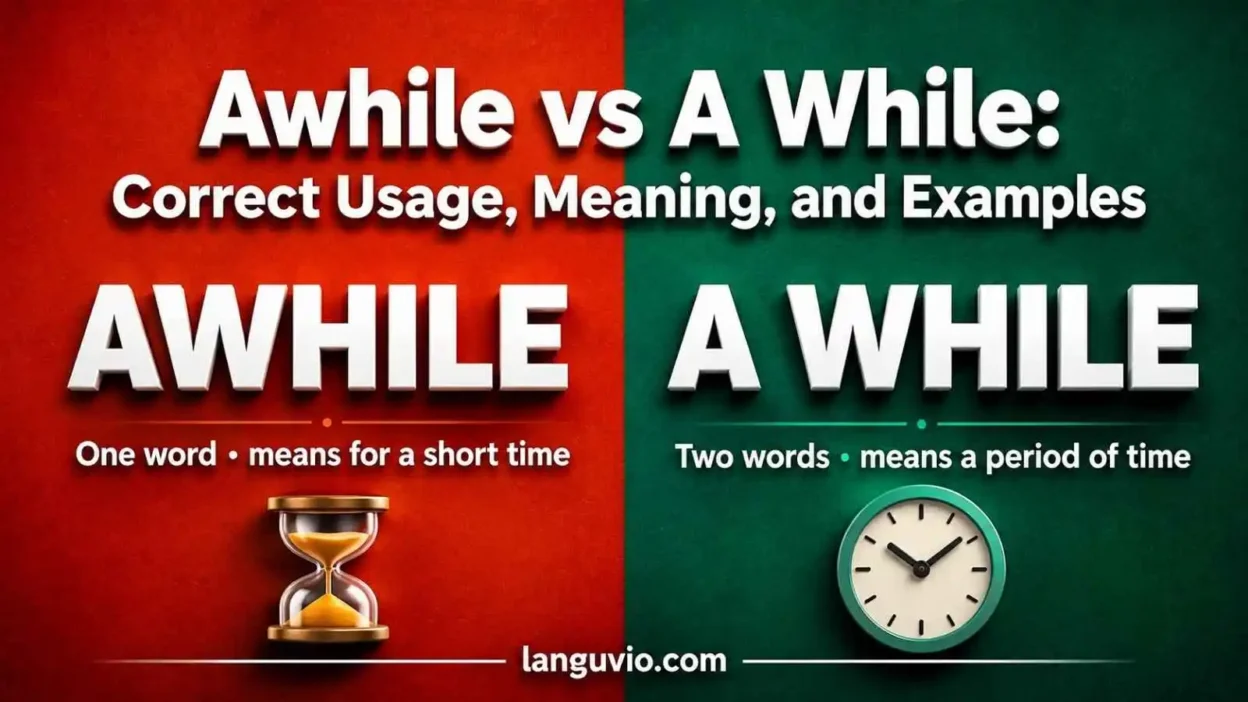
The difference between awhile vs a while is small in spelling but important in grammar. Both forms refer to time, and both sound the same in speech. The space changes how the expression works in a sentence.
Use awhile when you mean “for a while” and the word modifies an action. Use a while when you mean “a period of time,” especially after a preposition such as for, in, or after.
Quick Answer
Both awhile and a while are correct, but they are not used the same way. Awhile is an adverb meaning “for a while.” A while is a noun phrase meaning “a period of time.” Write wait awhile, but write for a while, in a while, and a while ago.
Why People Confuse Them
People confuse awhile and a while because they sound alike. In normal speech, you cannot hear the space between a and while.
Their meanings also overlap. Both point to an amount of time, usually an unspecified or short-to-moderate period.
The real difference is grammar. Awhile already includes the idea of for. That is why for awhile sounds redundant in careful writing. A while works as a noun phrase, so it can follow a preposition.
Key Differences At A Glance
| Context | Best Choice | Why |
| After a verb meaning “for some time” | awhile | It works as an adverb. |
| After for | a while | A preposition needs a noun phrase. |
| After in | a while | It refers to a future period of time. |
| After after | a while | It names a period of time. |
| Before ago or back | a while | It works as a noun phrase. |
| In “it’s been ___” | a while | It names the time that has passed. |
Meaning and Usage Difference
Awhile means “for a while” or “for a short time.” It usually follows a verb and tells how long the action continues.
Correct: “Stay awhile and talk.”
In that sentence, awhile modifies stay. You could also say, “Stay for a while and talk.”
A while means “a period of time.” It is the article a plus the noun while. Because it is a noun phrase, it works well after prepositions.
Correct: “Stay for a while and talk.”
The pronunciation is nearly the same: uh-WILE. So, this is mostly a writing choice, not a speaking problem.
Here is the compact comparison:
| Feature | awhile | a while |
| Grammar role | Adverb | Noun phrase |
| Basic meaning | For a while | A period of time |
| Common position | After a verb | After a preposition |
| Safe example | “Rest awhile.” | “Rest for a while.” |
Tone, Context, and Formality
Both forms are standard in American English. However, a while is useful in more sentence patterns because it can follow prepositions and appear in common time phrases.
Awhile can sound a little more polished or literary in some sentences, such as “Sit awhile” or “Rest awhile.” Still, it is not too formal for everyday writing.
In business, school, and edited writing, the safest rule is simple: use a while after a preposition. Use awhile only when it directly modifies a verb.
Which One Should You Use?
Use awhile when you can replace it with for a while without creating a double for.
Correct: “We waited awhile before ordering.”
This works because it means, “We waited for a while before ordering.”
Use a while after for, in, after, and similar prepositions.
Correct: “We waited for a while before ordering.”
Also use a while in common phrases about past time.
Correct: I saw her a while ago.
We talked a while back.
It’s been a while since our last meeting.
When One Choice Sounds Wrong
For awhile is the most common mistake. Since awhile already means “for a while,” the phrase repeats the idea of for.
Wrong: “I stayed for awhile.”
Better: “I stayed for a while.”
Better: “I stayed awhile.”
Awhile ago also sounds wrong in careful writing because ago needs a time phrase before it.
Wrong: “She moved awhile ago.”
Better: “She moved a while ago.”
The same pattern applies to a while back.
Wrong: “We met awhile back.”
Better: “We met a while back.”
Common Mistakes (and Quick Fixes)
Wrong: “I’ll call you in awhile.”
Correct: “I’ll call you in a while.”
Wrong: “The update may take awhile.”
Better in careful writing: “The update may take a while.”
Wrong: “It’s been awhile since we talked.”
Better: “It’s been a while since we talked.”
Wrong: “Let’s wait for awhile.”
Correct: “Let’s wait for a while.”
Also correct: “Let’s wait awhile.”
The quick fix is to check the word before it. If you see a preposition, choose a while.
Everyday Examples
“I’m going to sit awhile before I drive home.”
“Can you stay a while after the meeting?”
“The repair took a while, but the car runs well now.”
“Let the soup cool awhile before serving it.”
“I haven’t seen that movie in a while.”
“We talked for a while after class.”
“Pause awhile and think before you reply.”
“She joined the company a while ago.”
“The kids played outside awhile, then came in for lunch.”
“I’ll be ready in a while.”
Dictionary-Style Word Details
Verb
awhile: Not used as a verb in standard American English. It is an adverb.
a while: Not used as a verb phrase. In this comparison, it is a noun phrase, not an action word.
Noun
awhile: Not a noun. It works as an adverb meaning “for a while.”
a while: A noun phrase. It means “a period of time.”
Example: “It took a while to finish the form.”
Synonyms
awhile: Closest plain alternatives include briefly, for a bit, for some time, and for a short time.
a while: Closest plain alternatives include a short time, some time, a period of time, and a bit of time.
Clear antonyms do not fit neatly because both expressions refer to an unspecified time period, not a fixed amount.
Example Sentences
awhile: “The team rested awhile after practice.”
awhile: “Stay awhile if you want coffee.”
a while: “The team rested for a while after practice.”
a while: “It has been a while since I checked that file.”
Word History
awhile: This one-word form developed from the idea of “for a while.” In modern use, it works as an adverb.
a while: This two-word form uses while as a noun meaning a period of time. The exact older development is best left to dictionaries, but the modern distinction is clear enough for everyday writing.
Phrases Containing
awhile: stay awhile, wait awhile, rest awhile, linger awhile, pause awhile.
a while: for a while, in a while, after a while, once in a while, a while ago, a while back.
FAQs
Is “awhile” one word or two words?
Awhile is one word when it works as an adverb meaning “for a while.” For example, “Please stay awhile” means “Please stay for a while.” Use the one-word form only when it describes how long an action continues.
Is “a while” correct?
Yes. A while is correct when you mean “a period of time.” It is the safer choice after prepositions such as for, in, and after. For example, write “for a while,” “in a while,” and “after a while.”
Is it “for awhile” or “for a while”?
Use for a while. The word awhile already includes the meaning of “for a while,” so for awhile repeats the idea of for. Correct: “We waited for a while.” Also correct: “We waited awhile.”
Is it “in awhile” or “in a while”?
Use in a while. The word in is a preposition, so it should be followed by the noun phrase a while. Correct: “I’ll call you in a while.” Avoid “I’ll call you in awhile” in careful writing.
Is it “a while ago” or “awhile ago”?
Use a while ago. The phrase ago needs a time expression before it, and a while works as that time expression. Correct: “She moved a while ago.” Avoid “She moved awhile ago.”
Is “it’s been a while” correct?
Yes. It’s been a while is the standard choice because a while names the period of time that has passed. Example: “It’s been a while since we talked.”
What is the easiest way to remember the difference?
Use awhile when you can replace it with for a while. Use a while after words like for, in, after, and ago.
Conclusion
The safest way to choose between awhile and a while is to look at the sentence structure. Use awhile when it means “for a while” and modifies a verb: “Wait awhile.” Use a while when you need a noun phrase: “for a while,” “in a while,” “a while ago,” and “it’s been a while.”
When in doubt, choose a while after a preposition.
Awhile is one word when it works as an adverb meaning “for a while.” For example, “Please stay awhile” means “Please stay for a while.” Use the one-word form only when it describes how long an action continues.
Yes. A while is correct when you mean “a period of time.” It is the safer choice after prepositions such as for, in, and after. For example, write “for a while,” “in a while,” and “after a while.”
Use for a while. The word awhile already includes the meaning of “for a while,” so for awhile repeats the idea of for. Correct: “We waited for a while.” Also correct: “We waited awhile.”
Use in a while. The word in is a preposition, so it should be followed by the noun phrase a while. Correct: “I’ll call you in a while.” Avoid “I’ll call you in awhile” in careful writing.
Use a while ago. The phrase ago needs a time expression before it, and a while works as that time expression. Correct: “She moved a while ago.” Avoid “She moved awhile ago.”
Yes. It’s been a while is the standard choice because a while names the period of time that has passed. Example: “It’s been a while since we talked.”
Use awhile when you can replace it with for a while. Use a while after words like for, in, after, and ago.