That vs which can confuse even strong writers because both words can introduce information about a noun. The real choice depends on whether the information is essential to the sentence or just extra detail.
In everyday US English, the safest rule is simple: use that for information the sentence needs, and use which with commas for extra information. However, the full picture has one important nuance: which can sometimes introduce essential information too, especially in less strict writing.
Quick Answer
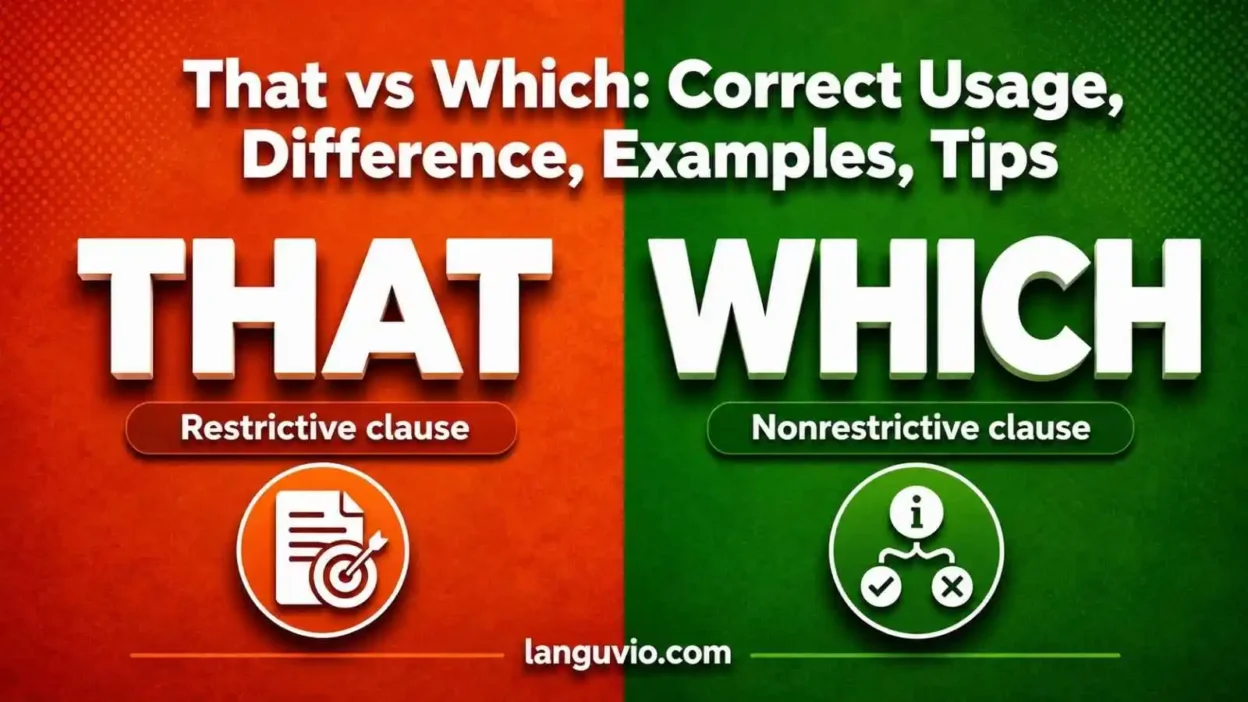
Use that for an essential clause that identifies exactly which person, place, thing, or idea you mean. Use which for a nonessential clause that adds extra information and usually needs commas. In polished US writing, that is the clearer choice for essential information, while which is the standard choice for extra information.
Why People Confuse Them
People confuse that and which because both can point back to a noun.
For example, both of these sentences sound natural to many readers:
The laptop that I bought yesterday is already on sale.
The laptop which I bought yesterday is already on sale.
The first sentence sounds more standard in edited US English. The second sentence can still work in some contexts, but many editors prefer that because the clause identifies which laptop.
The confusion gets worse because which often appears after a comma:
My laptop, which I bought yesterday, is already on sale.
Here, the meaning changes. The speaker is no longer identifying one laptop from several laptops. The speaker is adding extra detail about the laptop.
Key Differences At A Glance
| Context | Best Choice | Why |
| Essential information | that | It identifies exactly which noun you mean. |
| Extra information | which | It adds detail that the sentence can lose without losing its main meaning. |
| Clause set off by commas | which | Commas usually mark nonessential information. |
| No commas in a polished US sentence | that | This is the cleaner editorial choice for essential clauses. |
| Formal business or academic writing | that for essential, which for extra | This keeps meaning and punctuation clear. |
| Casual speech | either may appear in essential clauses | Spoken English is often less strict than edited writing. |
Meaning and Usage Difference
That often introduces a restrictive clause. A restrictive clause limits the noun and tells the reader exactly which one you mean.
Example:
The report that includes the budget numbers is on my desk.
This means there may be more than one report. The clause that includes the budget numbers tells us which report.
Which usually introduces a nonrestrictive clause. A nonrestrictive clause adds extra information about a noun that is already clear.
Example:
The report, which includes the budget numbers, is on my desk.
This sentence suggests the report is already identified. The clause adds more information, but the main sentence still works without it:
The report is on my desk.
Here is the important nuance: which can also appear in essential clauses.
Example:
The report which includes the budget numbers is on my desk.
Some readers accept this. Still, in modern US editing, that is usually clearer and less distracting for essential clauses. Therefore, choose that when the clause is needed, unless your style guide allows restrictive which.
Tone, Context, and Formality
In formal US writing, that usually sounds sharper when the clause is essential. It helps the reader know that the information cannot be removed.
Example:
The policy that changed last month affects new hires.
This sentence points to one policy: the policy that changed last month.
Which sounds more natural when the writer adds a side note.
Example:
The policy, which changed last month, affects new hires.
This version treats “changed last month” as extra information. It also uses commas because the clause works like a side note.
In casual speech, people often use which and that loosely. However, published writing needs more control. The difference can affect meaning, especially in legal, school, workplace, and instruction-based writing.
Which One Should You Use?
Use this quick test: remove the clause.
If the sentence loses needed meaning, use that.
Example:
The files that contain client data need a password.
Remove the clause:
The files need a password.
Now the meaning is too broad. Which files? Because the clause identifies the files, that is the better choice.
If the sentence still means the same basic thing, use which with commas.
Example:
The files, which contain client data, need a password.
Remove the clause:
The files need a password.
The main point still works. The clause only adds extra detail, so which fits.
When One Choice Sounds Wrong
That sounds wrong when it follows a comma and introduces a side note.
Wrong:
My car, that needs new tires, is in the driveway.
Better:
My car, which needs new tires, is in the driveway.
The comma tells the reader that the clause is extra. Because that does not normally introduce this kind of extra clause in standard modern English, which is the natural choice.
Which can sound wrong or at least less clean when it introduces essential information in formal US writing.
Less clean:
The email which has the contract is from Dana.
Cleaner:
The email that has the contract is from Dana.
The second version sounds more direct because the clause identifies which email.
Common Mistakes (and Quick Fixes)
Mistake 1: Using which with no comma for extra information.
Incorrect: The office which closes at 6 p.m. is on Main Street.
Correct: The office, which closes at 6 p.m., is on Main Street.
However, this correction works only if there is one clear office. If you mean one office among several, use that:
The office that closes at 6 p.m. is on Main Street.
Mistake 2: Using that after commas.
Incorrect: The app, that we updated yesterday, runs faster now.
Correct: The app, which we updated yesterday, runs faster now.
Mistake 3: Treating every which as wrong.
Incorrect advice: Never use which for essential information.
Better advice: In polished US writing, prefer that for essential information, but know that restrictive which exists.
Mistake 4: Ignoring meaning.
Weak: The chairs, which are broken, should be removed.
Clearer if only some chairs are broken: The chairs that are broken should be removed.
The comma version suggests all the chairs are broken. The that version says only the broken chairs should go.
Everyday Examples
Use that when the clause identifies the noun:
The shoes that I ordered online finally arrived.
The route that avoids downtown is faster today.
The restaurant that opened near campus serves breakfast all day.
The password that you created last week has expired.
The episode that everyone talked about aired last night.
Use which when the clause adds extra detail:
My shoes, which I ordered online, finally arrived.
The new route, which avoids downtown, is faster today.
That restaurant, which opened near campus, serves breakfast all day.
Your password, which you created last week, has expired.
The finale, which aired last night, surprised everyone.
Small comparison:
| Feature | that | which |
| Main job in this comparison | Identifies necessary information | Adds extra information |
| Common punctuation | No commas | Usually commas |
| Strongest use in US editing | Essential clauses | Nonessential clauses |
| Typical reader signal | “This tells me which one” | “This is a side note” |
Dictionary-Style Word Details
Verb
• that: Not commonly used as a verb in standard US English. In this comparison, that works mainly as a relative pronoun introducing an essential clause.
• which: Not commonly used as a verb in standard US English. In this comparison, which works mainly as a relative pronoun introducing a clause about a thing, animal, group, or idea.
Noun
• that: Not commonly used as a noun in standard US English. It can work as a pronoun, as in “That is the problem,” but that is not the same as being a noun.
• which: Not commonly used as a noun in standard US English. It can work as a pronoun, as in “Which do you prefer?” but it is not usually a noun.
Synonyms
• that: In essential clauses, the closest plain alternative can sometimes be which, but many US editors prefer that for clarity. In other uses, that may mean “the one,” “the thing,” or “the idea,” depending on the sentence.
• which: In nonessential clauses, there is no exact one-word substitute that works in every sentence. Closest plain alternatives may include “and it,” “and this,” or “the one that,” depending on the structure.
Clear antonyms do not fit this comparison well because that and which are function words, not simple opposites.
Example Sentences
• that: The jacket that has the torn sleeve belongs to Marcus.
• that: The class that finishes first can leave early.
• that: Please upload the file that shows the final totals.
• which: The jacket, which has a torn sleeve, belongs to Marcus.
• which: Algebra II, which finishes at 11 a.m., meets in Room 204.
• which: The final file, which shows the totals, is ready to upload.
Word History
• that: That comes from Old English and has long worked as a demonstrative word and a clause-introducing word. Its modern uses include pronoun, adjective-like determiner, conjunction, and adverb roles.
• which: Which also comes from Old English and has long been used to ask about selection and to introduce relative clauses. Its modern uses include pronoun, adjective-like determiner, and relative-clause roles.
The history is useful, but it should not distract from the modern choice. For today’s US writing, the clause type matters more than the origin.
Phrases Containing
• that: that is, that said, all that, at that, for that matter, now that, so that, that depends, that’s it.
• which: which is which, in which case, every which way, which is to say, the degree to which, know which way the wind is blowing.
These phrases do not all follow the same that vs which rule because many of them use the words in fixed expressions. Still, they show how common both words are in everyday English.
FAQs
Is it better to use that or which?
Use that when the clause gives essential information. Use which when the clause adds extra information that the sentence does not need. In polished US writing, this rule keeps your meaning clear and helps readers understand whether the detail identifies the noun or simply adds a side note.
Do I need a comma before which?
Usually, yes. When which introduces extra information, place a comma before it and another comma after the clause if the sentence continues. Example: “The laptop, which I bought last week, is already slow.” The commas show that the detail is extra.
Can which be used without a comma?
Yes, which can appear without a comma in some essential clauses. However, many US editors prefer that in that structure. For example, “The file that contains the invoice is missing” sounds cleaner than “The file which contains the invoice is missing.”
Is that always correct for essential clauses?
In most US writing, that is the best choice for essential clauses about things, groups, ideas, or animals. Example: “The book that you recommended is sold out.” The clause tells readers which book you mean, so that fits naturally.
Is which only for extra information?
In strict edited style, which is usually used for extra information with commas. In real usage, though, some writers use which for essential information too. To avoid confusion, choose that for needed details and which for added details.
What is the easiest way to remember that vs which?
Remove the clause from the sentence. If the sentence loses important meaning, use that. If the sentence still makes sense and the clause only adds detail, use which with commas. This quick test works well for school, work, and everyday writing.
Conclusion
The best US writing rule is simple: use that for essential information and which for extra information set off by commas. This rule keeps sentences clear and helps readers know whether the clause identifies the noun or simply adds detail.
Still, do not overstate the rule. Which can appear in essential clauses, but that is usually the cleaner choice in polished US English. When you are unsure, remove the clause. If the sentence needs it, choose that. If it only adds a side note, choose which with commas.
Use that when the clause gives essential information. Use which when the clause adds extra information that the sentence does not need. In polished US writing, this rule keeps your meaning clear and helps readers understand whether the detail identifies the noun or simply adds a side note.
Usually, yes. When which introduces extra information, place a comma before it and another comma after the clause if the sentence continues. Example: “The laptop, which I bought last week, is already slow.” The commas show that the detail is extra.
Yes, which can appear without a comma in some essential clauses. However, many US editors prefer that in that structure. For example, “The file that contains the invoice is missing” sounds cleaner than “The file which contains the invoice is missing.”
In most US writing, that is the best choice for essential clauses about things, groups, ideas, or animals. Example: “The book that you recommended is sold out.” The clause tells readers which book you mean, so that fits naturally.
In strict edited style, which is usually used for extra information with commas. In real usage, though, some writers use which for essential information too. To avoid confusion, choose that for needed details and which for added details.
Remove the clause from the sentence. If the sentence loses important meaning, use that. If the sentence still makes sense and the clause only adds detail, use which with commas. This quick test works well for school, work, and everyday writing.