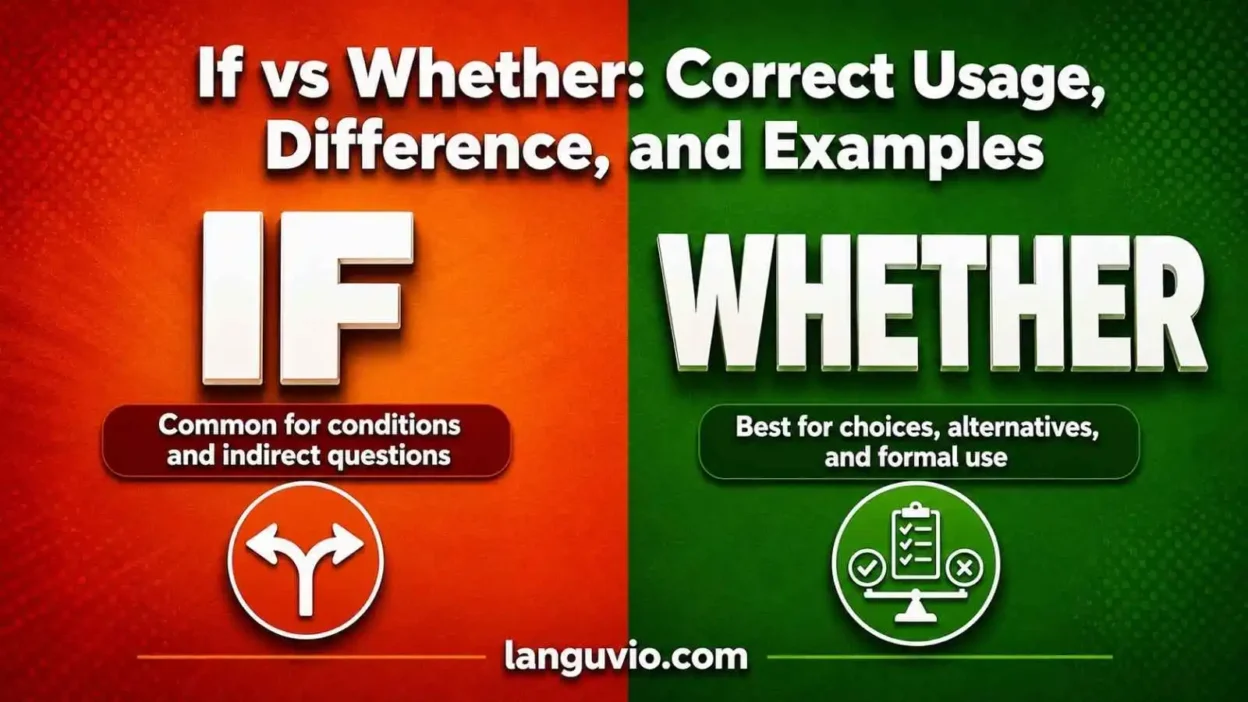
If vs whether can confuse even strong writers because both words can introduce uncertainty. You can say, “I don’t know if she called” or “I don’t know whether she called,” and both sound normal.
However, they are not always equal. If works best when you mean “on the condition that.” Whether works best when you mean “which choice is true” or “one option or another.” Once you see that difference, the choice becomes much easier.
Quick Answer
Use if for a condition: “Call me if you need help.” Use whether for a choice, an alternative, or a formal indirect question: “I’m deciding whether to apply.” In casual speech, both can work in some yes-or-no questions, but whether is usually clearer when two possibilities are involved.
Why People Confuse Them
People confuse if and whether because both can introduce a yes-or-no idea.
For example, these two sentences mean almost the same thing:
“I asked if the store was open.”
“I asked whether the store was open.”
In both cases, the speaker wants to know the answer: yes, it was open, or no, it was not. Because of this overlap, many people use if in everyday speech even where whether would sound more precise.
Still, the words do different jobs in many sentences. If often creates a condition. Whether often presents alternatives. That difference matters most when the sentence could mean two different things.
Key Differences At A Glance
| Context | Best Choice | Why |
| A condition | if | It means something will happen only under that condition. |
| A choice between options | whether | It points to one option or another. |
| Before “to” + verb | whether | “Whether to go” is standard; “if to go” sounds wrong. |
| With “or not” directly after the word | whether | “Whether or not” is standard. |
| Casual indirect yes-no question | if or whether | Both can work when no meaning changes. |
| Formal writing | whether | It often sounds clearer and more polished. |
Here is the safest rule: use if when you mean on the condition that. Use whether when you mean which option is true.
Meaning and Usage Difference
If introduces a condition. The result depends on that condition.
Example: “We’ll leave early if traffic gets worse.”
This means the early departure depends on traffic. If traffic does not get worse, they may not leave early.
Whether introduces uncertainty between possibilities.
Example: “We’re deciding whether to leave early.”
This means the choice is open. The people may leave early, or they may not.
Both words can introduce indirect yes-no questions:
“I wonder if the package arrived.”
“I wonder whether the package arrived.”
Those sentences are both natural. However, whether becomes the better choice when the sentence includes a clear choice:
“She asked whether we should drive or fly.”
In that sentence, whether clearly points to two options: drive or fly.
| Feature | if | whether |
| Main use | Condition | Choice or uncertainty |
| Common tone | Casual and direct | Clearer and more formal |
| Works before “to” | No | Yes |
| Works in “whether or not” | No | Yes |
| Best in conditional sentences | Yes | No |
Tone, Context, and Formality
If sounds natural in everyday speech, texts, and simple instructions. It is short, common, and direct.
“Text me if you get there early.”
“Let me know if you need the file.”
Whether sounds a little more formal, especially in business, school, legal, and academic writing. It also sounds more exact when the writer wants to show a choice.
“Please confirm whether you received the contract.”
“The team will decide whether to extend the deadline.”
That does not mean whether is stiff or old-fashioned. It is normal English. It simply gives the sentence a more careful sound.
In US English, a good style habit is to use whether when clarity matters and if when you truly mean a condition.
Which One Should You Use?
Choose if when one action depends on another action.
“Bring a jacket if it gets cold.”
“I’ll join the call if my meeting ends early.”
Choose whether when someone is choosing, checking, deciding, discussing, or wondering about options.
“She is deciding whether to accept the offer.”
“We need to know whether the office is closed.”
Use whether after verbs like decide, discuss, consider, determine, and debate when a choice is involved.
Natural: “We discussed whether to cancel the trip.”
Awkward: “We discussed if to cancel the trip.”
Also, use whether before an infinitive:
Correct: “I don’t know whether to reply.”
Incorrect: “I don’t know if to reply.”
When One Choice Sounds Wrong
Sometimes if sounds wrong because the sentence does not describe a condition.
Awkward: “She is deciding if to move.”
Better: “She is deciding whether to move.”
The phrase if to is not standard in normal US English. Use whether to instead.
Also, if or not sounds wrong when or not comes right after the word.
Awkward: “If or not we win, we’ll celebrate.”
Better: “Whether or not we win, we’ll celebrate.”
However, if can work when or not comes later in some casual sentences:
“I don’t know if he’s coming or not.”
Still, in polished writing, whether is cleaner:
“I don’t know whether he’s coming.”
Common Mistakes (and Quick Fixes)
Mistake 1: Using whether for a simple condition.
Wrong: “Call me whether you need help.”
Correct: “Call me if you need help.”
The call depends on needing help, so if is the right word.
Mistake 2: Using if to before a verb.
Wrong: “I can’t decide if to email her.”
Correct: “I can’t decide whether to email her.”
Before to + verb, use whether.
Mistake 3: Using if when two clear options follow.
Less clear: “He asked if we wanted pizza or tacos.”
Clearer: “He asked whether we wanted pizza or tacos.”
The second version makes the choice clearer.
Mistake 4: Treating whether or not as always necessary.
Wordy: “I’m not sure whether or not she paid.”
Cleaner: “I’m not sure whether she paid.”
Use or not only when you need to stress both possibilities.
Everyday Examples
“Let me know if you want coffee.”
This means: tell me only in the case that you want coffee.
“Let me know whether you want coffee or tea.”
This means: tell me which option you want.
“I’ll go if my car starts.”
This means: my trip depends on the car starting.
“I’m not sure whether my car will start.”
This means: the result is uncertain.
“Ask if the gym is open.”
This sounds natural in casual speech.
“Ask whether the gym is open on July 4.”
This sounds a little more careful and specific.
“We need to decide whether to book the hotel today.”
This is correct because the sentence uses whether to before a verb.
Dictionary-Style Word Details
Verb
• if: Not commonly used as a verb in standard US English. It normally works as a conjunction, and it can appear as a noun in set phrases.
• whether: Not used as a verb in standard US English. It works as a conjunction.
Noun
• if: Can work as a noun in set expressions such as “no ifs, ands, or buts.” In that use, if means a condition, excuse, or uncertainty.
• whether: Not commonly used as a noun in standard US English. It introduces a question, choice, or alternative.
Synonyms
• if: Closest plain alternatives include provided that, assuming that, in case, and on the condition that. These do not fit every sentence, but they match the conditional meaning.
• whether: Closest plain alternatives include if, whether or not, which option, and one way or the other, depending on the sentence. Exact one-word replacements are limited because whether has a specific grammar job.
Clear antonyms do not fit either word well because both words connect ideas rather than name a thing with a direct opposite.
Example Sentences
• if: “We can reschedule if the weather gets bad.”
• if: “Please call me if you have any questions.”
• if: “If the printer jams again, restart it.”
• whether: “We need to decide whether to rent or buy.”
• whether: “She asked whether the report was ready.”
• whether: “Whether or not you agree, the policy starts Monday.”
Word History
• if: The word has a long history in English and has kept its core conditional job over time. For modern writers, the useful point is simple: it often means “on the condition that.”
• whether: The word also has a long history in English and has long been tied to alternatives and uncertainty. For modern writers, the practical point is that it helps present a choice or yes-no question clearly.
No special history detail is needed to choose between them in everyday writing.
Phrases Containing
• if: if so, if not, as if, even if, only if, what if, no ifs, ands, or buts.
• whether: whether or not, whether to, whether it is, whether we can, whether true or false, whether you like it or not.
These phrases show the difference clearly. If often sets up a condition. Whether often sets up alternatives or uncertainty.
FAQs
Is “if” or “whether” correct?
Both words can be correct, but they do not always mean the same thing. Use if when you mean “on the condition that.” For example, “Call me if you need help.” Use whether when the sentence involves a choice, uncertainty, or two possible answers. For example, “I don’t know whether she will come.”
What is the main difference between if and whether?
The main difference is that if usually introduces a condition, while whether usually introduces a choice or an indirect yes-or-no question. “I’ll go if it stops raining” means your action depends on the weather. “I’m deciding whether to go” means you are choosing between going and not going.
Can I use if instead of whether?
Sometimes, yes. In casual sentences like “I don’t know if he called,” if sounds natural. However, whether is better when the sentence is formal, includes clear alternatives, or uses “to” before a verb. Write “I don’t know whether to reply,” not “I don’t know if to reply.”
Is whether more formal than if?
Yes, whether often sounds more formal and precise than if. That is why it works well in business emails, school writing, reports, and careful explanations. Still, whether is not too formal for everyday use. It simply makes choices and uncertainty clearer.
Should I write “whether or not” or just “whether”?
Use whether by itself when the meaning is already clear. For example, “Tell me whether you agree” is enough. Use whether or not when you want to stress both possibilities. For example, “Whether or not you agree, the rule still applies.”
Is “if to” correct?
No, if to sounds wrong in standard US English. Use whether to before a verb. Correct examples include “whether to stay,” “whether to apply,” and “whether to call back.”
Conclusion
The difference between if vs whether is not hard once you focus on sentence meaning. Use if for a condition: “I’ll go if you go.” Use whether for a choice, alternative, or careful indirect question: “I’m deciding whether to go.”
In casual yes-or-no questions, both words can sometimes work. Even so, whether is usually the stronger choice when the sentence involves options, “or not,” or “to” + verb. When clarity matters, choose the word that matches the structure.
Both words can be correct, but they do not always mean the same thing. Use if when you mean “on the condition that.” For example, “Call me if you need help.” Use whether when the sentence involves a choice, uncertainty, or two possible answers. For example, “I don’t know whether she will come.”
The main difference is that if usually introduces a condition, while whether usually introduces a choice or an indirect yes-or-no question. “I’ll go if it stops raining” means your action depends on the weather. “I’m deciding whether to go” means you are choosing between going and not going.
Sometimes, yes. In casual sentences like “I don’t know if he called,” if sounds natural. However, whether is better when the sentence is formal, includes clear alternatives, or uses “to” before a verb. Write “I don’t know whether to reply,” not “I don’t know if to reply.”
Yes, whether often sounds more formal and precise than if. That is why it works well in business emails, school writing, reports, and careful explanations. Still, whether is not too formal for everyday use. It simply makes choices and uncertainty clearer.
Use whether by itself when the meaning is already clear. For example, “Tell me whether you agree” is enough. Use whether or not when you want to stress both possibilities. For example, “Whether or not you agree, the rule still applies.”
No, if to sounds wrong in standard US English. Use whether to before a verb. Correct examples include “whether to stay,” “whether to apply,” and “whether to call back.”