Tail vs tale is a common word-choice mix-up because the two words sound exactly alike. Their spelling changes the meaning completely.
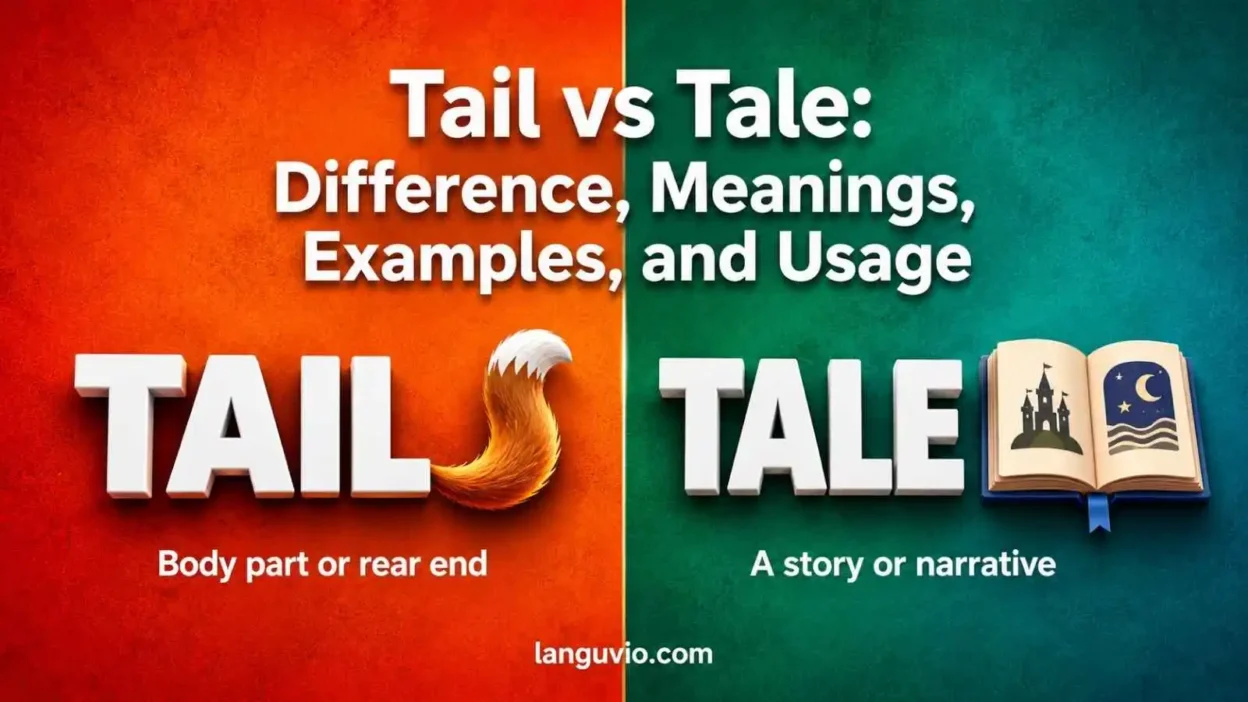
Use tail when you mean an animal’s body part, the rear or final part of something, the coin side called “tails,” or the act of following someone closely. Choose tale when you mean a story, account, legend, or sometimes an exaggerated report.
A simple memory trick helps: a dog has a tail, but a storyteller tells a tale.
Quick Answer
Tail usually means the rear part of an animal or object: “The dog wagged its tail.” It can also work as a verb meaning to follow closely: “The detective tailed the suspect.”
Tale means a story or account: “Grandma told us a tale about her childhood.”
These words are not interchangeable.
Why People Confuse Them
Many writers confuse tail and tale because they are homophones. In plain terms, they sound the same but have different spellings and meanings.
Both words are pronounced like tayl. Listening to the word aloud will not tell you which spelling is correct. Context decides the right choice.
That is why mistakes like “fairy tail” and “the cat’s tale” happen so easily. The sound matches, but the meaning does not.
Key Differences At A Glance
| Context | Best Choice | Why |
|---|---|---|
| Animal body part | tail | A tail is the rear appendage of an animal. |
| Story or narrative | tale | A tale is a story or account. |
| Last or rear part | tail | Tail can mean the back, end, or lower part. |
| Following someone secretly | tail | Tail can be a verb meaning to follow closely. |
| Coin toss | tail / tails | The coin side opposite heads is called tails. |
| Folk story or children’s story | tale | Use tale in phrases like fairy tale. |
Meaning and Usage Difference
Tail has several common uses. Most often, it names the body part at the back of an animal. Dogs, cats, horses, monkeys, and many other animals can have tails.
The word can also describe the rear or final part of something. For example, people say “the tail of the plane,” “the tail end of the line,” or “the tail end of the meeting.”
As a verb, tail means to follow and watch someone closely, often quietly or secretly. For example: “Police tailed the car for several blocks.”
Tale means a story, narrative, or account. It appears in phrases such as “fairy tale,” “folk tale,” “tall tale,” and “cautionary tale.” Depending on context, a tale may be fictional, traditional, exaggerated, or based on real events.
Pronunciation matters only because both words sound the same: tayl. Since sound will not help, meaning must guide the spelling.
Tone, Context, and Formality
Tail is a normal everyday word. It fits casual writing, school assignments, professional reports, and technical descriptions when the meaning is correct. You might use it in a pet care article, science lesson, police report, or project update.
Tale often sounds more story-like than “story.” In some sentences, it can feel literary, traditional, or slightly old-fashioned. “Tell me a story” sounds more casual than “tell me a tale.”
Still, tale is standard English. It works well when writing about folklore, fiction, legends, exaggeration, or lessons learned from events.
In formal writing, use tale with care. “A cautionary tale” is common and clear. “A tale of budget problems” may sound more dramatic than a plain report needs.
Which One Should You Use?
Choose tail when the sentence is about a body part, rear section, last part, coin side, or following someone.
Pick tale when the sentence is about a story, account, legend, report, or invented claim.
Use this compact check:
| Feature | tail | tale |
| Main meaning | rear part, animal appendage, follower action | story, narrative, account |
| Common grammar role | noun, verb, sometimes modifier | noun |
| Sound | tayl | tayl |
| Example phrase | tail end | fairy tale |
If you can replace the word with story, tale is probably right. When the idea points to something at the back or someone following, tail is usually correct.
When One Choice Sounds Wrong
Some mistakes are easy to spot once you check the meaning.
Wrong: The dog wagged its tale.
Correct: The dog wagged its tail.
Wrong: She told a funny tail about her first job.
Correct: She told a funny tale about her first job.
Wrong: We reached the tale end of the movie.
Correct: We reached the tail end of the movie.
Wrong: The detective tried to tale the suspect.
Correct: The detective tried to tail the suspect.
Common Mistakes (and Quick Fixes)
Write fairy tale, not “fairy tail,” unless you are literally talking about a fairy’s tail.
Use tall tale, not “tall tail.” A tall tale is an exaggerated story.
Choose dog tail when you mean the body part. However, dog tale could be correct if you mean a story about a dog.
Write tail end, not “tale end.” This phrase means the final or rear part of something.
For a coin toss, the phrase is heads or tails, not “heads or tales.”
Everyday Examples
The puppy chased its own tail around the living room.
I heard a strange tale about that old house on the corner.
A kite’s tail got caught in the tree.
My uncle loves telling a tale from his college days.
Police decided to tail the car after it left the parking lot.
We arrived at the tail end of the meeting.
That movie feels like a modern fairy tale.
The little girl tied a ribbon around the horse’s tail.
His excuse sounded more like a tall tale than the truth.
At the end of the parade, we could barely see the tail of the line.
Dictionary-Style Word Details
Verb
• tail: Commonly used as a verb meaning to follow closely or secretly.
Example: The investigator tailed the suspect after the interview.
• tale: Not commonly used as a verb in standard English. Use tell when you mean to speak or share a story.
Correct: Tell me a story.
Incorrect: Tale me a story.
Noun
• tail: A noun meaning the rear appendage of an animal, the back or final part of something, a person following someone, or the reverse side of a coin in “tails.”
Example: The dog’s tail knocked over the cup.
• tale: A noun meaning a story, account, narrative, or sometimes an untrue or exaggerated report.
Example: The book retells an old folk tale.
Synonyms
• tail: Closest plain alternatives depend on the meaning. For an animal, rear appendage or back end may work in limited contexts. For the verb, use follow, track, or shadow.
• tale: Good alternatives include story, narrative, account, legend, fable, or anecdote, depending on context. When the meaning is an untrue story, possible alternatives include lie, fib, or fabrication.
Clear antonyms are limited. For tail, head or front can work only when you mean the opposite end. For tale, truth or fact fits only when tale means a false or doubtful report.
Example Sentences
Tail examples:
• The cat curled its tail around its paws.
• Before takeoff, the crew checked the plane’s tail.
• Through downtown, a security team tailed the suspect.
Tale examples:
• During class, the teacher read a folk tale.
• His story sounded more like a tall tale than the truth.
• In the documentary, viewers hear the tale of a small town after the storm.
Word History
• tail: This word has long been used for the rear part of an animal or object. In modern English, that physical idea also supports phrases like “tail end” and the verb meaning “follow behind.”
• tale: This word has long been used for a story, account, or report. For today’s word choice, the practical point is simple: tale belongs with stories and accounts.
No special origin claim is needed to choose correctly. Modern meaning gives you the answer.
Phrases Containing
• tail: tail end, on someone’s tail, heads or tails, tail wagging the dog, with your tail between your legs, tail light.
• tale: fairy tale, tall tale, folk tale, cautionary tale, old wives’ tale, tale of woe.
These phrases are fixed enough that changing the spelling usually creates an error.
FAQs
Use tail when you mean an animal’s body part, the back part of something, the end of something, or the act of following someone. Use tale when you mean a story, account, legend, or exaggerated report.
Fairy tale is correct when you mean a magical or traditional story. “Fairy tail” would only be correct if you literally meant the tail of a fairy, which is rarely the intended meaning.
Use dog tail when you mean the body part on a dog. Use dog tale only when you mean a story about a dog.
Yes. Tail and tale are pronounced the same way: “tayl.” Because they sound alike, you must choose the spelling based on the meaning of the sentence.
Remember this simple clue: a dog has a tail, and a storyteller tells a tale. If the sentence is about a back part or animal body part, use tail. If it is about a story, use tale.
Conclusion
The difference between tail and tale is simple once you focus on meaning. Tail belongs with animals, rear parts, final sections, coin tosses, and following someone. Tale belongs with stories, accounts, legends, and exaggerated reports. Since the two words sound the same, pronunciation will not solve the choice. Read the sentence, ask whether you mean a back part or a story, and the correct spelling will usually be clear.