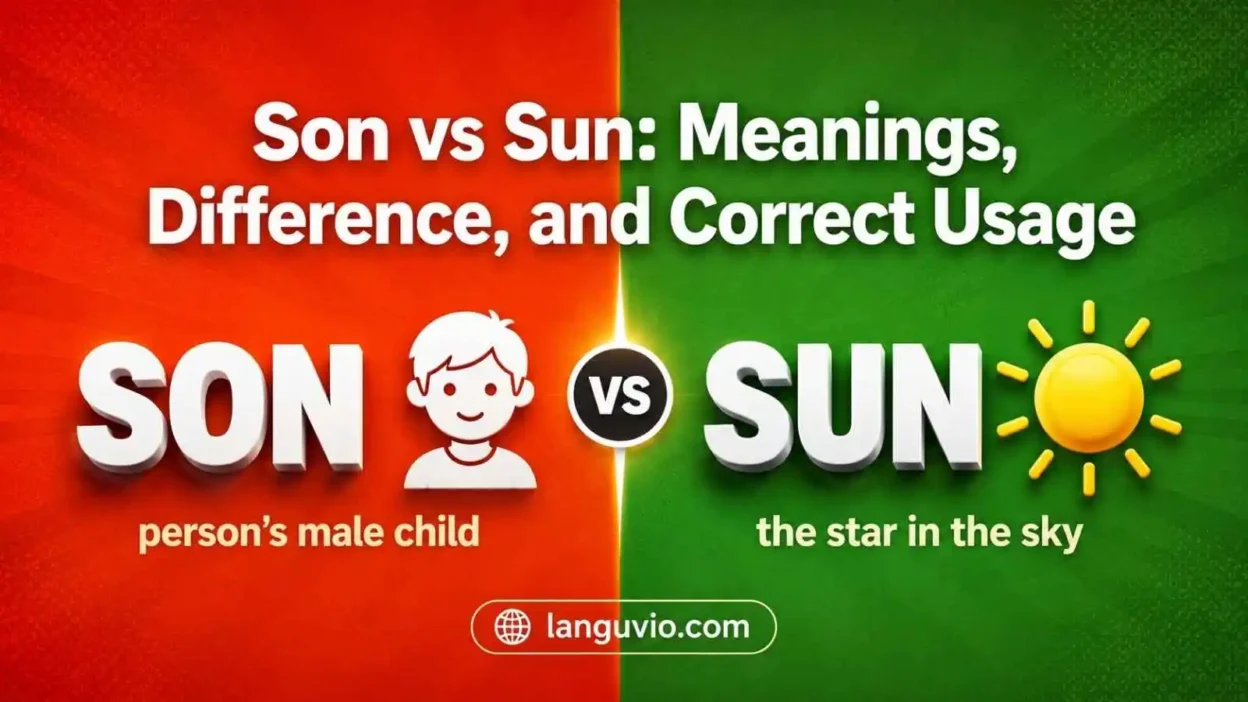
Son vs sun is a common mix-up because the two words sound exactly the same. In writing, though, they mean completely different things.
Use son when you mean a male child or male descendant. Use sun when you mean the star that gives Earth light and heat, sunlight itself, or the act of exposing something to sunlight.
The difference is not about formal grammar style. It is about meaning. One word belongs to family and people. The other belongs to nature, light, heat, and space.
Quick Answer
Son means a male child in relation to a parent.
Example: Her son starts kindergarten this fall.
Sun means the star that shines in the daytime sky. It can also mean the light or heat from that star.
Example: The sun came out after the storm.
The easiest rule is this: if you are talking about family, use son. If you are talking about light, heat, weather, or the star in the sky, use sun.
Why People Confuse Them
People confuse son and sun because they are homophones. That means they have the same pronunciation but different spellings and meanings.
Both words are pronounced like “suhn.” You cannot hear the difference in normal speech. The sentence around the word tells you which spelling is correct.
That is why the mistake usually appears in writing, not speaking. A sentence like “My sun is twelve” sounds normal when spoken, but it is wrong on the page. The correct word is son because the sentence is about a child.
Key Differences At A Glance
| Context | Best Choice | Why |
| A male child | son | It refers to a boy or man in relation to a parent. |
| A male descendant | son | It can describe a family line or origin. |
| The star in the sky | sun | It refers to the star that gives Earth light and heat. |
| Light or warmth outdoors | sun | It refers to sunlight or solar warmth. |
| Getting sunlight | sun | It can work as a verb meaning to expose to sunlight. |
| Religious title in Christian writing | Son | It may be capitalized in phrases like “the Son of God.” |
Meaning and Usage Difference
Son is mainly a noun. It names a male child, usually in relation to a parent.
Examples:
My son loves baseball.
Their youngest son just moved to Denver.
He is the son of two teachers.
Son can also be used in a wider way. A phrase like “a son of Texas” means a man who comes from, belongs to, or is strongly connected to Texas. This use is more literary or formal than everyday family use.
Sun is usually a noun too. It names the star that gives Earth daylight and warmth.
Examples:
The sun rose behind the trees.
Too much sun can burn your skin.
The room gets morning sun.
Sun can also be a verb. To sun yourself means to sit or lie in the sun. This use is standard, but it is less common than the noun.
Example:
The dog sunned itself on the porch.
Tone, Context, and Formality
Son is neutral in everyday English. It works in casual, formal, legal, family, and news contexts.
Examples:
Casual: My son is at soccer practice.
Formal: The property passed to his son.
Personal: She raised her son on her own.
Sun is also neutral. It appears in everyday speech, weather reports, health advice, gardening, science writing, and travel writing.
Examples:
Everyday: The sun feels great today.
Weather: The sun should return by afternoon.
Health: Wear sunscreen if you will be in the sun.
Science: The Sun is the center of our solar system.
In ordinary writing, sun is usually lowercase. It may be capitalized as Sun in scientific or astronomical contexts when treated as the name of Earth’s star. Son is usually lowercase unless it starts a sentence or appears in a title or religious phrase.
Which One Should You Use?
Use son when the sentence is about a child, parent, family, male descendant, or someone described as connected to a place or group.
Correct:
Their son is learning to drive.
He is the proud son of a small farming town.
Use sun when the sentence is about daylight, warmth, weather, the sky, space, or sunlight.
Correct:
The sun was bright, so we wore sunglasses.
The plants need more sun.
Use sun as a verb when someone or something is resting in sunlight.
Correct:
The cat likes to sun itself by the window.
When One Choice Sounds Wrong
Son sounds wrong when the sentence is about weather, daylight, heat, or the sky.
Wrong: The son is shining.
Correct: The sun is shining.
Sun sounds wrong when the sentence is about a child or family member.
Wrong: She picked up her sun from school.
Correct: She picked up her son from school.
The mistake can make the sentence funny or confusing because the reader sees a completely different meaning.
Common Mistakes (and Quick Fixes)
Mistake: My sun is six years old.
Fix: My son is six years old.
Why: A six-year-old child is a son, not the sun.
Mistake: The son set behind the mountains.
Fix: The sun set behind the mountains.
Why: The star in the sky is the sun.
Mistake: We sat in the son all afternoon.
Fix: We sat in the sun all afternoon.
Why: The sentence means sunlight or warmth.
Mistake: His oldest sun works in Chicago.
Fix: His oldest son works in Chicago.
Why: The sentence refers to a male child.
A quick check helps: ask, “Am I talking about family or sunlight?” Family takes son. Light, heat, or sky takes sun.
Everyday Examples
Here is a compact comparison:
• Son: a boy or man in relation to a parent
• Sun: the star in the sky, sunlight, or exposure to sunlight
• Son: usually only a noun in this comparison
• Sun: usually a noun, but also a verb
• Son: family context
• Sun: nature, weather, space, and outdoor context
• Son: “Their son called after dinner.”
• Sun: “The sun came out after dinner.”
More examples:
Their son wants to study engineering.
The sun was too bright for the photo.
My neighbor’s son mows lawns on weekends.
Keep the tomatoes in full sun.
She has one son and two daughters.
The afternoon sun warmed the kitchen.
The baby is their first son.
The dog sunned itself on the deck.
Dictionary-Style Word Details
Verb
Son: Not commonly used as a verb in standard US English. In this comparison, treat son as a noun.
Sun: Sun can be used as a verb. It means to expose someone or something to sunlight, or to sit or lie in sunlight.
Example: The turtle sunned itself on a rock.
Noun
Son: A male child in relation to a parent. It can also mean a male descendant or a man strongly connected with a place, group, or tradition.
Example: He is their only son.
Sun: The star that gives Earth light and heat. It can also mean the light or heat from that star.
Example: The sun disappeared behind the clouds.
Synonyms
Son: Exact synonyms are limited because son names a specific family relationship. Closest plain alternatives include male child, boy, child, and male descendant. These are not always exact replacements.
Sun: For the light or warmth meaning, closest plain alternatives include sunlight and sunshine. For the star itself, star can fit in some contexts, but it is broader than sun.
Antonyms: Son has daughter as a direct contrast in family context. Sun does not have one exact everyday antonym. Shade, darkness, or night may contrast with sunlight in some sentences, but they are not exact opposites of the word sun in every use.
Example Sentences
Son:
My son forgot his lunch at home.
Their son is applying to colleges this year.
He is a son of New Orleans and still loves the city.
Sun:
The sun rose at 6:12 this morning.
We moved the chairs out of the sun.
The cat sunned itself on the windowsill.
Word History
Son: The word comes from older English forms connected with the idea of a male child or male descendant. Its core family meaning has stayed stable over time.
Sun: The word also comes from older English forms. Its main meaning has long referred to the star that gives daylight and warmth.
The two words sound alike today, but they do not share the same meaning. Their similarity in sound is the reason for the spelling mistake, not a sign that they can be used the same way.
Phrases Containing
Son:
son-in-law
favorite son
prodigal son
son of God
like father, like son
Sun:
in the sun
under the sun
sun hat
sun-dried
sun-kissed
place in the sun
make hay while the sun shines
These phrases show the difference clearly. Son phrases usually point to family, identity, or tradition. Sun phrases usually point to light, warmth, weather, exposure, or opportunity.
FAQs
Son means a male child in relation to a parent. Sun means the star that gives Earth light and heat.
Example:
Her son loves swimming.
The sun is very bright today.
Yes. Son and sun are pronounced the same: “suhn.” They sound alike, but their meanings and spellings are different.
No. Son and sun are not interchangeable. Use son for a male child and sun for sunlight, heat, weather, or the star in the sky.
My son is correct when you are talking about your child.
Correct: My son is eight years old.
Incorrect: My sun is eight years old.
The sun is shining is correct. The sentence is about the star in the sky, not a male child.
Correct: The sun is shining.
Incorrect: The son is shining.
Yes. Sun can be a verb. It means to sit, lie, or place something in sunlight.
Example:
The cat likes to sun itself by the window.
In standard modern US English, son is not commonly used as a verb. It is usually a noun meaning a male child.
Remember this: son has to do with family. Sun has to do with light.
Family = son
Light = sun
Conclusion
Son and sun sound the same, but they are not interchangeable.
Use son for a male child, male descendant, or person connected to a place or group. Use sun for the star in the sky, sunlight, warmth, or the act of getting sunlight.
When you are unsure, check the context. Family means son. Light, heat, weather, or sky means sun.