“Break vs brake” is a common English confusion because the words sound the same but mean very different things. One refers to damaging or stopping something, while the other is linked to slowing or stopping a vehicle. Mixing them up can completely change the meaning of a sentence, especially in writing. This guide clears the confusion in a simple way so you can always choose the right word.
Quick Answer
Use break when something splits, stops working, or is interrupted.
Use brake when talking about stopping or slowing a vehicle or machine.
Why People Confuse Them
These words sound identical in speech. That makes them homophones, which often leads to spelling mistakes. Since both appear in everyday life—cars, rules, objects, and actions—people often type them quickly without thinking.
Key Differences At A Glance
| Feature | break | brake |
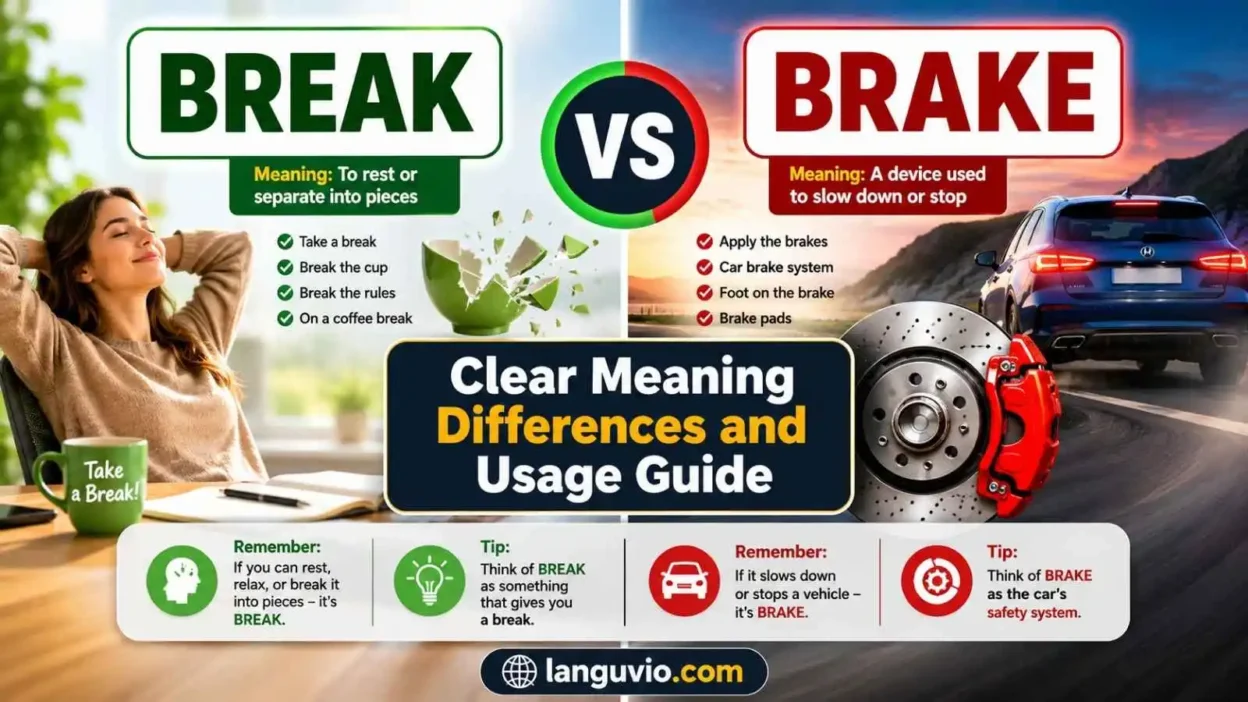
| Meaning | To damage, interrupt, or stop something | To slow or stop a vehicle or machine |
| Usage | General actions | Driving and mechanical systems |
| Context | Everyday language | Transportation/technical |
Meaning and Usage Difference
Break is a general action word. It can mean damaging something (“break a glass”), stopping something (“take a break”), or not following rules (“break the law”).
Brake is much more specific. It refers to devices or actions used to slow or stop movement, especially in cars, bikes, or machines (“press the brake pedal”).
Tone, Context, and Formality
Break is used in everyday casual and formal English. It fits many situations and has broad meaning.
Brake is more technical and usually appears in driving, mechanical, or safety-related contexts.
Which One Should You Use?
| Context | Best Choice | Why |
| Stopping a car | brake | It refers to vehicle control |
| Accident or damage | break | It describes destruction |
| Taking rest | break | It means pause |
| Bike slowing down | brake | It refers to stopping mechanism |
When One Choice Sounds Wrong
Using “break” in a driving situation sounds incorrect:
- “I need to break the car” ❌ (wrong meaning)
Using “brake” in general situations also sounds wrong:
- “Don’t brake the glass” ❌ (incorrect usage)
Common Mistakes (and Quick Fixes)
• Writing “break” when talking about cars → switch to “brake”
• Confusing “take a break” with mechanical meaning → remember break = pause
• Typing errors due to fast writing → slow down and check context
Quick trick:
If it involves wheels, pedals, or stopping motion → brake
Everything else → break
Everyday Examples
• I need a short break after work.
• The glass will break if you drop it.
• He pressed the brake too late.
• My bike’s brake is not working properly.
• Don’t break the rules in class.
Dictionary-Style Word Details
Verb
• break: To separate into pieces, interrupt, or stop something
• brake: Not commonly used as a verb in general writing, but can mean applying a braking system
Noun
• break: A pause or interruption (“coffee break”)
• brake: A device used to stop movement (car brake)
Synonyms
• break: shatter, pause, interrupt, damage (closest plain alternatives)
• brake: slow down, stop (context-based alternatives)
Antonyms:
• break: repair, fix, continue
• brake: accelerate, speed up
Example Sentences
• break: She needed a break after studying for hours.
• break: Be careful not to break the vase.
• brake: He hit the brake to avoid the collision.
• brake: The bicycle brake needs adjustment.
Word History
• break: Old English origin, historically tied to splitting or dividing something
• brake: Related to mechanical stopping devices that developed with transport systems
Phrases Containing
• break: break time, break the news, break down, break the law
• brake: brake pedal, brake system, brake pads, emergency brake
FAQs
1. What is the main difference between break and brake?
Break means to damage, interrupt, or stop something.
Brake means to slow down or stop a vehicle or moving machine.
2. Why do people confuse break and brake?
They sound exactly the same when spoken, so people often mix up the spelling when writing.
3. Is it “brake the car” or “break the car”?
It is “brake the car” when you mean slowing or stopping it.
“Break the car” would mean damaging it.
4. Can “break” ever mean stop?
Yes. “Break” can mean to pause or stop temporarily, like “take a break” or “break for lunch.”
5. What does “brake” mean in simple words?
It means the system or action used to slow down or stop something moving, especially a car or bike.
6. How can I remember the difference easily?
Think:
- brake = car has brakes
- break = everything else (damage, pause, split)
7. Are break and brake pronounced the same?
Yes, they are homophones, meaning they sound identical but have different meanings and spellings.
Conclusion
The difference between break and brake comes down to meaning and context. “Break” is broad and covers damage, interruption, or pause. “Brake” is specific to stopping or slowing movement, especially in vehicles. Once you link “brake” with cars and “break” with everything else, the confusion disappears quickly.