“Bare vs bear” is a common confusion in everyday English. These two words sound exactly the same, but they mean very different things.
If you mix them up, your sentence can quickly become awkward or incorrect. For example, “bare with me” doesn’t mean what you think—it’s actually wrong in standard usage.
This guide clears it up simply. You’ll learn what each word means, how they’re used, and how to choose the right one every time.
Quick Answer
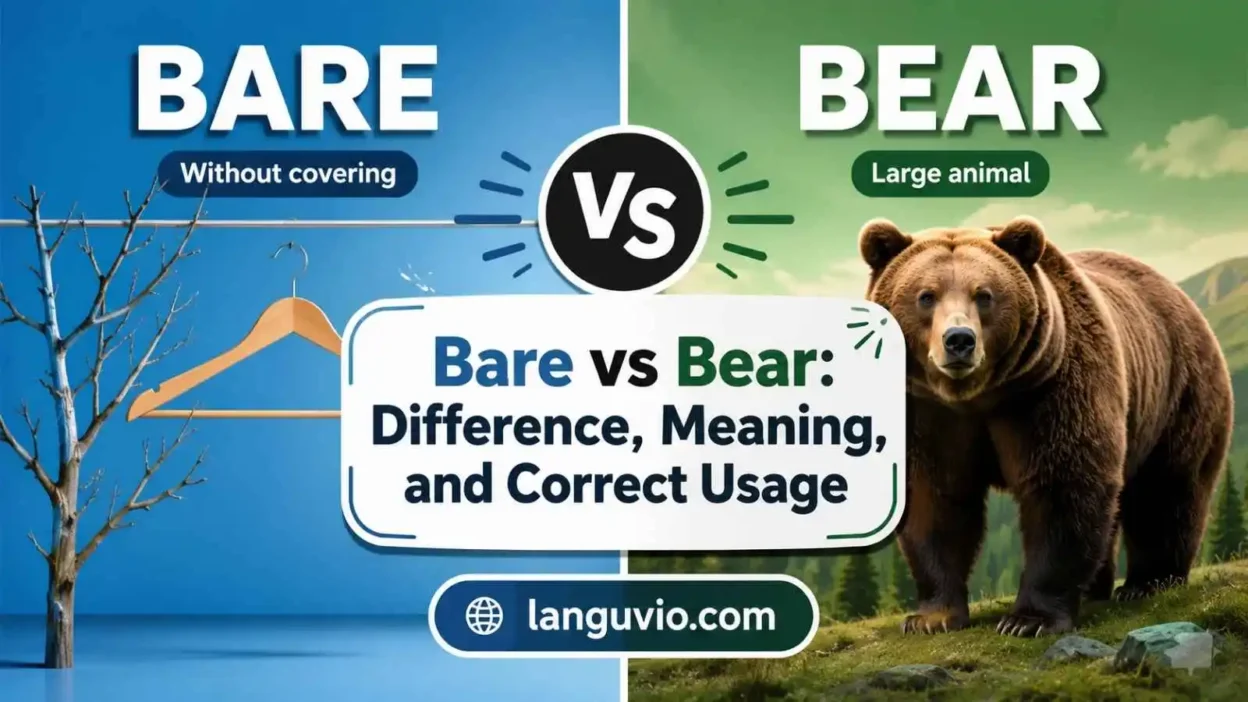
- Bare means uncovered, empty, or exposed.
- Bear usually means to carry, tolerate, or refers to the animal.
If you’re talking about exposure, use bare.
If you mean carry, handle, or endure, use bear.
Why People Confuse Them
The confusion comes down to one thing: sound.
“Bare” and “bear” are pronounced exactly the same in American English. Because of that, people often rely on memory instead of meaning—and that leads to mistakes.
Also, both words appear in common phrases, which adds to the confusion.
Key Differences At A Glance
| Context | Best Choice | Why |
|---|---|---|
| Uncovered or exposed | Bare | Means empty or without covering |
| Carry or hold | Bear | Means to support or carry weight |
| Tolerate something | Bear | Means endure or handle |
| Animal reference | Bear | Refers to the animal |
| Empty or minimal | Bare | Means just enough or stripped down |
Meaning and Usage Difference
Bare is usually an adjective. It describes something that is uncovered, empty, or minimal.
- “She walked on bare feet.”
- “The room was bare.”
Bear is more flexible. It can be a verb or a noun.
As a verb, it means:
- carry (“He bears responsibility.”)
- tolerate (“I can’t bear the noise.”)
As a noun, it means the animal.
- “We saw a bear in the woods.”
Tone, Context, and Formality
Both words are neutral and used in everyday English.
However, bear (verb) often appears in slightly more formal or structured phrases like:
- “bear responsibility”
- “bear in mind”
Bare tends to show up in descriptive, casual, or visual contexts:
- “bare walls”
- “bare minimum”
Which One Should You Use?
Use bare when something is:
- exposed
- empty
- stripped down
Use bear when something involves:
- carrying
- handling
- tolerating
- the animal
A simple trick:
If you can replace it with “carry” or “handle,” choose bear.
When One Choice Sounds Wrong
Some mistakes stand out immediately.
❌ “Bare with me”
✔ “Bear with me”
Why? Because you’re asking someone to be patient, not to be uncovered.
Another example:
❌ “He couldn’t bare the pain.”
✔ “He couldn’t bear the pain.”
If the sentence involves emotion or effort, bear is almost always correct.
Common Mistakes (and Quick Fixes)
- Mistake: Using bare when you mean tolerate
→ Fix: Use bear - Mistake: Using bear for physical exposure
→ Fix: Use bare - Mistake: Confusing phrases
→ Fix: Memorize “bear with me”
Everyday Examples
- “The shelves were completely bare.”
- “Please bear with me for a moment.”
- “He walked across the sand with bare feet.”
- “She couldn’t bear the stress anymore.”
- “The cabin looked bare after moving out.”
- “They saw a bear near the campsite.”
Dictionary-Style Word Details
Verb
- Bare: Rare as a verb; means to uncover or reveal (e.g., “to bare your teeth”).
- Bear: Common verb meaning to carry, support, endure, or accept.
Noun
- Bare: Not commonly used as a noun in standard US English.
- Bear: A large mammal; also used metaphorically in phrases like “bear market.”
Synonyms
- Bare: uncovered, empty, exposed (closest plain alternatives)
- Bear (verb): carry, endure, tolerate (closest plain alternatives)
- Bear (noun): no exact synonyms; closest plain alternative is “large wild animal”
Example Sentences
- Bare: “The trees stood bare in winter.”
- Bear: “She bears the burden alone.”
- Bear (noun): “A bear crossed the road.”
Word History
- Bare: Comes from Old English roots meaning “uncovered.”
- Bear: Has older roots linked to carrying and also to the animal name.
Exact historical timelines vary and are not always clearly defined.
Phrases Containing
- Bare: bare minimum, bare hands, bare essentials
- Bear: bear with me, bear in mind, bear responsibility
Bare means uncovered, empty, or exposed.
Bear means to carry, tolerate, or refers to the animal.
The correct phrase is “bear with me.”
It means “be patient with me.”
Yes. In American English, bare and bear sound exactly the same. That’s why they’re often confused.
Yes. As a verb, bear commonly means to handle or endure something.
Example: “I can’t bear the noise.”
Yes, but it’s less common.
Bare as a verb means to uncover or reveal.
Example: “He bared his teeth.”
Yes. Bare minimum is correct because it means the smallest or simplest amount needed.
Bear in mind means to remember or keep something in your thoughts.
Yes.
As a noun, it’s the animal.
As a verb, it means to carry, hold, or tolerate.
Writing “bare with me” instead of “bear with me”
Using “bare” when talking about pain or تحمل (tolerating something)
Think of it this way:
Bare = empty or exposed
Bear = carry or handle
If the sentence involves effort or patience, choose bear.
Conclusion
The difference between bare vs bear is simple once you focus on meaning instead of sound.
Use bare for anything uncovered or minimal.
Use bear for carrying, tolerating, or referring to the animal.
When in doubt, think about the action. If the sentence involves effort, responsibility, or patience, “bear” is almost always the right choice.