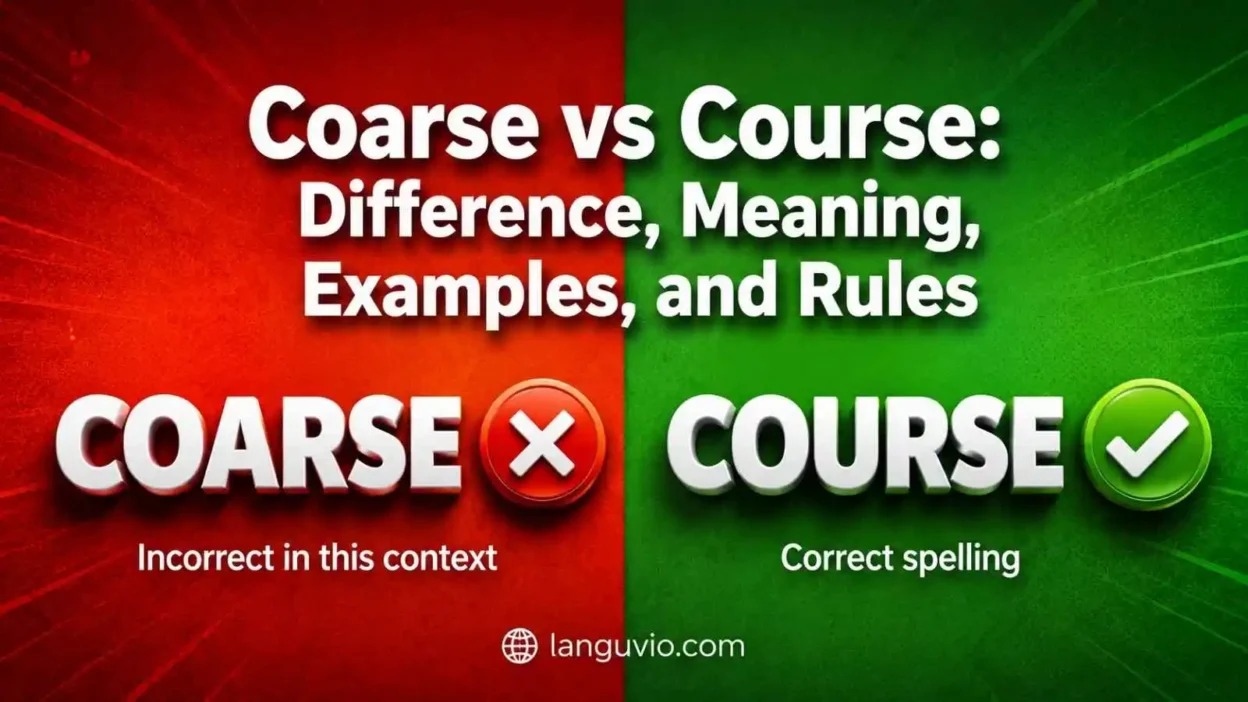
Coarse and course are both correct English words, but they are not interchangeable. They sound the same, yet they have different meanings and different jobs in a sentence.
In most cases, coarse describes something rough, large-grained, crude, or rude. Course, however, usually names a class, route, process, plan, meal part, or path.
Because the words are homophones, the confusion is easy to understand. Still, once you connect each word to its meaning, the choice becomes simple.
Quick Answer
Use coarse when you mean rough, not smooth, not fine, crude, or rude.
Examples:
- coarse sand
- coarse hair
- coarse salt
- coarse language
Use course when you mean a class, route, direction, process, plan, meal part, or movement.
Examples:
- a writing course
- a golf course
- a course of action
- the main course
Also, remember this common phrase: the correct spelling is of course, not of coarse.
Why People Confuse Them
People confuse coarse and course mainly because the words sound alike. In everyday American English, both are pronounced like “kors.”
Their spelling is also close. Coarse has an a, while course has a u. As a result, writers often choose the wrong one when they are typing quickly.
Another common reason is the phrase of course. Since the sound does not reveal the spelling, some people accidentally write of coarse. However, that spelling is wrong because coarse means rough or rude, not certainly.
Key Differences At A Glance
| Context | Best Choice | Why |
| Rough texture | coarse | It describes something not smooth. |
| Large grains or pieces | coarse | It describes texture or particle size. |
| Rude language or behavior | coarse | It means crude, vulgar, or offensive. |
| School or training class | course | It means a set of lessons. |
| Route or direction | course | It means a path something follows. |
| Plan or action | course | It means a way of proceeding. |
| Part of a meal | course | It means one stage of a meal. |
| Moving or flowing | course | As a verb, it means to move or flow. |
| Phrase meaning “certainly” | of course | This fixed phrase uses course. |
Meaning and Usage Difference
Coarse is usually an adjective. It describes the quality of a person, thing, texture, or expression.
For example, coarse sand is rough or made of larger grains. Similarly, coarse salt has larger crystals than fine salt. In another context, coarse language means rude, crude, or offensive language.
Here are a few natural uses:
- The towel felt coarse after too many washes.
- The chef finished the dish with coarse salt.
- His coarse joke made everyone uncomfortable.
Course is usually a noun, although it can also work as a verb. As a noun, it can mean a class, a route, a direction, a process, a plan, a meal part, or a playing area.
For example, a college course is a class. A golf course is a place where golf is played. Meanwhile, a course of action is a plan or next step.
Here are common uses:
- She signed up for a business course.
- The boat changed course during the storm.
- We need a better course of action.
- Dessert was the final course.
As a verb, course means to move or flow quickly. This use is standard, but it sounds a little more formal or literary than “run” or “flow.”
Example:
- Rainwater coursed down the street.
Tone, Context, and Formality
Coarse can be neutral or negative, depending on the context. When it describes texture, it is usually neutral.
For example:
- coarse sand
- coarse pepper
- coarse fabric
However, when coarse describes language, humor, manners, or behavior, it usually sounds negative. A coarse comment is not just informal; it is rude or crude.
Course, on the other hand, is usually neutral. It appears in everyday, academic, professional, food, travel, sports, and planning contexts.
For example:
- She is taking an online course.
- The plane stayed on course.
- The main course was pasta.
- The safest course is to wait.
In formal writing, course often appears in phrases such as course of action, in due course, and in the course of the meeting. Therefore, the word can sound polished without being difficult.
Which One Should You Use?
Choose coarse if the word describes something rough, large-grained, crude, or rude.
Choose course if the word refers to a class, path, direction, process, plan, meal part, or movement.
A helpful shortcut is this:
- Coarse describes a rough quality.
- Course usually names a path, class, process, or part.
- Of course is the correct phrase for “certainly.”
In short, ask what the word is doing. If it describes texture or rudeness, choose coarse. If it names a class, route, plan, or sequence, choose course.
When One Choice Sounds Wrong
The wrong word can make a sentence confusing or even funny. Fortunately, most mistakes are easy to fix once you check the meaning.
Wrong: I’m taking a coarse in marketing.
Correct: I’m taking a course in marketing.
A class is a course, not a coarse.
Wrong: The towel felt course.
Correct: The towel felt coarse.
A rough texture is coarse.
Wrong: We need a new coarse of action.
Correct: We need a new course of action.
A plan or direction is a course.
Wrong: The dinner had four coarses.
Correct: The dinner had four courses.
Meal parts are courses.
Wrong: Of coarse, you can join us.
Correct: Of course, you can join us.
The phrase meaning “certainly” is of course.
Common Mistakes (and Quick Fixes)
Mistake 1: Using coarse for a class
Wrong: She enrolled in a photography coarse.
Correct: She enrolled in a photography course.
A class, lesson series, or training program is a course.
Mistake 2: Using course for rough texture
Wrong: The bread had a course crumb.
Correct: The bread had a coarse crumb.
A rough or large-grained texture is coarse.
Mistake 3: Writing “of coarse”
Wrong: Of coarse, I remember you.
Correct: Of course, I remember you.
The fixed phrase uses course, because it means “certainly” or “naturally.”
Mistake 4: Forgetting that course can be a verb
Correct: Sweat coursed down his face after the race.
Although this use is less common in casual speech, it is still correct.
Mistake 5: Treating coarse as a noun
Wrong: The coarse starts at 9 a.m.
Correct: The course starts at 9 a.m.
A scheduled class or lesson series is a course.
Everyday Examples
- The cutting board was covered with coarse salt.
- After several washes, the blanket felt coarse.
- Her dog has a coarse coat in winter.
- The speaker apologized for his coarse language.
- For this recipe, use coarse pepper instead of fine pepper.
- I signed up for an online accounting course.
- The river changed course after the flood.
- Before we decide, we need a better course of action.
- The main course was grilled salmon.
- During the storm, the pilot changed course.
- Of course, I can send you the file.
- The golf course was closed after heavy rain.
- The training course lasts six weeks.
- Eventually, the illness ran its course.
Dictionary-Style Word Details
Verb
- Coarse: Not commonly used as a verb in standard US English. Instead, the related verb coarsen means to make or become coarse.
- Example: Cold weather can coarsen exposed skin.
- Course: Used as a verb meaning to move, run, or flow quickly.
- Example: Water coursed through the narrow ditch.
Noun
- Coarse: Not commonly used as a noun in standard US English. Instead, use coarseness for the quality of being coarse.
- Example: The coarseness of the fabric made it uncomfortable.
- Course: Commonly used as a noun. It can mean a class, route, direction, process, plan, meal part, or sports area.
- Example: She took a finance course.
- Example: The runner stayed on the marked course.
- Example: Soup was the first course.
Synonyms
- Coarse: Closest plain alternatives include rough, scratchy, gritty, crude, rude, and vulgar. Clear opposites include smooth, soft, fine, polite, and refined, depending on the meaning.
- Course: Closest plain alternatives depend on context. For a class, use class or program of study. For a route, use path, route, or direction. For a plan, use approach or course of action. For a meal part, serving or dish may fit, although they are not exact matches in every sentence.
Example Sentences
- Coarse: The chef topped the fries with coarse sea salt.
- Coarse: His coarse reply made the room uncomfortable.
- Coarse: The rope was coarse enough to scrape my palms.
- Course: The college added a new coding course.
- Course: The plane changed course to avoid the storm.
- Course: We served salad as the second course.
Word History
- Coarse: The word has long been connected with roughness, ordinary quality, and lack of refinement. Today, it still points to something not smooth, not fine, or not polite.
- Course: The word is connected with movement, direction, order, and sequence. That connection helps explain modern uses such as a route, a process, a class sequence, a meal sequence, or movement as a verb.
Phrases Containing
- Coarse: coarse salt, coarse sand, coarse hair, coarse fabric, coarse language, coarse joke, coarse-grained
- Course: of course, on course, off course, course of action, course of study, main course, golf course, race course, run its course, stay the course, in due course
FAQs
Coarse means rough, large-grained, crude, or rude. Course usually means a class, route, direction, process, plan, meal part, or movement. For example, you can write coarse salt, but you should write a writing course.
The correct phrase is of course. It means “certainly,” “yes,” or “naturally.” Of coarse is incorrect in this phrase because coarse means rough or rude.
Use course for a class, lesson series, or training program. For example, “She is taking a business course” is correct. Coarse does not mean a class.
Coarse means rough, not smooth, or made of large grains. You can use it in phrases like coarse sand, coarse hair, coarse fabric, and coarse salt.
Yes. Course can be a verb meaning to move or flow quickly. For example, “Rainwater coursed down the street” is correct. However, this use sounds more formal or literary than “ran” or “flowed.”
Coarse is mainly an adjective. It describes something rough, crude, rude, or not fine. It is not commonly used as a noun in standard US English.
Yes. In everyday American English, coarse and course are pronounced the same, like “kors.” Because they sound alike, you must choose the correct spelling by meaning.
Here are two simple examples: “The recipe calls for coarse salt” and “I signed up for a Spanish course.” In the first sentence, coarse describes salt. In the second sentence, course means a class.
Yes. Coarse language is correct when you mean rude, crude, vulgar, or offensive language. For example, “The show contains coarse language” means the language may not be polite or family-friendly.
Remember this: coarse describes roughness, while course points to a path, class, process, or sequence. Also, the phrase meaning “certainly” is always of course.
Conclusion
The difference between coarse and course comes down to meaning.
Use coarse for something rough, large-grained, crude, or rude. Use course for a class, route, direction, plan, process, meal part, or movement.
Most importantly, remember this simple clue: coarse describes roughness, while course points to a path, class, process, or sequence. And when you mean “certainly,” the correct phrase is always of course.