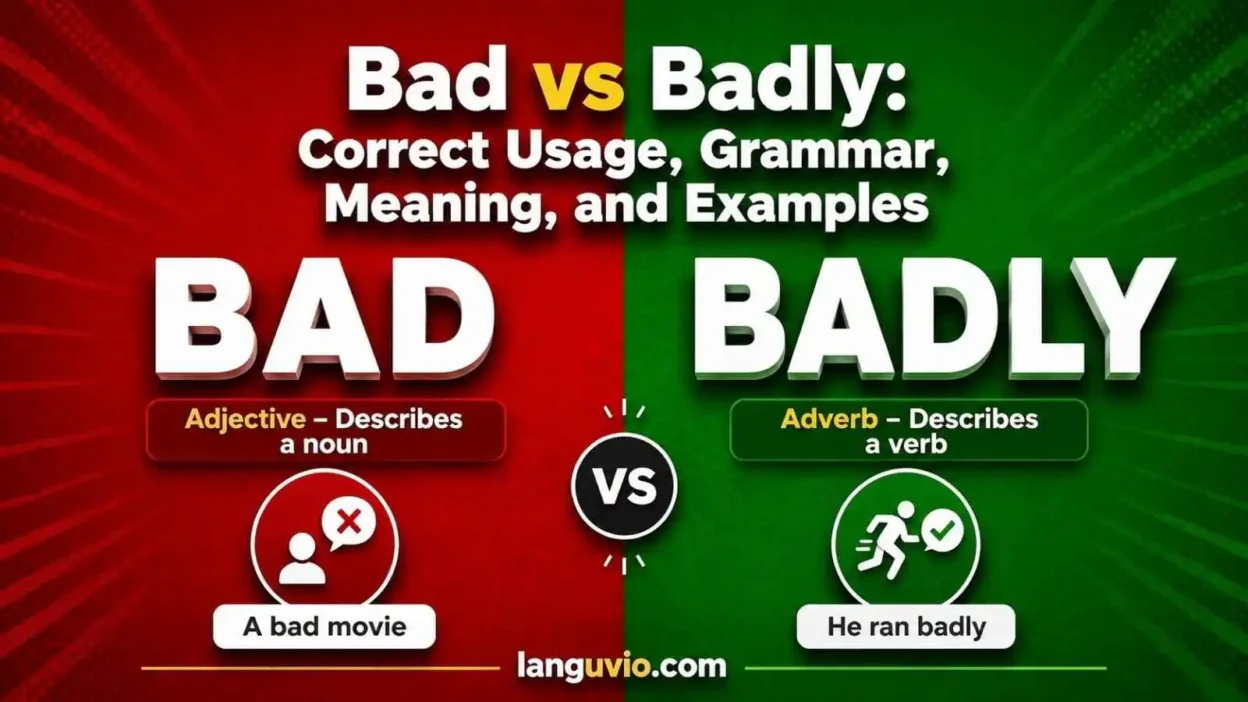
Bad vs badly can confuse writers because both words point to something negative. However, they do different jobs in a sentence. Bad is usually an adjective, while badly is usually an adverb.
In other words, bad describes a noun, pronoun, feeling, or state. Badly, on the other hand, describes how an action is done or how serious a condition is. Once you know what the word is describing, the choice becomes much easier.
Quick Answer
Use bad when you need an adjective: “That was a bad idea.” Use badly when you need an adverb: “She played badly.” However, after linking verbs such as feel, smell, taste, look, and sound, use bad when describing the subject: “I feel bad” and “The milk smells bad.”
Why People Confuse Them
People often confuse bad and badly because many adverbs end in -ly. Therefore, it is easy to assume that badly must always be the “more grammatical” choice. That idea, however, is too simple.
For example, badly is correct when it describes an action. You can say someone drives badly, writes badly, or behaves badly. In each case, the word explains how the action happens.
However, some verbs do not work that way. Verbs such as feel, smell, taste, look, and sound often connect the subject to a description. Because of that, they usually take an adjective.
Correct examples include:
I feel bad about the mistake.
The room smells bad.
The soup tastes bad.
That plan sounds bad.
Your ankle looks bad.
In these sentences, bad describes the person, room, soup, plan, or ankle. It does not describe an action.
Key Differences At A Glance
| Context | Best Choice | Why |
| Describing a noun | bad | “Bad” is an adjective: a bad choice. |
| Describing a feeling or state | bad | “I feel bad” describes your condition. |
| Describing how an action is done | badly | “She sang badly” describes the action. |
| After smell, taste, look, sound, or feel | bad | These often work as linking verbs. |
| After action verbs like drive, write, play, or behave | badly | The word modifies the action. |
| Formal writing | badly for actions | “Badly” is the standard adverb. |
| Casual speech | bad sometimes appears as an adverb | “I want it bad” is informal. |
Meaning and Usage Difference
Bad is mainly an adjective. It means poor, unpleasant, harmful, wrong, spoiled, serious, or not acceptable.
For example:
That was a bad decision.
She had a bad headache.
The store got a bad review.
This milk smells bad.
In each sentence, bad describes a thing or state. It tells us what something is like.
Badly is mainly an adverb. It means in a poor way, in an unsuccessful way, seriously, severely, or very much.
For example:
He drove badly in the storm.
The project was badly managed.
Her wrist was badly swollen.
They wanted the win badly.
In these examples, badly describes an action, condition, or degree. It tells us how something happened or how strong something was.
A simple test can help. If the sentence answers “What is it like?” use bad. If it answers “How was it done?” use badly.
Tone, Context, and Formality
In standard US English, bad is the normal adjective. As a result, it works well in casual, professional, and formal writing when an adjective is needed.
You can write:
The service was bad.
The timing was bad.
I feel bad about missing the call.
Meanwhile, badly is the normal adverb. Therefore, it is usually the better choice when you describe how someone does something.
You can write:
The service was handled badly.
The team performed badly.
I explained the rule badly.
Still, casual English sometimes uses bad as an adverb. For example, people may say, “I want it bad” or “He did bad on the test.” These forms are common in conversation, but they are not the safest choice in school, work, or edited writing.
The phrase feel badly needs special care. In modern US English, I feel bad is the clearest and most natural choice when you mean you feel sad, guilty, sorry, sick, or uncomfortable. Although feel badly appears in real usage, it can sound stiff or confusing. In some readings, it may even suggest that your sense of touch is poor. For most writing, choose feel bad.
Which One Should You Use?
Use bad when the word describes a noun, pronoun, feeling, or state.
Correct:
That is a bad habit.
I feel bad about the delay.
The kitchen smells bad.
Your answer does not sound bad.
Use badly when the word describes how an action happens.
Correct:
He behaved badly at dinner.
The report was written badly.
She played badly during the first half.
The window was badly cracked.
In short, bad describes what something is like. By contrast, badly describes how something is done or how seriously something is affected.
When One Choice Sounds Wrong
Sometimes the wrong choice changes the meaning. Other times, it simply makes the sentence sound awkward.
Wrong: I feel badly about being late.
Better: I feel bad about being late.
Here, bad describes your emotional state.
Wrong: The soup tastes badly.
Better: The soup tastes bad.
In this sentence, bad describes the soup. The soup is not performing the action of tasting in a poor way.
Wrong: She drives bad in traffic.
Better: She drives badly in traffic.
Here, badly describes how she drives.
Wrong: The report was bad written.
Better: The report was badly written.
In this case, badly describes how the report was written.
A small wording change can also change the meaning:
The dog smells bad.
The dog smells badly.
The first sentence means the dog has a bad odor. However, the second sentence suggests the dog has a poor ability to smell. Since that is rarely the intended meaning, smells bad is usually the right choice.
Common Mistakes (and Quick Fixes)
One common mistake is using badly after a linking verb.
Weak: The pizza tastes badly.
Fixed: The pizza tastes bad.
Another common mistake is using bad after an action verb in polished writing.
Weak: The team played bad.
Fixed: The team played badly.
Writers also sometimes assume every verb needs an adverb.
Weak: I feel badly for her.
Fixed: I feel bad for her.
In addition, casual speech can make the wrong form feel normal.
Casual: I need that job bad.
Polished: I need that job badly.
Finally, some errors happen because the writer does not check what the word describes.
Weak: The app worked bad after the update.
Fixed: The app worked badly after the update.
To fix the sentence, ask one question: does the word describe a thing or an action? If it describes a thing, feeling, or state, use bad. If it describes an action, use badly.
Everyday Examples
| Feature | bad | badly |
| Main role | Adjective | Adverb |
| Describes | A thing, person, feeling, or state | An action, effect, or degree |
| Common pattern | bad idea, feel bad, smells bad | drive badly, badly hurt, need badly |
| Formal writing use | Correct when an adjective is needed | Correct when an adverb is needed |
More examples:
I feel bad about canceling at the last minute.
However, the meeting went badly after the budget question came up.
That was a bad answer, but you can revise it.
In contrast, the complaint was handled badly.
The coffee tastes bad because it sat out too long.
Also, he wanted the promotion badly.
The room looked bad after the leak.
As a result, the walls were badly damaged.
She felt bad after reading the message.
Meanwhile, the new employee was trained badly.
That joke sounded bad in a work meeting.
Therefore, he apologized for behaving badly.
The car smelled bad after the road trip.
Later, the driver reacted badly to the sudden stop.
Dictionary-Style Word Details
Verb
• Bad: Not commonly used as a verb in standard modern US English. Instead, use a clearer verb such as spoil, damage, criticize, or mess up, depending on the meaning.
Example: The heat spoiled the food.
• Badly: Not used as a verb in standard US English. It is normally an adverb.
Example: The food was badly spoiled.
Noun
• Bad: Can work as a noun in limited phrases, usually meaning something bad, the bad part, or bad people as a group.
Example: We had to accept the good with the bad.
• Badly: Not commonly used as a noun in standard US English. Instead, it normally modifies a verb, adjective, or past participle.
Example: The badly damaged roof needs repair.
Synonyms
• Bad: Closest plain alternatives include poor, wrong, unpleasant, harmful, spoiled, faulty, and serious, depending on context. Useful opposites include good, right, pleasant, safe, and healthy.
• Badly: Closest plain alternatives include poorly, terribly, severely, seriously, incorrectly, and very much, depending on context. Useful opposites include well, properly, carefully, and successfully.
Example Sentences
• Bad: That was a bad time to bring up the issue.
• Bad: I feel bad that I missed your call.
• Bad: The leftovers smelled bad, so we threw them out.
• Bad: The update caused a bad glitch in the app.
• Badly: The printer worked badly after the power outage.
• Badly: She badly needed a break after the long shift.
• Badly: The team played badly in the first quarter.
• Badly: His laptop was badly damaged in the fall.
Word History
• Bad: The exact deeper origin of bad is not fully certain. However, the word has long been used to mean poor, harmful, unpleasant, wrong, or not good. Because the history is not simple, it is better not to claim one definite origin in a general usage guide.
• Badly: Badly was formed from bad plus the adverb ending -ly. Its core use is to describe something done in a bad way. In addition, it can mean severely or very much in common phrases.
Phrases Containing
• Bad: bad news, bad idea, bad habit, bad luck, bad mood, feel bad, too bad, not bad, my bad, go bad, bad taste, bad grammar.
• Badly: badly hurt, badly damaged, badly needed, badly written, badly behaved, badly managed, badly affected, badly mistaken, perform badly, react badly.
FAQs
Is it bad or badly?
Use bad when you need an adjective and badly when you need an adverb. For example, “That was a bad mistake” is correct because bad describes the mistake. However, “He behaved badly” is correct because badly describes how he behaved. The right choice depends on what the word describes.
Is “I feel bad” or “I feel badly” correct?
I feel bad is the best choice in modern US English. In this sentence, feel works like a linking verb, so bad describes your state or emotion. Although “I feel badly” appears in real usage, it can sound awkward or overly formal.
Do you say “did bad” or “did badly”?
In polished writing, use did badly. For example, “She did badly on the exam” is the standard form because badly describes how she did. “Did bad” is common in casual speech, but it is not the best choice for school or work.
Why is “smells bad” correct?
Smells bad is correct because bad describes the subject. In “The milk smells bad,” the sentence means the milk has a bad odor. By contrast, “smells badly” would suggest a poor ability to smell.
Can bad ever be an adverb?
Yes, bad can appear as an adverb in informal speech, as in “I want it bad.” Still, badly is usually better in formal writing: “I want it badly.”
What is the easiest way to remember bad vs badly?
Use bad for a thing, feeling, or state. Use badly for an action. If the sentence answers “what is it like?” choose bad. If it answers “how was it done?” choose badly.
Conclusion
The difference between bad and badly depends on what the word describes. Use bad for a noun, pronoun, feeling, or state. Use badly for an action, degree, or serious effect.
Therefore, the safest choices are simple: I feel bad, it smells bad, she drove badly, and the report was badly written. Once you identify whether the word describes a state or an action, the correct form becomes much easier to choose.
Use bad when you need an adjective and badly when you need an adverb. For example, “That was a bad mistake” is correct because bad describes the mistake. However, “He behaved badly” is correct because badly describes how he behaved. The right choice depends on what the word describes.
I feel bad is the best choice in modern US English. In this sentence, feel works like a linking verb, so bad describes your state or emotion. Although “I feel badly” appears in real usage, it can sound awkward or overly formal.
In polished writing, use did badly. For example, “She did badly on the exam” is the standard form because badly describes how she did. “Did bad” is common in casual speech, but it is not the best choice for school or work.
Smells bad is correct because bad describes the subject. In “The milk smells bad,” the sentence means the milk has a bad odor. By contrast, “smells badly” would suggest a poor ability to smell.
Yes, bad can appear as an adverb in informal speech, as in “I want it bad.” Still, badly is usually better in formal writing: “I want it badly.”
Use bad for a thing, feeling, or state. Use badly for an action. If the sentence answers “what is it like?” choose bad. If it answers “how was it done?” choose badly.