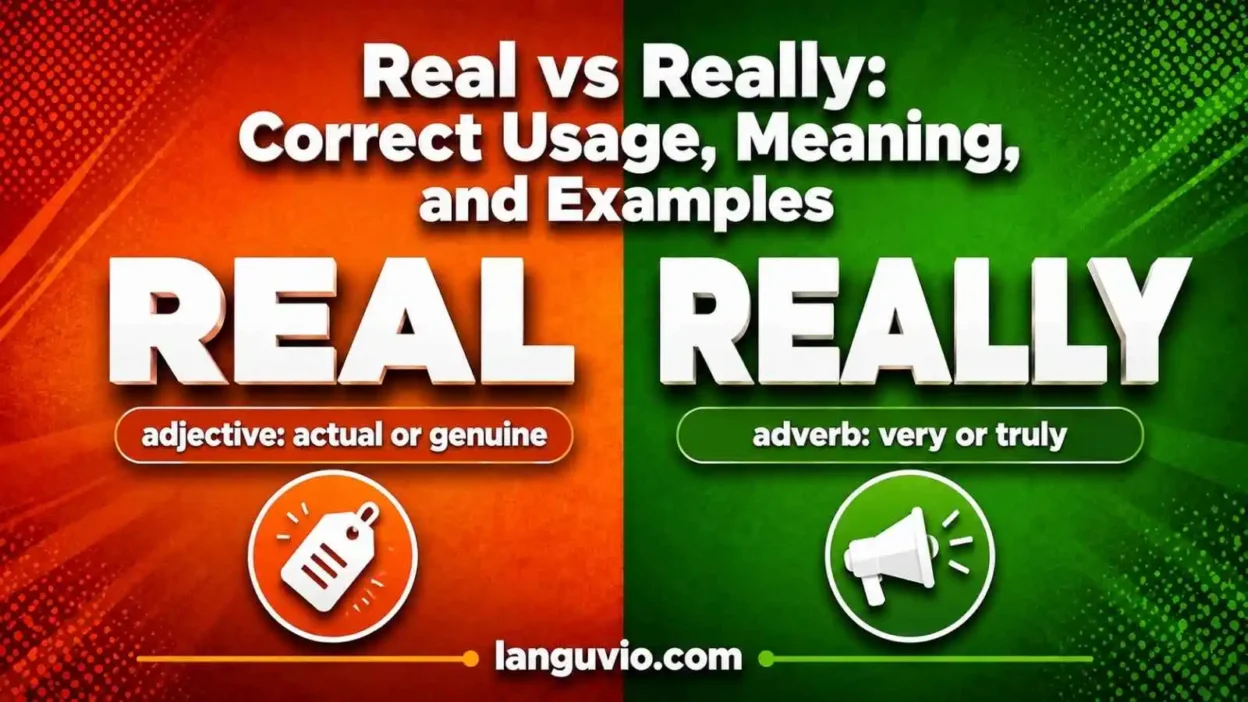
Real vs really is a common English question because both words can describe truth, strength, or intensity. The safest difference is simple: real is usually an adjective, and really is usually an adverb.
Still, the choice is not always as simple as “one is correct and one is wrong.” In casual US speech, real can also work as an informal intensifier, as in “real nice” or “real quick.” For polished writing, however, really is usually the better choice when you are modifying a verb, adjective, or adverb.
Quick Answer
Use real when you mean “actual,” “genuine,” or “not fake”: a real diamond, a real problem, a real person. Use really when you mean “truly,” “actually,” or “very”: I really liked it, really good, really fast. Casual speakers may say real good, but really good is safer in standard writing.
Why People Confuse Them
People confuse real and really because both can point to truth. A real story means the story is based on something actual. I really believe the story means you truly believe it.
The confusion grows because American English often uses short adverbs in casual speech. That is why phrases like real nice, real fast, and real quiet sound familiar. They are common in relaxed conversation, but they are not the best choice for school papers, business writing, or formal articles.
Another reason is that really often means “very.” If really good means “very good,” many speakers naturally shorten it to real good in speech.
Key Differences At A Glance
| Context | Best Choice | Why |
| Before a noun | Real | Use it as an adjective: a real issue. |
| After a linking verb | Real | It describes the subject: The threat is real. |
| Before an adjective | Really | Standard choice: really helpful. |
| Before an adverb | Really | Standard choice: really well. |
| Before a verb | Really | Use it to modify the action: I really care. |
| Casual speech before an adjective | Real | Informal: real nice, real quick. |
| Formal or professional writing | Really | Clearer and safer as an adverb. |
Meaning and Usage Difference
Real usually describes a noun. It means something is actual, genuine, true, or not fake.
Examples:
- That is a real leather jacket.
- We have a real chance to win.
- The movie is based on real events.
- Her concern was real, not pretend.
Really usually modifies a verb, adjective, adverb, or full idea. It can mean “truly,” “actually,” or “very.”
Examples:
- I really want to go.
- That was really helpful.
- She handled it really well.
- Are you really moving to Denver?
The key grammar point is this: real usually describes a thing, while really usually adds force or truth to an action, quality, or statement.
A compact comparison:
- Real = actual or genuine: a real problem
- Really = truly, actually, or very: really serious
- Real can be informal before adjectives: real serious
- Really is the safer standard choice: really serious
Tone, Context, and Formality
Real is standard when it works as an adjective. There is nothing casual or incorrect about a real problem, a real friend, or real evidence.
As an adverb, real is informal. Phrases like real good, real fast, and real simple are common in casual American speech. They can sound friendly, relaxed, and conversational. They can also sound too casual in academic, legal, business, or edited writing.
Really is more flexible. It works in everyday speech and standard writing. It can sound natural in casual sentences, such as I really liked that show. In more formal writing, you may sometimes choose a stronger word instead, but really is still grammatically standard.
Pronunciation does not usually cause the confusion. The issue is grammar and tone, not sound.
Which One Should You Use?
Use real when the word describes a noun or follows a linking verb.
Correct:
- This is a real emergency.
- The painting looks real.
- We need real answers.
- His apology seemed real.
Use really when the word modifies a verb, adjective, or adverb.
Correct:
- I really need your help.
- This coffee is really strong.
- You did really well.
- She really enjoys her job.
For safe standard English, choose really in phrases like really good, really fast, really hard, and really important. Use real good only when you want an informal spoken tone.
When One Choice Sounds Wrong
Real sounds wrong when it tries to modify a verb.
Incorrect: I real like this song.
Correct: I really like this song.
Incorrect: She real wants the job.
Correct: She really wants the job.
Really sounds wrong when it is placed where an adjective should describe a noun.
Incorrect: That is a really diamond.
Correct: That is a real diamond.
Incorrect: We need a really solution.
Correct: We need a real solution.
Be careful with noun phrases. You can say a really good solution because really modifies good, not solution. But you cannot say a really solution.
Common Mistakes (and Quick Fixes)
Mistake 1: Using real before a verb
Wrong: I real hope you pass.
Right: I really hope you pass.
Mistake 2: Using really before a noun without an adjective
Wrong: That was a really surprise.
Right: That was a real surprise.
Also right: That was a really big surprise.
Mistake 3: Treating real good as always standard
Casual: The tacos were real good.
Standard: The tacos were really good.
Mistake 4: Using really when you mean genuine
Wrong: Is this really gold?
Better, if asking about authenticity: Is this real gold?
The sentence Is this really gold? can work, but it asks whether the claim is actually true. Is this real gold? directly asks whether the gold is genuine.
Everyday Examples
- That is a real dog, not a toy.
- I really love your new haircut.
- We had a real problem with the app this morning.
- The meeting went really well.
- His fear felt real.
- I am really tired today.
- That was a real mistake.
- She was really patient with the kids.
- The offer sounds too good to be real.
- Do you really think that will work?
- He gave us real help when we needed it.
- This room gets really cold at night.
- The story is real, but some details were changed.
- I really appreciate your time.
- The test was real hard. Casual speech.
- The test was really hard. Standard writing.
Dictionary-Style Word Details
Verb
- Real: Not commonly used as a verb in standard US English. Use another verb, such as realize, make real, or confirm, depending on the meaning.
- Really: Not used as a verb in standard US English. It normally works as an adverb.
Noun
- Real: Can be a noun in specialized contexts, such as math, where a real can mean a real number. This noun use is not the main issue in everyday real vs really choices.
- Really: Not used as a noun in standard US English.
Synonyms
- Real: Closest plain alternatives include genuine, actual, true, authentic, and not fake. Clear opposites include fake, false, imaginary, and artificial.
- Really: Closest plain alternatives include truly, actually, genuinely, very, and indeed. A clean opposite depends on the sentence. In some contexts, not really means “not truly” or “not very.”
Example Sentences
- Real: We need a real plan before Friday.
- Real: The danger was real, but the team stayed calm.
- Real: Is that a real signature or a copy?
- Really: I really need to leave by six.
- Really: Your answer was really clear.
- Really: They worked really hard on the project.
Word History
- Real: The word has long been used for what is actual, genuine, or connected to things rather than appearance.
- Really: The word is related to real with an adverb-forming ending. In modern use, the choice depends more on grammar than history: real usually describes nouns, while really usually modifies verbs, adjectives, and adverbs.
Phrases Containing
- Real: real life, real world, real time, real estate, for real, real deal, real problem, real friend
- Really: really good, really well, really sorry, really?, not really, really want, really matter, really important
FAQs
Is real or really correct?
Both real and really are correct, but they are used differently. Use real when you mean actual, genuine, or not fake, as in a real problem or real gold. Use really when you mean truly, actually, or very, as in I really care or really helpful.
Is it real good or really good?
Really good is the safer standard choice. It works in school, work, and formal writing. Real good is common in casual American speech, but it sounds informal. For example, The food was really good is standard. The food was real good sounds relaxed and conversational.
Can real be an adverb?
Yes, real can work as an informal adverb in American English before adjectives or adverbs, as in real quick or real nice. Still, really is the better choice in polished writing. Use really quick or really nice when you want a more standard tone.
When should I use real?
Use real when you are describing a noun or saying that something is genuine. Examples include a real friend, a real emergency, real leather, and real evidence. You can also use it after a linking verb, as in The threat is real.
When should I use really?
Use really before a verb, adjective, or adverb. Say I really like this song, That was really funny, and She speaks really clearly. In these sentences, really adds truth, emphasis, or intensity.
Why does really sound better in formal writing?
Really sounds better in formal writing because it is the standard adverb form. It clearly modifies verbs, adjectives, and adverbs. Real as an intensifier is understood, but it can sound too casual in essays, reports, business emails, and edited articles.
Conclusion
The simplest rule for real vs really is this: use real for something actual or genuine, and use really when you mean truly, actually, or very.
Write a real reason, a real person, and a real problem because real describes nouns. Write really like, really good, and really well because really modifies verbs, adjectives, and adverbs.
In casual American speech, real good and real quick are common. In standard writing, really good and really quick are clearer, safer, and more widely accepted.
Both real and really are correct, but they are used differently. Use real when you mean actual, genuine, or not fake, as in a real problem or real gold. Use really when you mean truly, actually, or very, as in I really care or really helpful.
Really good is the safer standard choice. It works in school, work, and formal writing. Real good is common in casual American speech, but it sounds informal. For example, The food was really good is standard. The food was real good sounds relaxed and conversational.
Yes, real can work as an informal adverb in American English before adjectives or adverbs, as in real quick or real nice. Still, really is the better choice in polished writing. Use really quick or really nice when you want a more standard tone.
Use real when you are describing a noun or saying that something is genuine. Examples include a real friend, a real emergency, real leather, and real evidence. You can also use it after a linking verb, as in The threat is real.
Use really before a verb, adjective, or adverb. Say I really like this song, That was really funny, and She speaks really clearly. In these sentences, really adds truth, emphasis, or intensity.
Really sounds better in formal writing because it is the standard adverb form. It clearly modifies verbs, adjectives, and adverbs. Real as an intensifier is understood, but it can sound too casual in essays, reports, business emails, and edited articles.