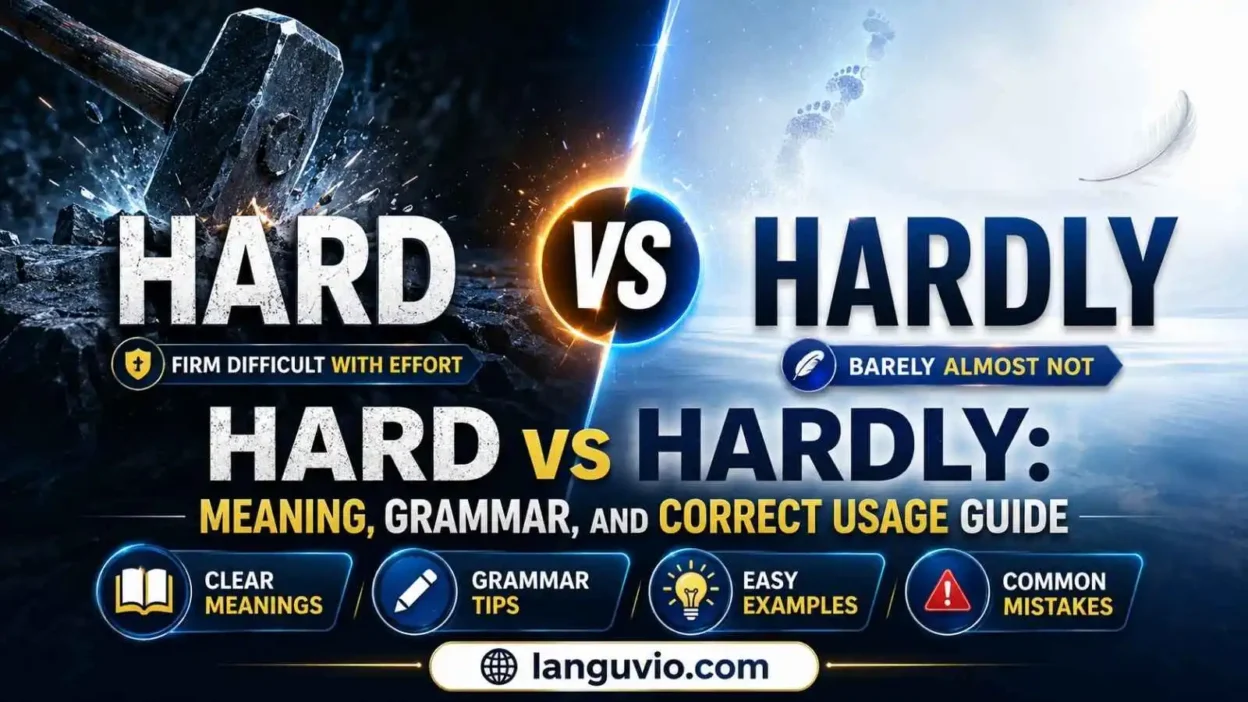
Hard vs hardly is confusing because both words look closely related. In real usage, though, they do not mean the same thing. Hard often describes something difficult, firm, strong, or done with effort. Hardly means “almost not,” “barely,” or “only just.”
That difference can change a sentence completely. “She worked hard” means she made a strong effort. “She hardly worked” means she did very little work. Once you understand that contrast, the choice becomes much easier.
Quick Answer
Use hard when you mean difficult, firm, forceful, or done with effort. Use hardly when you mean almost not, barely, or only just. Hard can be an adjective or an adverb. Hardly is an adverb, but it is not the adverb form of hard.
Why People Confuse Them
Many English adjectives form adverbs with -ly. For example, quick becomes quickly, and careful becomes carefully. That pattern makes many learners expect hard to become hardly.
This word does not follow that pattern. The adverb form stays hard when the meaning is effort or force.
Correct: She studied hard for the test.
Incorrect for this meaning: She studied hardly for the test.
The second sentence does not mean she studied with effort. It suggests she almost did not study.
Another reason for the confusion is that hardly is a real word. It is not a misspelling. It simply has a different meaning.
Key Differences At A Glance
| Context | Best Choice | Why |
| A difficult question | hard | It describes difficulty. |
| A firm surface | hard | It describes physical firmness. |
| Strong effort | hard | It means with effort or energy. |
| Strong force | hard | It means forcefully. |
| Almost no action | hardly | It means almost not. |
| Very little amount | hardly | It limits the amount. |
| Almost never | hardly ever | It describes very low frequency. |
| Barely able to do something | can hardly | It means almost cannot. |
Meaning and Usage Difference
Hard has several common meanings. As an adjective, it can mean difficult, firm, strict, harsh, or strong. In everyday writing, the most common meaning in this comparison is “difficult.”
Examples:
The exam was hard.
That chair is too hard.
We had a hard week.
Hard can also work as an adverb. In that role, it often means “with effort,” “with energy,” or “with force.”
Examples:
He worked hard all summer.
The rain came down hard.
She pushed hard against the door.
Hardly is different. It means “almost not,” “barely,” or “only just.” It often gives a sentence a negative or limiting meaning.
Examples:
I could hardly hear the speaker.
We hardly ever eat out during the week.
There was hardly any food left.
The most important contrast is this:
- He worked hard = he worked with effort.
- He hardly worked = he almost did not work.
A small word change creates an opposite idea.
Tone, Context, and Formality
Hard is neutral and common in speech, school writing, business writing, and everyday messages. It can describe tasks, effort, surfaces, facts, weather, choices, and personal experiences.
Examples:
That was a hard decision.
Our team worked hard to finish the project.
The floor was hard and cold.
Hardly is also standard, but it has a more specific tone. It often sounds limiting, negative, or lightly dismissive. You can use it in casual and formal writing, but it must fit the meaning.
Examples:
I hardly know him.
That is hardly fair.
She could hardly believe the news.
In polished US English, avoid using hardly with another negative when a clear positive verb would do the job.
Better: I can hardly see the road.
Less clear: I can’t hardly see the road.
Some speakers use forms like “can’t hardly” in regional or informal speech, but standard edited writing usually uses can hardly.
Which One Should You Use?
Choose hard when you mean:
- difficult
- firm
- strong
- severe
- with effort
- with force
Examples:
This math problem is hard.
The team trained hard.
The ball hit the wall hard.
Choose hardly when you mean:
- almost not
- barely
- only just
- almost no
- almost never
Examples:
I hardly slept last night.
There is hardly any time left.
We hardly ever watch cable anymore.
Use this quick test: if you can replace the word with barely or almost not, choose hardly. If you mean effort, force, difficulty, or firmness, choose hard.
When One Choice Sounds Wrong
Hardly sounds wrong when the sentence needs effort or force.
Wrong: She tried hardly to stay calm.
Correct: She tried hard to stay calm.
Wrong: The employees worked hardly during the launch.
Correct: The employees worked hard during the launch.
Wrong: It rained hardly all night.
Correct: It rained hard all night.
Hard sounds wrong when the sentence needs “almost not” or “barely.”
Wrong: I hard know anyone at this party.
Correct: I hardly know anyone at this party.
Wrong: He hard ate his lunch.
Correct: He hardly ate his lunch.
Wrong: We hard ever go downtown.
Correct: We hardly ever go downtown.
Here is the compact comparison:
| Feature | hard | hardly |
| Main role | Adjective or adverb | Adverb |
| Core idea | Difficulty, firmness, effort, force | Almost not, barely, only just |
| Sentence feel | Neutral or strong | Limiting or negative |
| Common pattern | work hard, try hard, hard question | hardly any, hardly ever, can hardly |
Common Mistakes (and Quick Fixes)
Mistake: I worked hardly today.
Fix: I worked hard today.
Why: You mean effort, not “almost not.”
Mistake: She studied hardly for the exam.
Fix: She studied hard for the exam.
Why: Studying with effort takes hard.
Mistake: I can’t hardly hear you.
Fix: I can hardly hear you.
Why: Hardly already has a negative meaning.
Mistake: This question is hardly.
Fix: This question is hard.
Why: You need an adjective meaning difficult.
Mistake: He hardly hit the ball.
Possible fix: He hit the ball hard.
Why: Use hard if you mean force. Keep hardly only if he barely hit it.
Mistake: We hard have any money left.
Fix: We hardly have any money left.
Why: The meaning is “almost no money.”
Everyday Examples
I had a hard time finding parking near the office.
She worked hard to save enough money for the trip.
The couch looked nice, but the cushions felt hard.
Our manager asked some hard questions during the meeting.
He hit the brakes hard when the car stopped ahead of him.
I hardly slept because the neighbors were loud.
We hardly ever order dessert after dinner.
There was hardly any traffic on the way home.
I could hardly read the tiny print on the label.
That explanation is hardly clear enough for beginners.
She tried hard to stay positive during a hard week.
He hardly tried, so the result did not surprise anyone.
The class was hard, but the professor explained each step well.
I can hardly believe the price went up again.
They trained hard before the championship game.
Dictionary-Style Word Details
Verb
Hard: Not commonly used as a verb in standard US English. Use harden when you mean “make or become hard.”
Example: The glue will harden overnight.
Hardly: Not used as a verb in standard US English. It works as an adverb.
Noun
Hard: Not commonly used as a standalone noun in everyday standard use for this comparison. It usually works as an adjective or adverb. Related nouns include hardness, hardship, and difficulty, depending on the meaning.
Hardly: Not used as a noun in standard US English.
Synonyms
Hard: Closest plain alternatives include difficult, tough, challenging, firm, solid, forcefully, and diligently. The best choice depends on the sentence.
Antonyms that may fit include easy, soft, gentle, and lightly.
Hardly: Closest plain alternatives include barely, scarcely, almost not, only just, and almost never in phrases like hardly ever.
A clear opposite depends on context. For amount, plenty or a lot may fit. For frequency, often may fit.
Example Sentences
Hard:
The final interview was hard, but she handled it well.
He works hard without making a big show of it.
The wind blew hard enough to shake the windows.
A hard surface can make long workouts uncomfortable.
Hardly:
I hardly noticed the delay.
She had hardly any time to answer the last question.
We hardly ever drive during rush hour.
He could hardly speak after the long presentation.
Word History
Hard: The word has old Germanic roots and has long been used in English for firmness, difficulty, severity, effort, and force. The exact history includes several related senses, so a short modern guide should focus on current use.
Hardly: The word is historically related to hard, but modern hardly developed meanings such as “barely,” “almost not,” and “only just.” That is why it should not be treated as the normal adverb form of hard today.
Phrases Containing
Hard:
work hard
try hard
study hard
hard work
hard question
hard time
hard choice
hard facts
take it hard
learn the hard way
Hardly:
hardly ever
hardly any
hardly anyone
hardly anything
can hardly wait
could hardly hear
hardly surprising
hardly matters
hardly likely
hardly enough
FAQ
Is “hard” or “hardly” correct?
Both words are correct, but they do not mean the same thing. Use hard when you mean difficult, firm, strong, or done with effort. Use hardly when you mean almost not, barely, or only just. For example, “She worked hard” means she made a strong effort. “She hardly worked” means she did very little work.
Is “hardly” the adverb form of “hard”?
No. This is the main confusion. Many adjectives add -ly to become adverbs, but hard is different. The adverb form can still be hard. Say “He tried hard,” not “He tried hardly,” when you mean he made an effort.
What does “hardly” mean?
Hardly means almost not, barely, or only just. It often gives a sentence a negative meaning. For example, “I hardly slept” means I slept very little. “We hardly ever go there” means we almost never go there.
Can I say “I worked hardly”?
No, not if you mean you made a strong effort. The correct sentence is “I worked hard.” “I worked hardly” sounds unnatural in standard US English because hardly means almost not.
What is the difference between “work hard” and “hardly work”?
“Work hard” means to put in effort. “Hardly work” means to do very little work. These phrases can create almost opposite meanings, so choose carefully.
Can “hard” describe both things and actions?
Yes. Hard can describe a thing, as in “a hard chair,” or a task, as in “a hard test.” It can also describe an action, as in “She studied hard.”
Should I use “can’t hardly”?
In standard edited US English, use can hardly, not can’t hardly. Say “I can hardly hear you,” because hardly already carries a negative meaning.
Conclusion
Hard and hardly are both correct words, but they are not interchangeable. Use hard for difficulty, firmness, effort, or force. Use hardly for “almost not,” “barely,” or “only just.”
The easiest memory trick is simple: work hard means make effort, but hardly work means almost not work. That contrast will help you choose the right word in most everyday sentences.
Both words are correct, but they do not mean the same thing. Use hard when you mean difficult, firm, strong, or done with effort. Use hardly when you mean almost not, barely, or only just. For example, “She worked hard” means she made a strong effort. “She hardly worked” means she did very little work.
No. This is the main confusion. Many adjectives add -ly to become adverbs, but hard is different. The adverb form can still be hard. Say “He tried hard,” not “He tried hardly,” when you mean he made an effort.
Hardly means almost not, barely, or only just. It often gives a sentence a negative meaning. For example, “I hardly slept” means I slept very little. “We hardly ever go there” means we almost never go there.
No, not if you mean you made a strong effort. The correct sentence is “I worked hard.” “I worked hardly” sounds unnatural in standard US English because hardly means almost not.
“Work hard” means to put in effort. “Hardly work” means to do very little work. These phrases can create almost opposite meanings, so choose carefully.
Yes. Hard can describe a thing, as in “a hard chair,” or a task, as in “a hard test.” It can also describe an action, as in “She studied hard.”
In standard edited US English, use can hardly, not can’t hardly. Say “I can hardly hear you,” because hardly already carries a negative meaning.