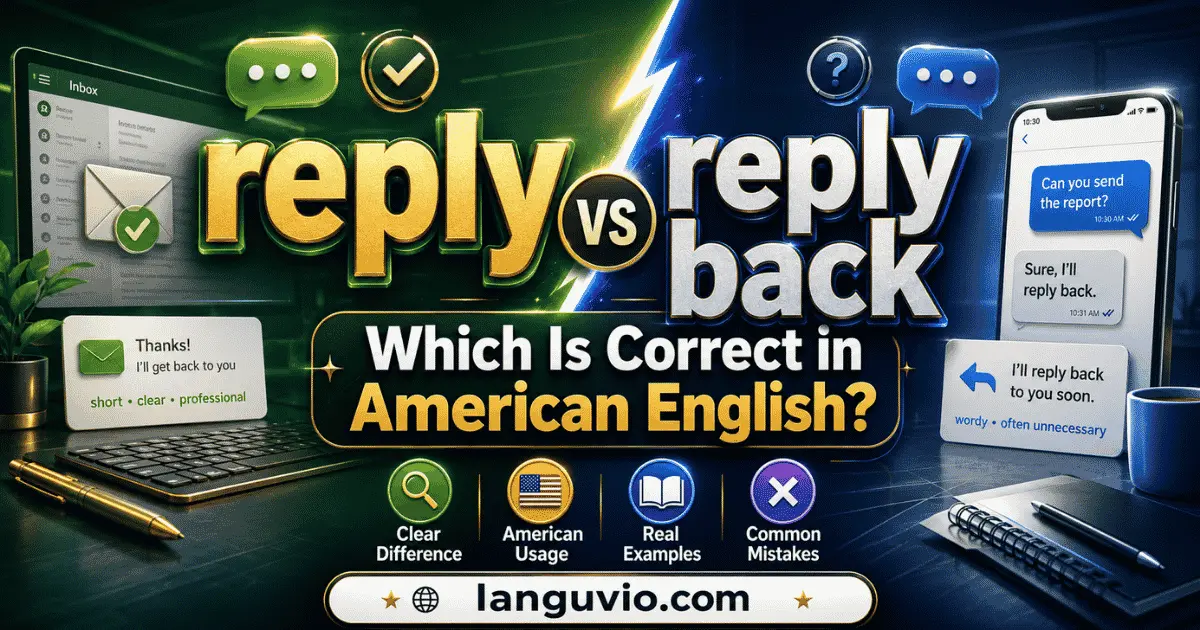
Should you say reply or reply back when asking someone to answer a message?
In most situations, reply is the clearer and more natural choice. The word already means to answer or respond to something, so adding back usually repeats an idea that is already present.
However, reply back does occur in everyday English. It is understandable and can sound natural in casual conversation. The main issue is usually unnecessary wording, not a completely different meaning.
Quick Answer
Use reply as your default choice in American English.
Say:
“Please reply by Friday.”
“I replied to her email.”
“Did he reply yet?”
Reply back usually means the same thing, but back adds little or nothing:
“Please reply back by Friday.”
This sentence is understandable, but “Please reply by Friday” is shorter and more polished.
For professional, academic, and careful everyday writing, reply is generally the better choice.
Why People Confuse Them
The confusion makes sense because English has many expressions in which back clearly shows a return action.
We say call back, write back, and get back to someone. Because a reply also travels from one person back to another, speakers sometimes naturally add back and say reply back.
That does not usually create a new meaning, though. Reply already expresses the idea of giving an answer or response.
As a result, back often works as conversational emphasis rather than necessary information.
Key Differences At A Glance
| Context | Best Choice | Why |
| Professional email | reply | Clear, concise, and standard |
| School or academic writing | reply | Avoids unnecessary wording |
| Formal communication | reply | Sounds more polished |
| Everyday texting | reply | Natural and sufficient |
| Casual conversation | reply / reply back | Both may occur, but reply is shorter |
| Asking for an answer | reply | The return-response meaning is already included |
The safest rule is simple: choose reply unless you have a clear reason to emphasize the idea of communication coming back to someone.
Meaning and Usage Difference
Reply means to give an answer or respond to something someone has said, written, asked, or done.
For example:
“Maria replied to my text.”
“Please reply before noon.”
“He replied that he would attend.”
The standard structure is often reply to + person or thing:
“Reply to James.”
“Reply to the message.”
“Reply to my question.”
Reply back combines the verb reply with the adverb back. In ordinary use, it normally refers to the same return communication.
- reply: standard, concise, and widely suitable
- reply back: understandable and used conversationally, but usually more wordy
- Meaning difference: usually little or none
- Best general choice: reply
Compare:
“Please reply when you have the final numbers.”
“Please reply back when you have the final numbers.”
Both requests are clear. The first is more concise.
Tone, Context, and Formality
Reply has a neutral tone. It works naturally in casual texts, business communication, customer messages, school assignments, and more formal writing.
“Please reply by Tuesday.”
“I’ll reply after the meeting.”
“She never replied to my message.”
Reply back often feels more conversational.
“I texted him, but he never replied back.”
This type of sentence is common enough to understand immediately. Still, removing back makes the sentence tighter:
“I texted him, but he never replied.”
In edited or professional writing, unnecessary words can make a sentence feel less polished. For that reason, reply is usually preferable.
Which One Should You Use?
Choose reply in nearly every situation where you mean “give an answer” or “respond.”
Use it for texts:
“Reply when you get home.”
Use it for workplace communication:
“Please reply to the request by 3 p.m.”
Use it when describing a conversation:
“She replied that she was busy.”
You may hear reply back in relaxed conversation, especially when a speaker wants to stress that another person should send communication back.
For example:
“Message them today and see whether they reply back.”
The sentence is understandable, but “see whether they reply” communicates the same idea more efficiently.
Therefore, reply back is not usually needed simply to show who is responding to whom.
When One Choice Sounds Wrong
Reply back can sound awkward when the sentence already makes the return direction obvious.
Wordy:
“Please reply back to my email with your answer.”
Cleaner:
“Please reply to my email with your answer.”
Another common problem is confusing reply back with answer back.
Answer back can have a special meaning involving a rude, argumentative, or challenging response, especially toward someone in authority.
Reply back does not automatically carry that meaning.
Therefore:
“The student answered back to the teacher.”
may suggest disrespect.
“The student replied to the teacher.”
simply describes a response.
Do not assume that adding back to reply creates the same special meaning.
Common Mistakes (and Quick Fixes)
A frequent error is leaving out to before the person or message receiving the response.
Less standard:
“Please reply me tomorrow.”
Standard:
“Please reply to me tomorrow.”
Another mistake is assuming reply back must always be treated as impossible English. People do use the expression, especially in conversation. The more accurate editing advice is usually to remove back because it is unnecessary.
Wordy:
“I’ll reply back after lunch.”
Better:
“I’ll reply after lunch.”
Also avoid adding back when the sentence already contains another return idea:
Wordy:
“Get back to me and reply back with your decision.”
Better:
“Get back to me with your decision.”
Everyday Examples
Here are natural examples of reply:
“Did Maya reply to your text?”
“I’ll reply after I check my schedule.”
“Please reply by Monday if you plan to attend.”
“He read the message but didn’t reply.”
“She replied with a quick thank-you.”
“Our manager replied that the meeting had been moved.”
Now compare some conversational uses of reply back:
“She finally replied back last night.”
“Can you reply back when you see this?”
“I sent two messages, but he never replied back.”
These sentences are understandable, but each can be shortened naturally:
“She finally replied last night.”
“Can you reply when you see this?”
“I sent two messages, but he never replied.”
The shorter versions lose no important meaning.
Dictionary-Style Word Details
Verb
reply: A standard verb meaning to answer or respond in speech, writing, or sometimes through an action.
Example: “She replied to my question.”
It commonly appears with to before the person, question, message, or other thing receiving the response.
reply back: A verb-plus-adverb combination. It generally means to reply or send a response back. In most ordinary contexts, back is optional and does not create a separate core meaning.
Example: “He replied back later that evening.”
More concise: “He replied later that evening.”
Noun
reply: A standard noun meaning an answer or response.
Example: “I received a reply this morning.”
The plural is replies.
reply back: Not normally treated as a separate compound noun with its own distinct standard meaning.
A speaker might say, “I finally got a reply back,” but reply remains the noun, and back adds a return-direction idea that is usually unnecessary.
Cleaner: “I finally got a reply.”
Synonyms
reply: Depending on context, close alternatives include respond and answer.
Example:
“Please reply today.”
“Please respond today.”
These can be close in meaning, although their grammar and tone may differ in some sentences.
reply back: The closest plain alternative is usually simply reply.
In some situations, get back to someone may fit, especially when the speaker means contacting someone again later after checking information.
There is no useful single antonym that directly opposes every meaning of either expression, so forcing one would be misleading.
Example Sentences
reply:
“Please reply to the invitation by Friday.”
“I forgot to reply to Noah’s message.”
“She replied that she needed more time.”
“We received a helpful reply from customer service.”
reply back:
“Can you reply back tonight?”
“He never replied back after the interview.”
Both examples are understandable, but the more concise versions are:
“Can you reply tonight?”
“He never replied after the interview.”
Word History
reply: The word entered English through earlier French forms and ultimately traces to Latin replicare. Its historical development included ideas connected with answering or responding.
Modern usage should be judged by the word’s current meaning rather than by etymology alone. Today, reply itself already expresses the act of giving an answer or response.
reply back: This is not generally treated as a separate historical word with an independent origin. It combines reply with back.
Because the modern meaning of reply already includes responding, back is usually unnecessary in ordinary contexts.
Phrases Containing
reply:
- reply to someone
- reply to a message
- reply with an answer
- in reply to
- receive a reply
- no reply
- await a reply
Examples:
“Please reply to the email.”
“In reply to your question, the date has been changed.”
reply back:
Common conversational combinations include:
- reply back to me
- please reply back
- reply back later
- reply back by Friday
These forms are understandable, but in most cases they can be simplified:
“Reply to me.”
“Please reply.”
“Reply later.”
“Reply by Friday.”
FAQs
“Reply back” is understandable and widely used in everyday conversation. However, reply already means to answer or respond, so back is usually unnecessary. In most writing, especially professional or formal communication, simply using reply sounds cleaner and more concise.
Please reply is usually the better choice. It is direct, natural, and complete. “Please reply back” has the same basic meaning, but the word back normally adds no important information.
In most situations, yes. The verb reply already includes the idea of giving a response. Because of that, adding back often repeats part of the meaning. Still, the phrase occurs naturally in casual speech and is not difficult to understand.
Usually, no. Standard American English normally uses reply to before a person or message. Say, “Please reply to me,” not “Please reply me.” You can also say, “Please reply to my email” or “She replied to his question.”
Yes. As a verb, it means to respond: “She replied quickly.” As a noun, it means an answer or response: “I received her reply this morning.”
Choose reply in most situations. It works naturally in emails, texts, workplace messages, school writing, and everyday conversation. Reply back may appear informally, but it is usually wordier without adding a clear new meaning.
Conclusion
In the reply vs reply back choice, reply is usually the better option.
It already means to answer or respond, so back normally adds no necessary meaning. Reply is concise, natural, and appropriate in casual, professional, and formal American English.
Reply back does occur in real conversation and writing, so calling it universally impossible would go too far. Still, it is usually wordier than necessary.
When in doubt, keep it simple: use reply.