
“Revert” and “reply” can appear in the same workplace setting, especially in email, but they do not usually mean the same thing in American English.
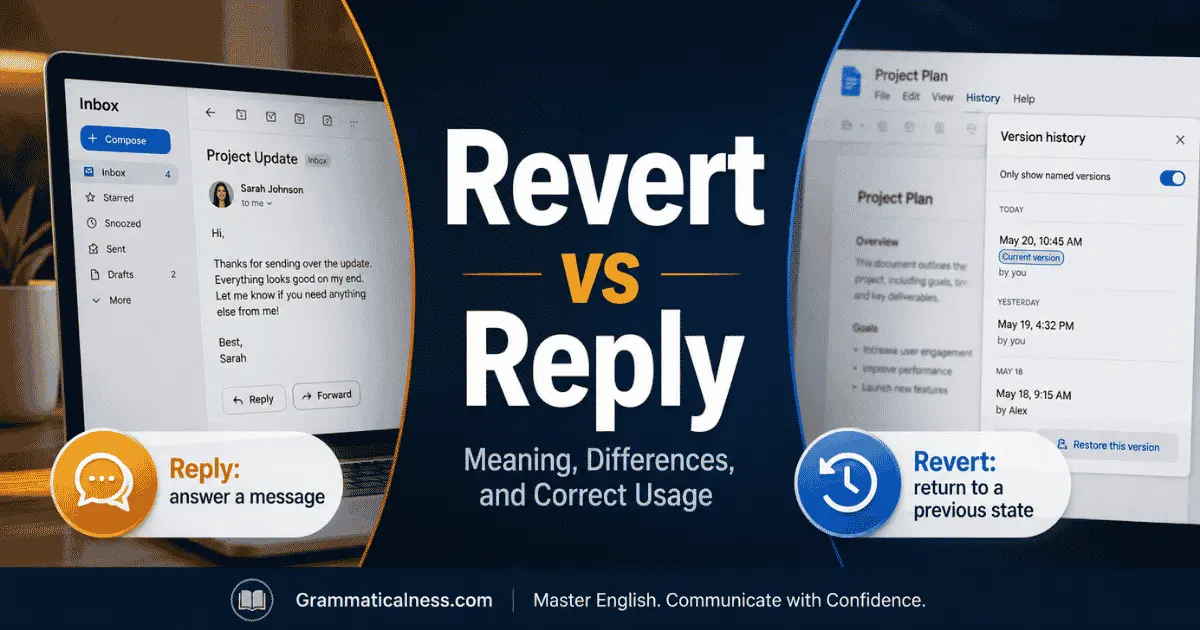
Use reply when you mean “answer” or “respond.” Use revert when something returns to an earlier state, condition, practice, or subject.
A regional exception exists. In Indian English, revert can mean “reply” or “get back to someone.” That usage is established regionally, but it may sound unusual or unclear to many US readers.
Quick Answer
For a US audience, choose reply when you are answering an email, text, question, request, or comment.
- “Please reply by Friday.”
- “She replied to my email.”
Choose revert when something goes back to an earlier state or way of doing things.
- “The settings reverted to their defaults.”
- “After one week, the team reverted to the old schedule.”
So, in most American business communication, “Please reply” is clearer than “Please revert.”
Why People Confuse Them
The confusion is strongest in workplace email. In some varieties of English, especially Indian English, revert is used to mean “reply” or “report back.” That makes sentences such as “Please revert with your comments” familiar to many international professionals.
American readers, however, are more likely to understand revert in its return-to-an-earlier-state sense. As a result, “I will revert tomorrow” may sound as though something will change back rather than as though the writer will answer.
The safest choice for mixed or US-based audiences is simple: use reply for communication and revert for returning.
Key Differences At A Glance
| Feature | revert | reply |
| Core meaning | Return to an earlier state, condition, practice, or subject | Give an answer or response |
| Common US email use | Not the clearest choice for “answer” | Standard and natural |
| Grammar | Mainly used as a verb in everyday US English | Common as both a verb and a noun |
| Typical pattern | revert to + earlier state/practice | reply to + person/message; reply with + information |
| Regional note | Can mean “reply” in Indian English | Widely understood as “answer” |
Meaning and Usage Difference
The basic difference is the action each word describes.
Revert usually means to go back. A software setting can revert to default. A person can revert to an old habit. A discussion can revert to an earlier topic.
The word often appears with to because the sentence identifies the earlier state, condition, practice, or subject:
- “The system reverted to its previous settings.”
- “He reverted to his old routine.”
Reply means to answer or respond. You can reply to an email, question, text, complaint, or person.
- “Please reply to my message.”
- “She replied with the requested information.”
As a noun, reply means the answer itself:
- “I received her reply this morning.”
This makes the choice practical. Ask what is happening: Is someone answering, or is something returning?
If someone is answering, reply is usually right. If something is going back to an earlier condition, revert is usually right.
Tone, Context, and Formality
Reply works in casual, professional, and formal American English. It is direct without sounding abrupt.
“Please reply by noon” is suitable for ordinary workplace communication. “We await your reply” sounds more formal, while “Thanks for your reply” is neutral and common.
Revert can sound more technical or formal when used in its usual US sense:
“The system will revert to the previous configuration.”
In international business communication, you may also see revert used for “reply.” That wording may be natural within a regional workplace culture, but it is less clear for a broad US audience.
Neither word is automatically more professional. The better word is the one that expresses the intended meaning clearly.
Which One Should You Use?
Use this table as the main decision guide:
| Context | Best Choice | Why |
| Answering an email | reply | It directly means to answer a message |
| Responding to a question | reply | The action is communication, not returning |
| Sending requested information back | reply | “Reply with the details” is clear in US English |
| Software returns to an earlier setting | revert | The system goes back to a previous state |
| Someone returns to an old habit | revert | The person resumes an earlier behavior |
| Conversation returns to an earlier subject | revert | The discussion goes back to a previous topic |
| Writing for a mixed international audience | reply for an answer | It reduces regional ambiguity |
A useful test is to replace the word with answer.
If the sentence still means what you intend, reply is probably the better choice:
“Please answer my email.” → “Please reply to my email.”
If go back or return fits better, use revert:
“The settings returned to default.” → “The settings reverted to default.”
When One Choice Sounds Wrong
“Please revert to my email” sounds unnatural to many American readers when the intended meaning is “Please answer my email.”
Write:
“Please reply to my email.”
Similarly, “I received your revert” is unusual in ordinary American English.
Use:
“I received your reply.”
On the other hand, this sentence uses the wrong word:
“The software replied to the previous version.”
Software is not answering a message. The intended meaning is that it returned to an earlier version:
“The software reverted to the previous version.”
Be careful with revert back as well. Because revert already carries the idea of returning, back is often unnecessary.
Cleaner:
“The schedule reverted to normal.”
Wordier:
“The schedule reverted back to normal.”
The longer form does occur in real usage, but removing back often makes the sentence tighter.
Common Mistakes (and Quick Fixes)
Mistake: “Kindly revert by Monday.”
Clearer for US readers: “Please reply by Monday.”
Mistake: “I will revert to you after checking.”
Clearer: “I will reply after checking,” or “I will get back to you after checking.”
Mistake: “Please revert with the signed form.”
Clearer: “Please reply with the signed form attached.”
Mistake: “The app replied to its old settings.”
Correct: “The app reverted to its old settings.”
Mistake: Treating regional usage as universally incorrect.
Fix: Recognize that revert can mean “reply” in Indian English, while choosing reply when writing specifically for a US or broad international audience.
Everyday Examples
Here are natural examples that show the contrast:
- “I emailed the landlord yesterday, but she has not replied yet.”
- “Please reply with your preferred meeting time.”
- “His reply answered all three questions.”
- “After the update failed, the phone reverted to the previous settings.”
- “She reverted to her old morning routine after vacation.”
- “The discussion kept reverting to the budget.”
- “I’ll reply after I review the contract.”
- “If the test fails, the system will revert to the earlier configuration.”
Notice the pattern: reply centers on an answer. Revert centers on a return.
Dictionary-Style Word Details
Verb
revert: A verb meaning to return to an earlier state, condition, practice, subject, or ownership situation. In Indian English, it can also mean to reply, often in formal or business contexts.
Example: “The team reverted to the original plan.”
reply: A verb meaning to answer in speech, writing, or another response.
Example: “She replied to the customer within an hour.”
Noun
revert: Not commonly used as an everyday noun in modern American English. Some dictionaries record rare noun senses, but it is not the normal word for an email answer.
Do not normally write:
“I received your revert.”
Prefer:
“I received your reply.”
reply: A common countable noun meaning an answer or response.
Example: “We received a helpful reply.”
Synonyms
revert: Closest plain alternatives include return and go back. In some negative contexts, relapse or lapse may fit, but they are not exact substitutes in every sentence.
Contextual opposites can include advance or progress when the contrast is moving forward rather than returning.
reply: Close alternatives include answer and respond as verbs, and answer or response as nouns.
There is no single exact antonym that fits every use of reply. In communication, silence or no response can express the practical opposite.
Example Sentences
revert:
- “The website reverted to the earlier layout.”
- “After trying a new system, the office reverted to its old process.”
- “Let’s not revert to the same argument.”
reply:
- “Please reply when you have the final numbers.”
- “He replied that he could attend.”
- “Her reply arrived the next morning.”
Word History
revert: The word came into English through French and ultimately from Latin roots connected with turning or returning. Its long-established core meaning is tied to going back to an earlier state or position.
reply: The word entered English through Anglo-French and is historically connected with Latin forms involving folding back and responding. Over time, its ordinary meaning developed into the familiar sense of answering or responding.
The histories share a broad idea of something going “back,” but that does not make the two words interchangeable in modern American usage.
Phrases Containing
revert: Common patterns include:
- revert to
- revert to normal
- revert to default
- revert to an earlier version
- revert to type
reply: Common patterns include:
- reply to
- reply with
- in reply to
- await a reply
- send a reply
In regional business English, you may also encounter phrases such as “please revert” or “revert with details.”
For US-facing writing, “please reply” or “reply with details” is usually clearer.
FAQs
Not usually in American English. Reply means to answer a message, question, email, or comment. Revert usually means to return to an earlier state, condition, habit, or version. In some varieties of English, especially Indian English, revert can also mean reply.
For a US audience, “please reply” is the clearer and more natural choice. For example, write “Please reply by Friday” instead of “Please revert by Friday” when you want someone to answer your message.
This expression is common in some regional forms of business English, but it can sound unusual to American readers. In US English, “I will reply,” “I will get back to you,” or “I will respond” is usually clearer.
Yes, but its meaning should be clear. In American English, revert is best used when something returns to an earlier state, such as “The system reverted to its previous settings.” For answering an email, reply is normally preferred.
The phrase appears in real usage, but back is often unnecessary because revert already carries the idea of returning. “The settings reverted to default” is usually cleaner than “The settings reverted back to default.”
Yes. As a verb, reply means to answer: “She replied to my email.” As a noun, it means the response itself: “I received her reply this morning.” This flexibility makes reply especially common in everyday and professional American English.
Conclusion
The choice between revert and reply depends on what is actually happening.
Use reply when someone gives an answer or response:
“Please reply to my email.”
Use revert when something returns to an earlier state, habit, system, or subject:
“The settings reverted to default.”
The main exception is regional usage. In Indian English, revert can mean “reply,” especially in formal communication. That usage is real, but for clear American English, reply remains the safer and more natural choice when you mean “answer.”