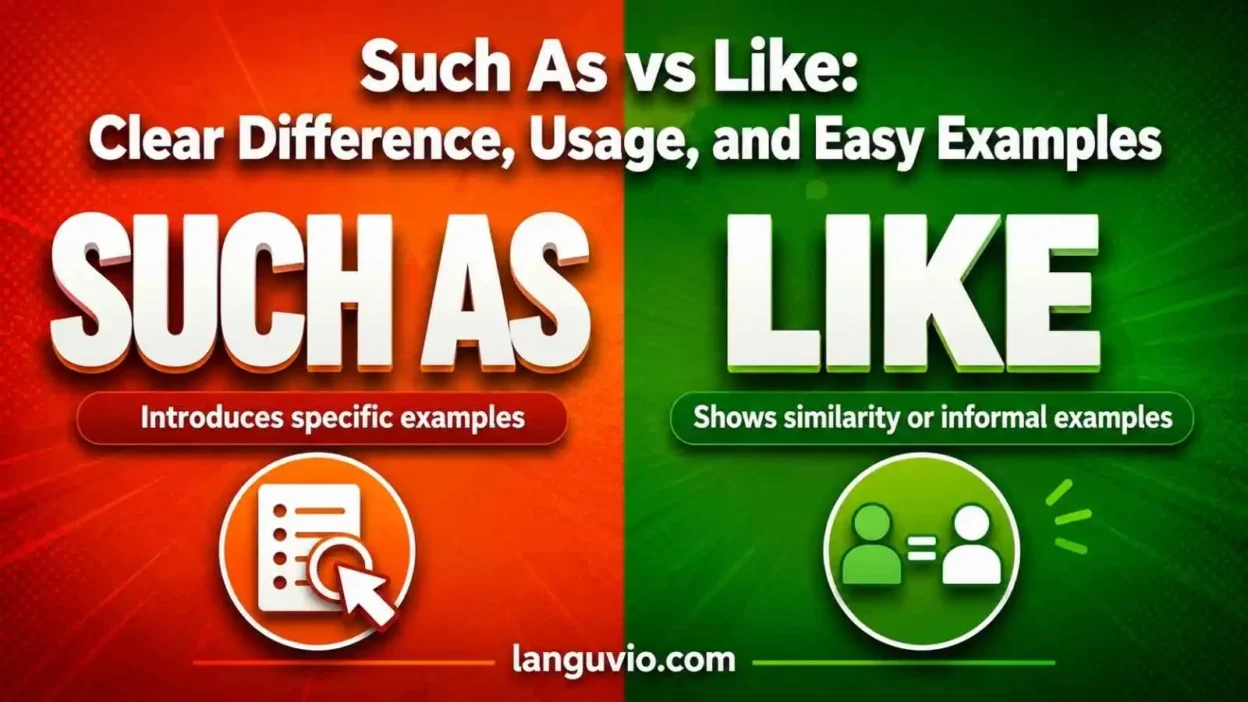
Such as and like are both correct, but they do not always mean the same thing. The best choice depends on whether you are naming real examples or making a looser comparison.
This guide explains the difference in simple US English. You will learn when such as sounds clearer, when like sounds natural, and how to avoid common mistakes in school, work, and everyday writing.
Quick Answer
Use such as when you mean “including these examples.” Use like when you mean “similar to these examples.” In casual English, like often introduces examples too, but such as is usually clearer and more polished in formal writing.
Why People Confuse Them
People confuse such as and like because both can appear before a list.
You might hear:
“I enjoy outdoor activities like hiking and kayaking.”
You might also see:
“I enjoy outdoor activities such as hiking and kayaking.”
Both sentences sound normal. The difference is the exact meaning. Such as clearly says hiking and kayaking are included in the outdoor activities. Like may mean those activities, or activities similar to them.
That difference matters more in careful writing than in relaxed speech.
Key Differences At A Glance
| Context | Best Choice | Why |
| Naming real examples from a group | such as | It means the examples are included |
| Making a comparison | like | It means similar to |
| Formal school or business writing | such as | It sounds more exact |
| Casual conversation | like | It sounds natural and relaxed |
| Avoiding possible confusion | such as | It makes the list feel specific |
| Describing similarity, style, or resemblance | like | It fits comparison better |
Meaning and Usage Difference
Such as introduces examples. It points to real members of a group.
Correct: The store sells fresh fruit, such as apples, oranges, and pears.
This means apples, oranges, and pears are examples of the fresh fruit sold at the store.
Like often shows similarity. It compares one thing with another.
Correct: This fabric feels like silk.
This means the fabric feels similar to silk. It may not be silk.
The difference becomes clearer when the sentence changes meaning:
“I want to visit cities such as Boston and Seattle.”
This means Boston and Seattle are possible cities on the list.
“I want to visit cities like Boston and Seattle.”
This may mean the speaker wants cities similar to Boston and Seattle. The speaker may or may not mean those exact cities.
In everyday speech, many people use like for examples. That is common and usually understood. Still, such as is the safer choice when precision matters.
Tone, Context, and Formality
Such as sounds more formal, careful, and written. It works well in essays, reports, guides, business copy, and professional emails.
Example: Our team reviews costs such as payroll, software, and shipping.
Like sounds more conversational. It works well in speech, casual posts, captions, and relaxed writing.
Example: I like simple lunches like soup, salad, and sandwiches.
Neither term is automatically wrong. The tone just changes.
Use such as when the list should feel exact. Use like when the sentence needs a lighter, more natural sound or when you are comparing one thing to another.
Pronunciation does not usually affect this choice. Both terms are easy to recognize, and the confusion is mainly about meaning, not sound.
Which One Should You Use?
Choose such as when you can replace it with including.
Natural: Bring a photo ID, such as a driver’s license or passport.
Test: Bring a photo ID, including a driver’s license or passport.
Choose like when you can replace it with similar to.
Natural: She wants a phone case like mine.
Test: She wants a phone case similar to mine.
Here is the simplest rule:
• Such as = including these examples
• Like = similar to this or these
However, do not treat that rule as absolute in casual English. People often use like to give examples, and it often sounds perfectly natural.
When One Choice Sounds Wrong
Such as can sound wrong when the sentence is only making a comparison.
Wrong: This candle smells such as vanilla.
Correct: This candle smells like vanilla.
The candle is not an example of vanilla. It smells similar to vanilla, so like is the right choice.
Like can sound less clear when the sentence names exact examples that are part of a group.
Less clear: The policy covers expenses like meals and parking.
Clearer: The policy covers expenses such as meals and parking.
The second version makes it clearer that meals and parking are included examples of covered expenses.
Common Mistakes (and Quick Fixes)
Mistake 1: Using such as for simple resemblance
Incorrect: Her voice sounds such as her mother’s.
Correct: Her voice sounds like her mother’s.
Mistake 2: Using like when exact examples matter
Less precise: Submit documents like tax forms and bank statements.
Better: Submit documents such as tax forms and bank statements.
Mistake 3: Adding a colon right after such as
Incorrect: Bring supplies such as: pens, paper, and folders.
Correct: Bring supplies such as pens, paper, and folders.
Mistake 4: Using as alone to introduce examples
Incorrect: We offer services as editing, formatting, and coaching.
Correct: We offer services such as editing, formatting, and coaching.
Mistake 5: Thinking like is always wrong for examples
Too strict: Never use like before a list.
Better: Use such as for clearer formal writing, but like is common in casual example lists.
Everyday Examples
Correct: We visited popular parks such as Yosemite and Zion.
Correct: I want to visit parks like Yosemite and Zion.
The first sentence names Yosemite and Zion as examples. The second sentence may mean parks similar to them.
Correct: She enjoys creative hobbies such as painting and pottery.
Correct: She enjoys creative hobbies like painting and pottery.
Both sound natural. Such as sounds a little more polished.
Correct: This jacket feels like wool.
Incorrect: This jacket feels such as wool.
Use like because the sentence describes similarity.
Correct: Apps such as Venmo and PayPal make payments easier.
Natural but more casual: Apps like Venmo and PayPal make payments easier.
Both can work, but such as sounds more exact.
Dictionary-Style Word Details
Verb
• Such as: Not commonly used as a verb in standard US English. In this comparison, such as works as a phrase that introduces examples.
• Like: Like can be a verb meaning to enjoy, prefer, or approve of something. Example: “I like coffee.” That verb use is separate from the such as vs like choice.
Noun
• Such as: Not commonly used as a noun in standard US English.
• Like: Like can be a noun, often meaning something a person enjoys or a reaction on a post. Example: “Her likes include hiking and live music.” This noun use is not the same as like for similarity.
Synonyms
• Such as: Closest plain alternatives include including, for example, and for instance. Use them when you want to introduce real examples.
• Like: Closest plain alternatives include similar to, resembling, and in the same style as. Use them when you want to show comparison.
Clear antonyms do not fit these phrases well because they are function words in this comparison, not simple opposite-meaning words.
Example Sentences
• Such as: The gym offers classes such as yoga, boxing, and cycling.
• Such as: Please bring a valid ID, such as a passport or driver’s license.
• Such as: The article covers grammar issues such as commas and word choice.
• Like: The clouds looked like cotton.
• Like: He wants a backpack like yours.
• Like: We need a quiet place like the library.
Word History
• Such as: Such as is a fixed phrase made from such and as. In modern use, it introduces examples or points to a specified kind.
• Like: Like has several roles in English. In this comparison, its main job is to show similarity or introduce a casual example list.
The origin of these terms is not needed to choose correctly today. Meaning and sentence context matter more.
Phrases Containing
• Such as:
• such as this
• such as these
• such as the following
• examples such as
• cases such as this one
• Like:
• looks like
• sounds like
• feels like
• tastes like
• people like us
• something like that
• just like
FAQs
Is “such as” more correct than “like”?
No. Such as is not always more correct than like. The better choice depends on meaning. Use such as when you are naming real examples from a group. Use like when you mean “similar to.” In formal writing, such as often sounds clearer before a list.
Can I use “like” to give examples?
Yes, especially in everyday English. Many people say things like “I enjoy sports like basketball and tennis.” That sentence sounds natural. However, if you want to be very clear that basketball and tennis are included examples, such as is the stronger choice.
What is the easiest way to choose between them?
Try replacing the phrase with including or similar to. If including fits, use such as. Example: “Bring documents such as your ID and lease.” If similar to fits, use like. Example: “This jacket feels like leather.”
Is “such as” too formal for normal writing?
No. Such as works well in normal writing, especially when you want clarity. It may sound a little more polished than like, but it does not sound strange. It is common in guides, emails, reports, school writing, and business writing.
Do I need a comma before “such as”?
Sometimes. Use commas when the examples add extra information that is not essential. Example: “Some fruits, such as oranges and lemons, are high in vitamin C.” Do not use commas when the examples are needed to complete the meaning. Example: “Foods such as rice and beans are affordable.”
Which is better: “apps like Venmo” or “apps such as Venmo”?
Both can work. Apps like Venmo sounds casual and may mean apps similar to Venmo. Apps such as Venmo sounds more exact and clearly names Venmo as an example.
Conclusion
Such as and like are both useful, but they work best in different situations. Use such as when you want to introduce included examples. Use like when you want to compare, show resemblance, or sound more casual.
For clear formal writing, such as is usually the better choice before a list. For everyday speech and natural comparisons, like often sounds better.
No. Such as is not always more correct than like. The better choice depends on meaning. Use such as when you are naming real examples from a group. Use like when you mean “similar to.” In formal writing, such as often sounds clearer before a list.
Yes, especially in everyday English. Many people say things like “I enjoy sports like basketball and tennis.” That sentence sounds natural. However, if you want to be very clear that basketball and tennis are included examples, such as is the stronger choice.
Try replacing the phrase with including or similar to. If including fits, use such as. Example: “Bring documents such as your ID and lease.” If similar to fits, use like. Example: “This jacket feels like leather.”
No. Such as works well in normal writing, especially when you want clarity. It may sound a little more polished than like, but it does not sound strange. It is common in guides, emails, reports, school writing, and business writing.
Sometimes. Use commas when the examples add extra information that is not essential. Example: “Some fruits, such as oranges and lemons, are high in vitamin C.” Do not use commas when the examples are needed to complete the meaning. Example: “Foods such as rice and beans are affordable.”
Both can work. Apps like Venmo sounds casual and may mean apps similar to Venmo. Apps such as Venmo sounds more exact and clearly names Venmo as an example.