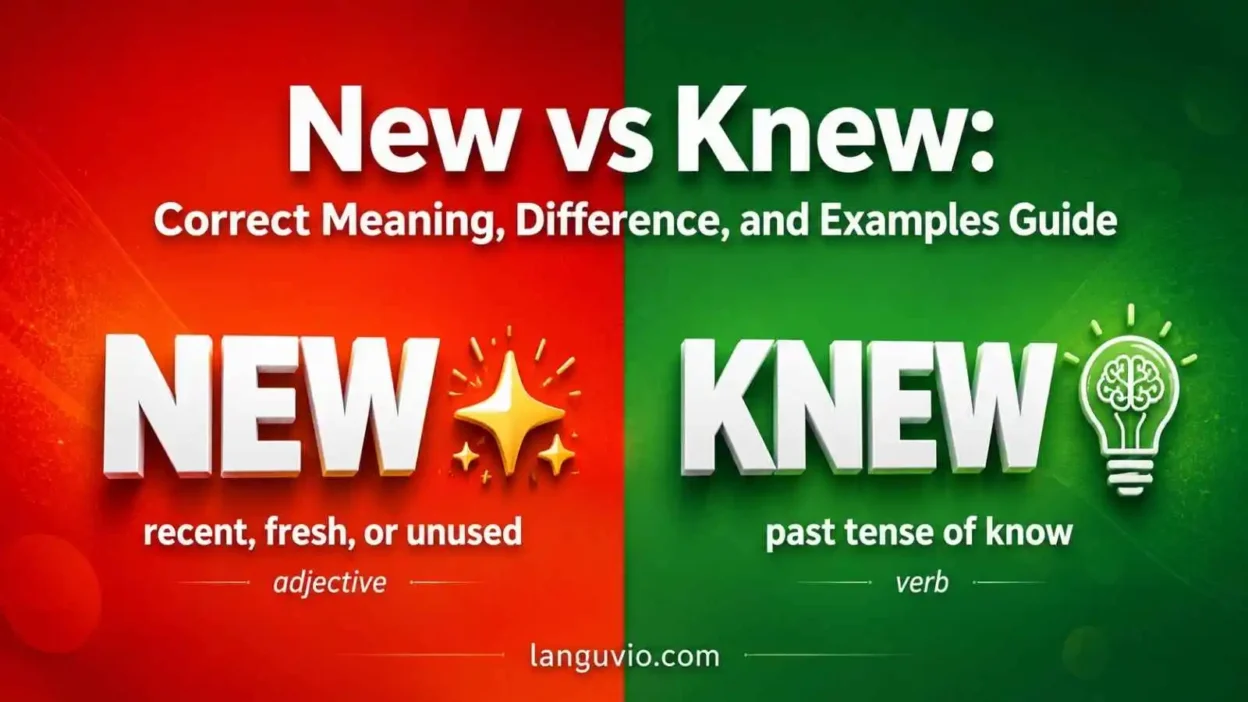
New vs knew is a common word-choice problem because the two words sound the same in everyday American English. The spelling changes the meaning completely.
Use new when you mean something recent, different, unfamiliar, or unused. Use knew when you mean someone had knowledge, awareness, or familiarity in the past.
They are not interchangeable. One describes a thing, person, idea, place, or situation. The other tells what someone understood or was aware of before now.
Quick Answer
New usually works as an adjective. It describes something that has recently appeared, recently changed, or has not been used before.
Example:
I bought a new laptop for work.
Knew is a verb. It is the past tense of know.
Example:
I knew the answer before she explained it.
A fast test: if you can replace the word with “was aware of,” use knew. If the word describes a noun, use new.
Why People Confuse Them
People confuse new and knew because they are homophones. In American English, both are commonly pronounced like “noo.” The k in knew is silent.
That means your ear cannot always help you choose the right spelling. You have to look at the job the word is doing in the sentence.
The confusion often happens in fast typing, school assignments, text messages, and emails. Someone may hear the right sound in their head but choose the wrong spelling on the page.
Key Differences At A Glance
| Context | Best Choice | Why |
| Something recently made | new | It describes a recent object or idea. |
| Something not used before | new | It describes condition. |
| A different person, place, or thing | new | It shows a change from the old one. |
| Past awareness | knew | It is the past tense of know. |
| Past understanding | knew | It tells what someone understood before now. |
| Familiarity with a person or place | knew | It shows past personal knowledge. |
| “Brand ___ phone” | new | Brand new is the correct phrase. |
| “I ___ the answer” | knew | The sentence needs a past-tense verb. |
Compact comparison block:
- New = recent, unused, unfamiliar, or different.
- Knew = understood, realized, recognized, or was aware of in the past.
- New usually comes before a noun: new job, new car, new idea.
- Knew usually follows a subject: I knew, she knew, they knew.
- New describes.
- Knew tells what someone knew before now.
Meaning and Usage Difference
New points to freshness, recentness, difference, or lack of previous use.
You can have a new phone, a new teacher, a new rule, a new city, or a new idea. The item does not always have to be newly created. It can simply be new to the person using it.
Example:
We moved into a new apartment last week.
The apartment may not be newly built. It is new for the people who moved in.
Knew points to knowledge in the past. It can mean someone had information, understood something, recognized someone, or was familiar with a person, fact, place, or situation.
Example:
She knew the meeting would run late.
Here, knew tells us what she understood before the meeting ended.
Pronunciation matters here because the words sound alike. In regular US speech, new and knew are both usually pronounced “noo.” The difference is spelling, meaning, and sentence role.
Tone, Context, and Formality
There is no strong formality difference between new and knew. Both words are normal in casual, school, business, and formal writing.
The difference is not tone. It is grammar and meaning.
Use new in everyday descriptions:
The company opened a new office.
I need a new password.
She is still new to the team.
Use knew when the sentence is about past knowledge:
The manager knew about the delay.
I knew we had met before.
They knew how to fix the issue.
In professional writing, mixing them up can look careless because the error is easy to notice. A sentence like “I new the deadline” does not just look informal. It is incorrect because the sentence needs a verb.
Which One Should You Use?
Choose new when the word describes a noun or a state.
Use new for:
a new car
a new idea
a new employee
a new chapter
new information
new to the neighborhood
Choose knew when the word tells what a person or group understood in the past.
Use knew for:
I knew the answer.
She knew him in college.
We knew the plan would change.
They knew about the problem.
He knew how to respond.
A simple sentence test helps:
“I ___ the address.”
Can you say “I was aware of the address”? Yes. Use knew.
“She bought a ___ jacket.”
Can you say “a recent jacket” or “an unused jacket”? Yes. Use new.
When One Choice Sounds Wrong
New sounds wrong when the sentence needs an action or state of knowing.
Wrong: I new she was upset.
Right: I knew she was upset.
Wrong: They new the answer.
Right: They knew the answer.
Wrong: He new better than to lie.
Right: He knew better than to lie.
Knew sounds wrong when the sentence describes a person, place, thing, idea, or condition.
Wrong: I bought a knew phone.
Right: I bought a new phone.
Wrong: We hired a knew assistant.
Right: We hired a new assistant.
Wrong: This is a knew problem for us.
Right: This is a new problem for us.
Common Mistakes (and Quick Fixes)
One common mistake is using new after a subject when the sentence needs the past tense of know.
Wrong: I new you would call.
Right: I knew you would call.
Another common mistake is using knew before a noun.
Wrong: She has a knew schedule.
Right: She has a new schedule.
A third mistake appears in fixed phrases.
Wrong: He got a knew lease on life.
Right: He got a new lease on life.
Wrong: She new better than to argue.
Right: She knew better than to argue.
Also watch for brand-new. It uses new, not knew.
Right: They bought a brand-new couch.
Wrong: They bought a brand-knew couch.
Everyday Examples
I started a new job on Monday.
I knew the training would be difficult.
She bought a new backpack for school.
She knew where her old one was, but it was torn.
We tried a new restaurant downtown.
We knew it would be busy on Friday night.
He made a new friend at soccer practice.
He knew one kid from his math class.
The office has a new coffee machine.
Everyone knew the old one was broken.
I need a new password for my account.
I knew I should have written the old one down.
That is a new rule for our building.
The tenants knew a policy change was coming.
She wore a new jacket to dinner.
I knew she would pick the blue one.
Dictionary-Style Word Details
Verb
new: Not commonly used as a verb in standard US English. In normal writing, use new mainly to describe something.
Example:
The team announced a new policy.
knew: A verb. It is the simple past tense of know. Use it for past awareness, understanding, recognition, or familiarity.
Example:
I knew the policy had changed.
Noun
new: Not commonly used as a regular count noun in everyday US English. You may see the new as a noun phrase meaning new things, new ideas, or a new group, but this is less common than the adjective use.
Example:
Some people welcome the new, while others prefer the familiar.
knew: Not used as a noun in standard modern US English when comparing new and knew.
Example:
Do not write “a knew” when you mean “a new one.”
Synonyms
new: Closest plain alternatives include fresh, recent, unused, different, unfamiliar, and modern, depending on the sentence.
Examples:
a new idea → a fresh idea
a new phone → an unused phone
a new employee → a recent hire
Clear opposites can include old, used, familiar, or former, depending on context.
knew: Closest plain alternatives include was aware of, understood, realized, recognized, and was familiar with.
Examples:
I knew the answer → I understood the answer.
She knew him → She was familiar with him.
They knew the risk → They were aware of the risk.
Clear opposites include did not know, was unaware of, or failed to recognize, depending on the sentence.
Example Sentences
new:
This is my new desk.
We need a new plan before Friday.
She is new to the neighborhood.
The store has new hours this month.
knew:
I knew the answer right away.
They knew about the delay.
He knew her from high school.
We knew the game would be close.
Word History
new: The word has a long history in English and has kept its core idea of recentness, freshness, or difference. For this comparison, the important point is its modern use: new describes something that is not old, not used before, recently introduced, or different from what came before.
knew: The word is the past-tense form of know. Its history belongs with the verb know, but the modern spelling knew is the form writers use when knowledge, awareness, or familiarity happened in the past.
The two words are not related in meaning just because they sound alike today.
Phrases Containing
new:
new car
new job
new idea
new phone
new to town
brand-new
new lease on life
new beginning
new information
knew:
I knew it
who knew
knew better
knew about
knew how
knew him well
never knew
already knew
knew all along
FAQs
New describes something recent, unused, unfamiliar, or different. Knew is the past tense of know and means someone had knowledge or awareness in the past.
Example:
I bought a new phone.
I knew you would like it.
The correct phrase is I knew. Use knew when you mean “I was aware,” “I understood,” or “I had knowledge.”
Correct: I knew the answer.
Incorrect: I new the answer.
Yes. In everyday American English, new and knew are usually pronounced the same, like “noo.” That is why people often confuse them in writing.
In normal modern US English, new is usually not used as a verb. It is most often an adjective.
Example:
She bought a new dress.
No. Knew is not a noun or adjective in standard US English. It is a verb form. More specifically, it is the past tense of know.
Example:
He knew the meeting time.
Use this simple trick: new describes something, while knew tells what someone understood in the past.
A new car = a car that is recent or unused.
I knew = I was aware or I understood.
Conclusion
The difference between new and knew is simple once you check the sentence role.
Use new when you are describing something recent, unused, unfamiliar, or different. Use knew when you mean someone had knowledge, awareness, understanding, or familiarity in the past.
They sound the same, but they do different jobs. If the sentence needs a describing word, choose new. If the sentence means “was aware of” or “understood,” choose knew.