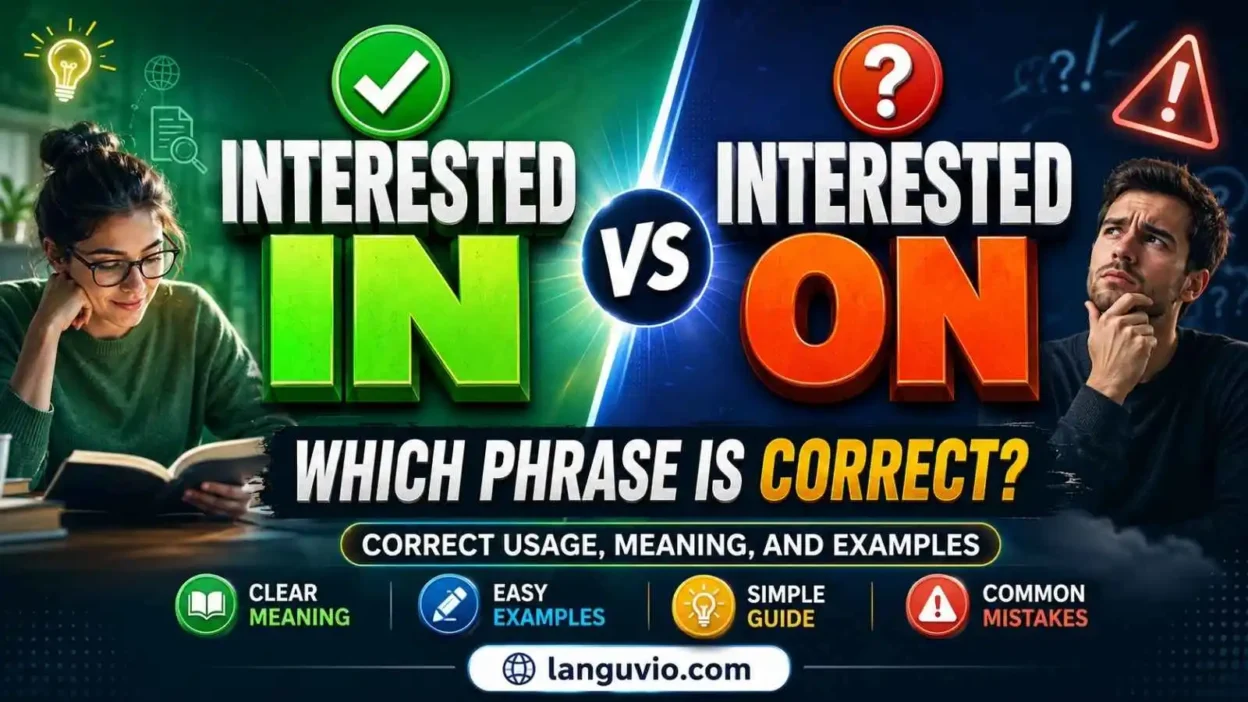
The standard phrase is interested in when you want to express curiosity, attraction, concern, or a desire to participate.
You can be interested in a subject, a person, an activity, an opportunity, or an idea. For example, you might be interested in photography, interested in someone, or interested in applying for a job.
Interested on does not serve as a standard alternative in this structure. It usually sounds unnatural because the adjective interested normally pairs with the preposition in.
Quick Answer
Use interested in before a noun, pronoun, activity, or subject that has someone’s attention.
Correct: She is interested in environmental science.
Incorrect: She is interested on environmental science.
The two expressions are not interchangeable. In standard American English, interested in is the natural choice for this meaning. Replace interested on with interested in unless on belongs to a separate part of the sentence.
Why People Confuse Them
The confusion often comes from other expressions that use on before a subject.
A person can give a presentation on health care, read an article on local history, or attend a lecture on photography. Because on can introduce a topic in those expressions, a learner may also write interested on photography.
English does not use the same preposition after every word related to a subject. A presentation can be on photography, but a person is interested in photography.
The choice depends on the word before the preposition, not only on the topic that follows it.
Key Differences At A Glance
| Context | Best Choice | Why |
| Curiosity about a subject | interested in | This is the standard adjective-preposition pattern. |
| Enjoying an activity | interested in | A gerund can follow the preposition. |
| Attraction to a person | interested in | The phrase can express personal or romantic attention. |
| Considering an opportunity | interested in | It can show a desire to participate or learn more. |
| Formal business communication | interested in | The construction works naturally in professional writing. |
| Introducing the subject of a book | Neither by itself | Use a separate pattern such as “a book on history.” |
| Expressing curiosity with interested on | Avoid it | The pairing is not standard for this meaning. |
Meaning and Usage Difference
Interested in means that something has your attention or that you want to learn about, experience, obtain, or join it.
The phrase can be followed by a noun:
Maria is interested in architecture.
It can also be followed by a pronoun:
The hiring manager is interested in you.
When an action follows, use its -ing form because in functions as a preposition:
We are interested in expanding the program.
The comparison can be reduced to two practical points:
- interested in: The standard phrase for attention, curiosity, attraction, concern, or possible participation.
- interested on: Not a standard replacement for interested in in this structure.
Occasionally, the words interested and on may appear next to each other because on begins a separate phrase. That accidental placement does not make interested on a normal adjective-preposition combination.
For a trusted dictionary reference, Cambridge Dictionary lists interested in someone/something/doing something as the standard collocation for giving attention to someone or something.
Tone, Context, and Formality
Interested in works in casual, academic, professional, and formal situations.
In conversation, someone might say, “I’m interested in that class.” In a job application, an applicant might write, “I am interested in the marketing position.” A researcher may describe participants who are interested in a study.
The phrase itself has a neutral tone. The surrounding words show whether the interest feels casual, serious, professional, financial, or romantic.
Interested on does not create a more formal, technical, or specialized meaning. Using it instead of interested in normally makes the sentence sound incorrect rather than more sophisticated.
Which One Should You Use?
Choose interested in whenever you name the thing, person, subject, activity, or opportunity that attracts someone’s attention.
Use it before concrete subjects:
He is interested in the used car.
Use it before broad fields:
They are interested in public policy.
Use it before activities:
Are you interested in volunteering this weekend?
Use it before clauses introduced by words such as whether, what, or how:
The committee is interested in whether the plan can succeed.
Do not select interested on merely because the following noun describes a topic. The adjective determines the preposition, so in remains the correct choice.
When One Choice Sounds Wrong
Interested on sounds wrong when it directly introduces the object of someone’s curiosity or attention.
Incorrect: I am interested on your proposal.
Correct: I am interested in your proposal.
Incorrect: She became interested on learning Spanish.
Correct: She became interested in learning Spanish.
Incorrect: Are they interested on the apartment?
Correct: Are they interested in the apartment?
However, do not change every nearby on automatically. It may belong to another expression:
She became interested in a documentary on space exploration.
Here, in follows interested, while on introduces the documentary’s subject. Both prepositions are correct because they perform different jobs.
Common Mistakes (and Quick Fixes)
A frequent mistake involves placing on before a school subject or professional field.
Wrong: Tyler is interested on computer science.
Fix: Tyler is interested in computer science.
Another mistake involves using a base verb after in.
Wrong: I am interested in learn more.
Fix: I am interested in learning more.
Because in is a preposition, a following action normally takes the -ing form.
Writers also sometimes confuse interested with interesting.
Wrong: I am interesting in the course.
Fix: I am interested in the course.
Interested describes the person’s feeling. Interesting describes the person or thing that causes that feeling.
Finally, some writers replace in with about.
Less natural: We are interested about the results.
Natural: We are interested in the results.
These corrections follow established word patterns rather than a general rule that assigns one meaning to every preposition.
Everyday Examples
My daughter is interested in dinosaurs and fossils.
I’m interested in hearing more about the position.
Several neighbors are interested in joining the community garden.
The buyer seemed interested in the house, but she wanted another inspection.
Are you interested in going to the concert Friday night?
Our class became interested in local history after visiting the museum.
The coach is interested in players who communicate well.
We are interested in your opinion on the proposed schedule.
In the last example, in completes interested in your opinion. The later on introduces the subject of the opinion. This sentence shows why a writer must examine each preposition’s role instead of replacing every on mechanically.
Dictionary-Style Word Details
Verb
interested in: The complete expression is not a verb by itself. In “She is interested in design,” interested functions as an adjective after is. The related active verb appears in a sentence such as “Design interests her.”
interested on: This combination does not form a standard verb pattern for expressing curiosity, attraction, or involvement.
Noun
interested in: The phrase is not a noun. The related noun construction is interest in, as in “He has an interest in architecture.”
interested on: This phrase is not a noun. Do not confuse it with the separate financial expression interest on a loan, where interest means money charged for borrowing.
Synonyms
interested in: Closest plain alternatives include curious about, drawn to, engaged with, considering, and wanting to learn about. The best alternative depends on context.
Helpful opposites include uninterested in, indifferent to, and not concerned with.
interested on: It has no separate synonyms for this meaning because it is not the standard construction. Replace it with interested in rather than searching for a different definition.
Example Sentences
interested in: Kayla is interested in studying nursing. The company is interested in purchasing the property. I would be interested in hearing your suggestions.
interested on: “The company is interested on purchasing the property” is not standard. Write “The company is interested in purchasing the property.”
Word History
interested in: The form interested is connected to the word interest and the -ed ending. That formation explains the word itself, but it does not provide a simple logical reason for the preposition. Modern English convention uses in for this pattern.
interested on: It did not develop as an equally standard alternative for expressing interest in a person, subject, or activity. Its occasional appearance does not establish a separate accepted meaning.
Phrases Containing
interested in: Common patterns include interested in learning, interested in buying, interested in joining, interested in someone, interested in hearing more, and not interested in.
interested on: No standard phrase family uses this combination to express curiosity or attraction. In ordinary sentences, change it to interested in.
FAQs
Is “interested in” or “interested on” correct?
Interested in is correct in standard American English. Use it when something attracts your attention, curiosity, or concern.
Example: She is interested in graphic design.
Why is “interested on” incorrect?
The adjective interested normally pairs with the preposition in. English uses fixed adjective-preposition combinations, so replacing in with on sounds unnatural.
Incorrect: I am interested on the course.
Correct: I am interested in the course.
Can a verb follow “interested in”?
Yes, but the verb should usually end in -ing because in functions as a preposition.
Correct: We are interested in buying the house.
Incorrect: We are interested in buy the house.
Can “interested in” describe romantic attraction?
Yes. Interested in someone may show personal or romantic attraction, depending on the context.
Example: I think he is interested in Maya.
Can “on” appear later in the same sentence?
Yes. It can introduce the subject of another noun.
Example: I am interested in your report on climate change.
Here, in follows interested, while on introduces the report’s topic.
Is “interested about” also correct?
Interested about is generally unnatural in standard English. Use interested in instead.
Natural: They are interested in the results.
You may use curious about when you want a similar expression.
Example: They are curious about the results.
Conclusion
Use interested in when a person feels curiosity, attraction, concern, or a desire to participate.
The phrase works before nouns, pronouns, subjects, and -ing forms. Interested on does not offer a different tone or meaning in this structure. It normally represents an incorrect preposition choice.
Remember the dependable pattern: you may read an article on a topic, but you are interested in that topic.
Interested in is correct in standard American English. Use it when something attracts your attention, curiosity, or concern.
Example: She is interested in graphic design.
The adjective interested normally pairs with the preposition in. English uses fixed adjective-preposition combinations, so replacing in with on sounds unnatural.
Incorrect: I am interested on the course.
Correct: I am interested in the course.
Yes, but the verb should usually end in -ing because in functions as a preposition.
Correct: We are interested in buying the house.
Incorrect: We are interested in buy the house.
Yes. Interested in someone may show personal or romantic attraction, depending on the context.
Example: I think he is interested in Maya.
Yes. It can introduce the subject of another noun.
Example: I am interested in your report on climate change.
Here, in follows interested, while on introduces the report’s topic.
Interested about is generally unnatural in standard English. Use interested in instead.
Natural: They are interested in the results.
You may use curious about when you want a similar expression.
Example: They are curious about the results.