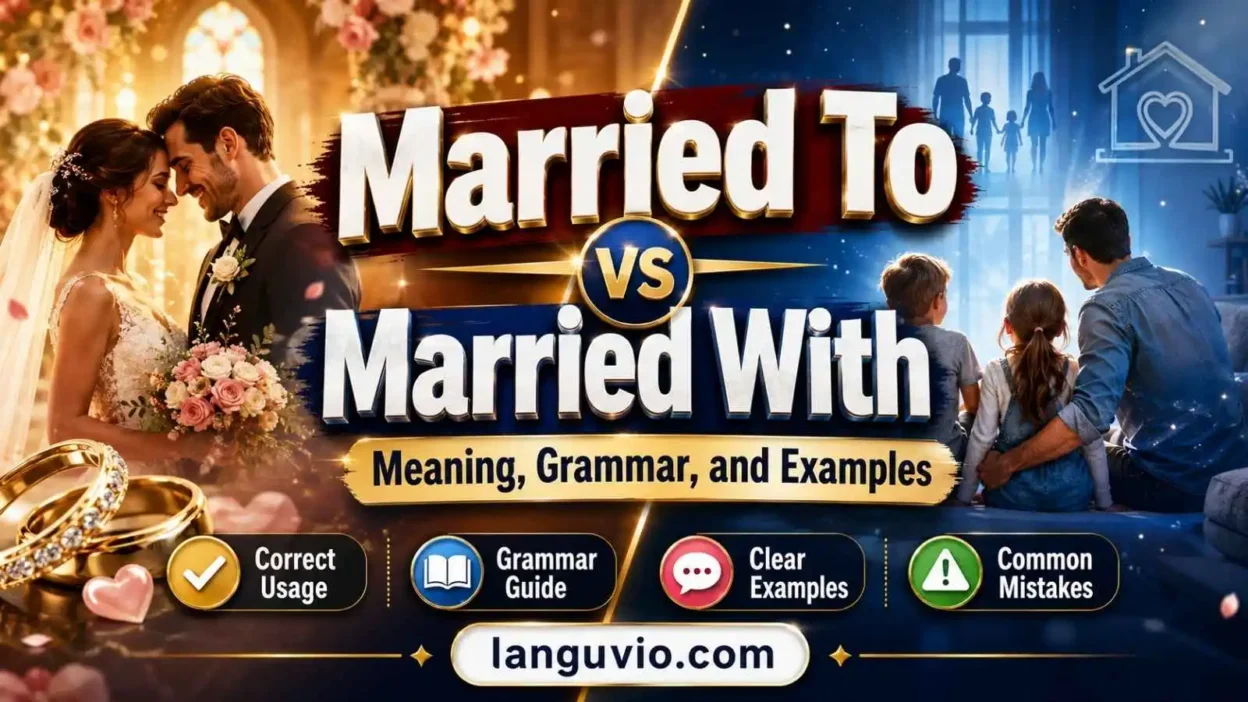
Many English learners hesitate between married to and married with. Both expressions can appear in correct sentences, but they perform different jobs.
Use married to when you identify someone’s spouse. Choose married with when you add information about children or family circumstances.
For example, “Laura is married to James” identifies James as Laura’s spouse. In contrast, “Laura is married with two children” describes Laura’s family situation.
You cannot exchange the two prepositions without changing the meaning. The information after the phrase determines the correct choice.
Quick Answer
Use married to before a spouse’s name, title, or description:
- Maria is married to Daniel
- My aunt is married to a lawyer
- Ryan and Sophie are married to each other
Choose married with when the following words add family information:
- Daniel is married with two children
- She is married with kids
- They are married with a young daughter
In everyday American English, married and has children often sounds clearer than married with children.
Why People Confuse Them
The word with often connects people. Someone can live with a partner, travel with a spouse, or attend dinner with a date. These familiar patterns may lead learners to write “married with someone.”
English follows another pattern for spouses. Speakers connect one spouse to another with to.
The familiar expression married with children causes further confusion. Here, with adds information about the children. It does not identify the person’s spouse.
Verb patterns also create mistakes. Compare these three structures:
- Marry someone: Emma married Luke
- Get married to someone: Emma got married to Luke
- Be married to someone: Emma and Luke have a marital relationship
The main verb marry takes a direct object. Therefore, you should not add to after it.
Key Differences At A Glance
| Context | Best Choice | Why |
| Naming the spouse | married to | The words after to identify the spouse |
| Describing the spouse’s job | married to | The occupation tells us who the spouse is |
| Mentioning children | married with | The words after with add family details |
| Writing a short family profile | married with | The phrase summarizes marital and parental status |
| Describing devotion to work | married to | The phrase can express strong commitment |
| Using marry as the main verb | No preposition | The verb takes a direct object |
Meaning and Usage Difference
The two expressions differ because the prepositions introduce different kinds of information.
Married To
Use married to when the following word or phrase names the spouse.
Consider these examples:
- Hannah is married to Eric
- My brother is married to his high school sweetheart
- The mayor is married to a teacher
- Paul has remained married to Nina for twenty years
In every example, the words after to identify the spouse.
The phrase can also describe a figurative commitment. A person who feels “married to the job” devotes too much time or energy to work.
Similarly, someone who says, “I’m not married to this idea,” shows a willingness to consider other options.
Married With
Use married with when the following phrase provides additional family information.
Examples include:
- Married with children
- Married with two sons
- Married with a daughter
- Married with three young children
The word with does not introduce the spouse in these phrases. Instead, it tells readers that the person also has children.
Many American speakers prefer a more direct structure in ordinary conversation:
“Michael has a wife and two children.”
You could also write:
“Michael is married and has two children.”
Both alternatives separate the two facts and make the meaning immediately clear.
Tone, Context, and Formality
Married to fits almost every context. People use it in casual conversations, formal biographies, applications, news stories, and professional profiles.
For instance:
- “My cousin is married to an architect.”
- “The company president has been married to her husband since 2014.”
- “Alex married his longtime partner last summer.”
The phrase sounds neutral because American English regularly uses to before a spouse.
Married with children also follows standard English usage. However, it often appears in short descriptions rather than detailed conversation.
A brief biography might say:
“Kevin, 38, married with two children, works in healthcare.”
A conversational version would probably sound more natural as:
“Kevin has a spouse and two children.”
Neither phrase carries a special formal or informal tone. Sentence structure and meaning guide the choice, not formality.
Which One Should You Use?
Ask what information comes next.
When the next words answer Who is the spouse?, choose married to.
Examples:
- married to Jennifer
- married to a doctor
- married to his childhood friend
- married to each other
When the next words answer What other family details apply?, choose married with.
Examples:
- married with children
- married with one son
- married with three daughters
You can also avoid the second phrase by using and has:
- married and has two children
- married and has a teenage daughter
- married and has a family
Next, check the verb structure. Use marry directly before the person:
Correct: “Sarah married David.”
Incorrect: “Sarah married to David.”
Add to only when you use structures such as get married or be married:
- Sarah got married to David
- Sarah has stayed married to David for ten years
When One Choice Sounds Wrong
Using married with before a person usually sounds unnatural in American English.
Incorrect: “Anna is married with Robert.”
Correct: “Anna is married to Robert.”
Robert represents the spouse, so the sentence needs to.
Using married to before children creates a much more serious meaning problem.
Incorrect: “Anna is married to two children.”
This wording makes the children sound like Anna’s spouses. To express family status, change the sentence:
Correct: “Anna is married with two children.”
Clearer: “Anna is married and has two children.”
Writers also make mistakes when they add a preposition after the active verb.
Incorrect: “Anna married to Robert in June.”
Correct: “Anna married Robert in June.”
Alternative: “Anna got married to Robert in June.”
The first correction uses married as the main action. The second focuses on the change in marital status.
Common Mistakes (and Quick Fixes)
Mistake 1: Placing With Before the Spouse
Incorrect: “My sister is married with Thomas.”
Correct: “My sister is married to Thomas.”
The name after the phrase identifies the spouse, so to provides the correct connection.
Mistake 2: Adding To After Marry
Incorrect: “Julia married to her neighbor.”
Correct: “Julia married her neighbor.”
The verb marry takes the person directly as its object.
Mistake 3: Using Married With Before an Occupation
Incorrect: “He is married with a nurse.”
Correct: “He is married to a nurse.”
The occupation describes the spouse. It does not add information about children or family circumstances.
Mistake 4: Treating Both Expressions as Synonyms
Compare the meanings:
- David is married to Rachel: Rachel is David’s spouse
- David is married with two children: David has a spouse and two children
Each preposition creates a different relationship between the words.
Mistake 5: Misreading Married With Children
The expression does not connect marriage and children directly. It simply combines two facts: the person has a spouse and children.
Mistake 6: Overusing Married With
Although married with children works, longer sentences often sound better with and has.
Less direct: “Brian is married with three children.”
Clearer: “Brian is married and has three children.”
Mistake 7: Using Married to With a Wedding Date
Incorrect: “They married to each other last year.”
Correct: “They married each other last year.”
Also correct: “They got married last year.”
Everyday Examples
A new coworker might say, “My name is Carlos, and my wife, Elena, works at a nearby school.”
Later, another employee could explain, “Carlos is married to Elena.”
A company profile may describe someone as “married with two children.” The writer uses the phrase to summarize the employee’s family situation.
During a conversation, a person may choose a more natural sentence: “I have a husband and two kids.”
A friend could introduce a couple by saying, “Amanda and Josh married last spring.”
Someone discussing a public figure might say, “The senator’s spouse works as a physician.” Another writer could express the same relationship with married to.
Figurative uses also appear in everyday speech. A manager may say, “We aren’t married to the original schedule.” The comment tells the team that they can change the plan.
A friend might joke, “Jason seems married to his job.” That description suggests that Jason gives work too much attention.
Dictionary-Style Word Details
Verb
Married to: This phrase commonly follows a form of be or get. It describes a marital relationship or the process of entering one.
Examples:
- got married to someone
- has remained married to someone
The main verb marry does not need a preposition:
“Claire married Noah.”
Married with: This combination does not function as a verb meaning “marry someone.” The phrase adds family information after a description of marital status.
Noun
Married to: The expression does not function as a noun. Use marriage when you need a noun:
“Her marriage to Noah lasted twelve years.”
Married with: This expression also does not function as a noun. It combines a marital description with an added detail.
Synonyms
Married to: Closest plain alternatives include:
- wedded to
- the spouse of
- has as a spouse
- in a marriage with
Married with: No exact alternative works in every context. Clear replacements include:
- married and has
- has a spouse and
- a married parent of
- married, with
The adjective unmarried provides the clearest opposite of the basic word married.
Example Sentences
Married to:
- “Liam is married to Ava.”
- “My uncle is married to a veterinarian.”
- “The couple have remained married to each other for fifteen years.”
- “Our team is not married to that proposal.”
Married with:
- “Liam is married with two children.”
- “She describes herself as married with one daughter.”
- “The short biography lists him as married with children.”
- “They moved to Texas as a married couple with two young sons.”
Word History
The word marry entered English through French and ultimately connects to Latin terms related to marriage.
English developed the pattern married to someone to link one spouse with the other. Speakers later extended the phrase to strong figurative commitments.
In married with children, the preposition with adds another circumstance. The expression combines marital status with information about children.
Phrases Containing
Common phrases with married to include:
- married to someone
- get married to someone
- married to each other
- married to one’s work
- not married to an idea
Common phrases with married with include:
- married with children
- married with two children
- married with kids
- married with one daughter
FAQs
Is “married to” or “married with” correct?
Both can work, but each phrase serves a different purpose. Use married to before the spouse’s name or description. Choose married with when you add information about children or family circumstances.
Can I say “I am married with John”?
No. Say, “I am married to John.” The name John identifies the spouse, so American English requires to in this structure.
Does “married with children” follow correct grammar?
Yes. The expression means that someone has a spouse and children. However, “married and has children” may sound clearer in everyday conversation.
Should I write “She married him” or “She married to him”?
Write “She married him.” The active verb marry takes a direct object without a preposition. You may also write, “She got married to him.”
What does “married to work” mean?
The phrase describes someone who devotes excessive time or attention to work. It uses marriage as a metaphor for strong commitment.
Which form sounds more natural: “married with children” or “married and has children”?
Both communicate the same basic family information. Short biographies often use married with children, while everyday conversation usually favors married and has children.
Do I need a preposition after the verb marry?
No. Place the person directly after the active verb:
“Daniel married Rebecca.”
When you use get married, add to before the spouse:
“Daniel got married to Rebecca.”
Conclusion
Use married to when you identify the spouse:
“Kim is married to Jordan.”
Choose married with when you add information about children:
“Kim is married with two children.”
For smoother everyday English, you may write, “Kim is married and has two children.”
Remember the verb rule as well. Write “Kim married Jordan,” not “Kim married to Jordan.”
A simple question can guide your choice. When the following words name the spouse, use to. When they add family details, with may fit.
Both can work, but each phrase serves a different purpose. Use married to before the spouse’s name or description. Choose married with when you add information about children or family circumstances.
No. Say, “I am married to John.” The name John identifies the spouse, so American English requires to in this structure.
Yes. The expression means that someone has a spouse and children. However, “married and has children” may sound clearer in everyday conversation.
Write “She married him.” The active verb marry takes a direct object without a preposition. You may also write, “She got married to him.”
The phrase describes someone who devotes excessive time or attention to work. It uses marriage as a metaphor for strong commitment.
Both communicate the same basic family information. Short biographies often use married with children, while everyday conversation usually favors married and has children.
No. Place the person directly after the active verb:
“Daniel married Rebecca.”
When you use get married, add to before the spouse:
“Daniel got married to Rebecca.”