Repeat and repeat again may look like two ways to express the same idea. In many sentences, they are. The verb repeat already means to say, do, or perform something another time, so adding again is often unnecessary.
However, repeat again is not automatically wrong in every context. Sometimes again points to an additional repetition—something was done, repeated once, and then repeated one more time.
The real choice depends on what you want to say.
Quick Answer
Use repeat when you simply mean “say or do something another time.”
“Could you repeat the address?”
In this ordinary situation, repeat again usually adds no useful meaning because the idea of “again” is already built into repeat.
Use repeat again when again clearly means an additional repetition after something has already been repeated.
“She repeated the instructions once, then repeated them again for the late arrivals.”
Both forms can therefore occur in grammatical sentences, but repeat is usually the clearer and more concise choice.
Why People Confuse Them
The confusion comes from overlapping meaning.
Repeat already expresses recurrence. Again also means another time. When speakers combine them casually, the result may express the same idea twice.
For example:
“Can you repeat that again?”
Most people understand this immediately. Still, when the speaker has heard the statement only once, again usually contributes nothing essential. “Can you repeat that?” says everything needed.
The longer version becomes more useful when another repetition has already happened. In that case, again can distinguish a further repetition from the first one.
Key Differences At A Glance
| Context | Best Choice | Why |
| Asking someone to say something a second time | repeat | The verb already means to say it another time. |
| Giving a normal instruction to redo a step | repeat | Clear and concise. |
| Referring to another repetition after an earlier repeat | repeat again | “Again” can mark one more repetition. |
| Formal or professional writing with no added meaning | repeat | Avoids unnecessary wording. |
| Casual speech for emphasis | repeat or repeat again | The longer form may occur naturally, though it can be redundant. |
| Stressing that the same mistake happened yet another time | repeat again | “Again” can emphasize an additional recurrence. |
Compact comparison:
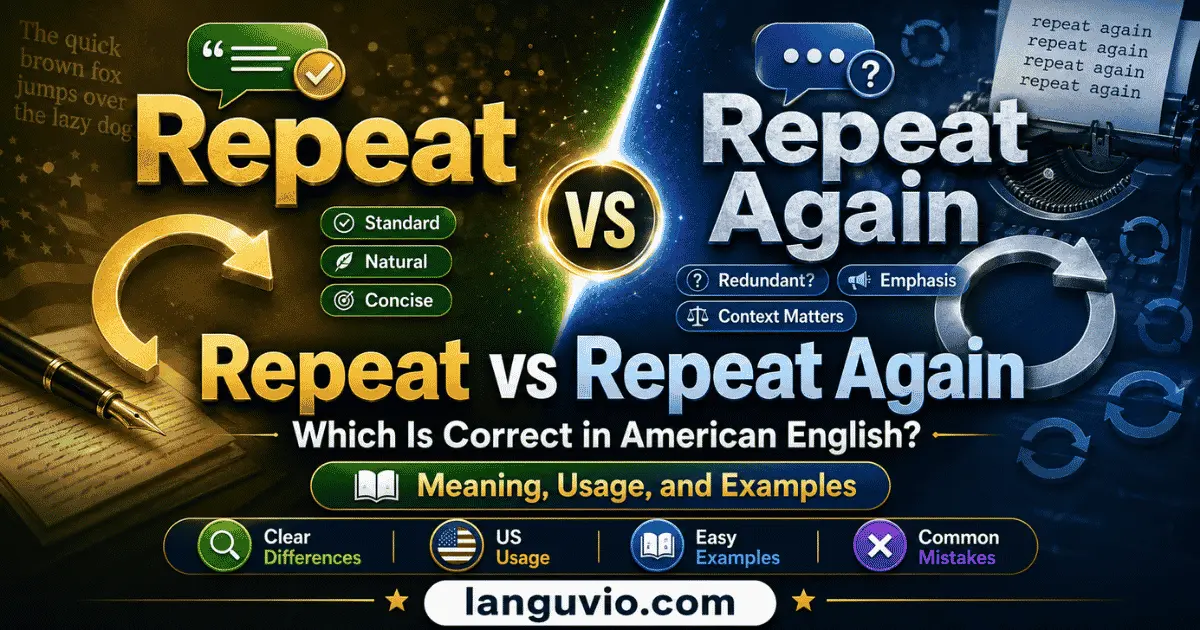
- repeat: The standard verb for saying, doing, performing, or experiencing something another time.
- repeat again: A verb-plus-adverb combination that is often redundant but can mean to repeat something one additional time after it has already been repeated.
Meaning and Usage Difference
The main difference is not that one expression is always correct and the other is always incorrect. The difference is whether again adds information.
Consider:
“Please repeat the phone number.”
The number was said once. You want to hear it one more time. Repeat is enough.
Now consider:
“I still couldn’t hear her after she repeated the number, so she repeated it again.”
Here, again has a clearer job. The first repetition has already occurred. The second again tells us that another repetition followed.
This distinction also appears with actions:
“Repeat the test tomorrow.”
This means perform the test another time.
“We repeated the test Tuesday and repeated it again Thursday.”
Here, the second wording marks another repetition beyond Tuesday’s repeated test.
Therefore, do not treat repeat again as universally incorrect. Instead, ask whether again adds a new layer of timing, number, or emphasis.
Tone, Context, and Formality
In professional, academic, instructional, and edited writing, repeat is usually preferable when both versions communicate exactly the same thing.
“Please repeat the final figure.”
This sounds direct and polished.
“Please repeat the final figure again.”
This is understandable, but again may sound unnecessary when no earlier repetition has occurred.
Casual speech is less strict about redundancy. A person may naturally say, “Can you repeat that again?” without causing confusion. The issue is usually style and precision rather than sentence structure.
When a further repetition matters, however, repeat again can be precise even in formal writing.
“The procedure was repeated in May and repeated again in June.”
In that sentence, again helps show separate repeated occurrences.
Which One Should You Use?
Choose repeat by default when you want something said or done one more time.
Use:
“Could you repeat your name?”
“Please repeat step three.”
“Do not repeat that mistake.”
“Repeat the exercise five times.”
Choose repeat again only when the context makes the extra again useful.
For instance:
“He had already repeated the warning once, but he repeated it again before the storm arrived.”
The phrase tells the reader that there was not merely one repetition. There was a further one.
A useful test is simple: remove again. If the meaning stays exactly the same, the shorter repeat is usually better. If removing again hides the fact that another repetition occurred after an earlier one, keep it.
When One Choice Sounds Wrong
Repeat again can sound awkward when the sentence describes only a basic second occurrence.
Less natural:
“Could you repeat again what you said?”
Better:
“Could you repeat what you said?”
Also natural:
“Could you say that again?”
The last example is important. Say does not itself mean “say another time,” so again provides necessary information.
However, removing again can weaken a sentence when several repetitions are being distinguished.
“She repeated the demonstration for the morning group and repeated it again that afternoon.”
Here, again helps signal an additional performance.
Context determines whether the word is needless or meaningful.
Common Mistakes (and Quick Fixes)
A common mistake is assuming that every use of repeat again is grammatically impossible. That is too absolute.
The better approach is to identify what again is doing.
“Please repeat again the password.”
For a simple request, change this to:
“Please repeat the password.”
Another common problem is using repeat again where say again sounds more conversational:
“Could you say that again?”
This is especially natural when you did not hear someone clearly.
On the other hand, do not automatically delete again from a sentence such as:
“The technician repeated the test, found the same problem, and repeated it again after replacing the cable.”
The final again distinguishes a further test from the earlier repeat.
Everyday Examples
At work:
“Could you repeat the sales total?”
This is the natural choice when you need to hear the figure one more time.
In a classroom:
“Repeat each sentence after me.”
No again is necessary because repeat already gives the instruction.
During troubleshooting:
“We repeated the restart procedure, but the error returned, so we repeated it again after updating the system.”
Here, the second phrase identifies another repetition later in the sequence.
At home:
“I told him not to repeat the mistake.”
This means not to make the same mistake another time.
After several mistakes:
“He made the same error Monday, repeated it Tuesday, and repeated it again Wednesday.”
The final again emphasizes a further recurrence.
In conversation:
“Sorry, could you repeat that?”
This is concise and natural.
You could also say:
“Sorry, could you say that again?”
Both express the same basic request through different structures.
Dictionary-Style Word Details
Verb
repeat: Commonly functions as a verb meaning to say, do, perform, produce, or experience something another time or more than once.
Example: “Please repeat the last sentence.”
repeat again: Not a separate verb. It is the verb repeat modified by the adverb again. In an ordinary first repetition, again may be unnecessary. In a sequence of repeated occurrences, it can mean to repeat something one further time.
Example: “We repeated the test Monday and repeated it again Friday.”
Noun
repeat: Can function as a noun meaning an act, instance, or occurrence of something being repeated.
Example: “The team wants a repeat of last year’s success.”
It can also describe something presented or performed another time.
repeat again: Does not normally function as a noun by itself. In the comparison discussed here, it is a verb-plus-adverb construction.
Synonyms
repeat: Meaning-matched alternatives depend on context. For saying something another time, close alternatives include restate, reiterate, and say again. For doing something another time, redo may fit some contexts.
These are not interchangeable in every sentence. Restate, for example, can suggest expressing an idea again, sometimes in different words, while repeat may involve reproducing the same wording or action.
repeat again: There is no single exact substitute that fits every use. When again is unnecessary, the best replacement is simply repeat. When it means an additional repetition, closest plain alternatives include repeat one more time or do it one more time.
There is no single useful antonym for either expression across all of their meanings.
Example Sentences
repeat:
“Could you repeat the meeting time?”
“Please repeat the exercise three times.”
“She promised not to repeat the mistake.”
“The coach hopes the team can repeat last season’s success.”
repeat again:
“After repeating the instructions for one group, she repeated them again for the students who arrived late.”
“The technician repeated the test in the morning and repeated it again after replacing the battery.”
“He repeated the same error Tuesday and repeated it again Wednesday.”
In these examples, again refers to an additional repetition rather than merely duplicating the basic meaning of repeat.
Word History
repeat: The word entered English through earlier French and ultimately traces to Latin repetere, which carried senses connected with returning to or doing something again.
Its modern meanings developed around saying, doing, presenting, or experiencing something more than once.
repeat again: This is not a separate historical word with its own independent origin. It is an ordinary combination of repeat and again. Because both can express recurrence, the combination often contains overlapping meaning. Context can nevertheless give again a separate function when another repetition needs to be marked.
Phrases Containing
repeat: Common constructions include repeat after me, repeat oneself, repeat performance, repeat customer, and repeat offender.
“Repeat after me” asks someone to reproduce words another person has spoken.
“Repeat oneself” means saying the same thing another time.
repeat again: This is not normally treated as a fixed expression. It appears in flexible constructions such as repeat it again, repeat the process again, or repeat the test again.
These constructions are most useful when again clearly refers to an additional repetition. Without that context, repeat alone is usually cleaner.
FAQs
Yes, repeat again can be grammatically correct, but it is often unnecessary. The verb repeat already means to say or do something another time. However, again can be useful when something has already been repeated once and is repeated one more time.
In most situations, use repeat. For example, “Could you repeat the address?” is clear and natural. Use repeat again only when you need to show an additional repetition after an earlier repeat.
It often is. In a sentence like “Please repeat that again,” the word again usually repeats an idea already contained in repeat. The shorter “Please repeat that” is more concise. Still, context can make again meaningful.
It is understandable and common in conversation, but “Can you repeat that?” is usually cleaner. Another natural option is “Can you say that again?” because the verb say does not already include the idea of repetition.
Use it when again clearly means one additional repetition. For example, “The technician repeated the test Monday and repeated it again Friday.” Here, again helps show that another separate repetition occurred.
Remove again and check whether the meaning changes. If the sentence still communicates the same idea, use repeat alone. If again clearly shows that something happened one more time after an earlier repetition, keeping it can make the meaning more precise.
Conclusion
For most everyday choices between repeat vs repeat again, use repeat when you simply mean “say or do something another time.” The word already contains the idea of recurrence, so again is often unnecessary.
However, repeat again is not automatically wrong. It can be useful when something has already been repeated and then happens or is performed one more time.
Remember the practical rule: if removing again changes nothing, choose repeat. If again clearly identifies an additional repetition, keeping it can make the sentence more precise.