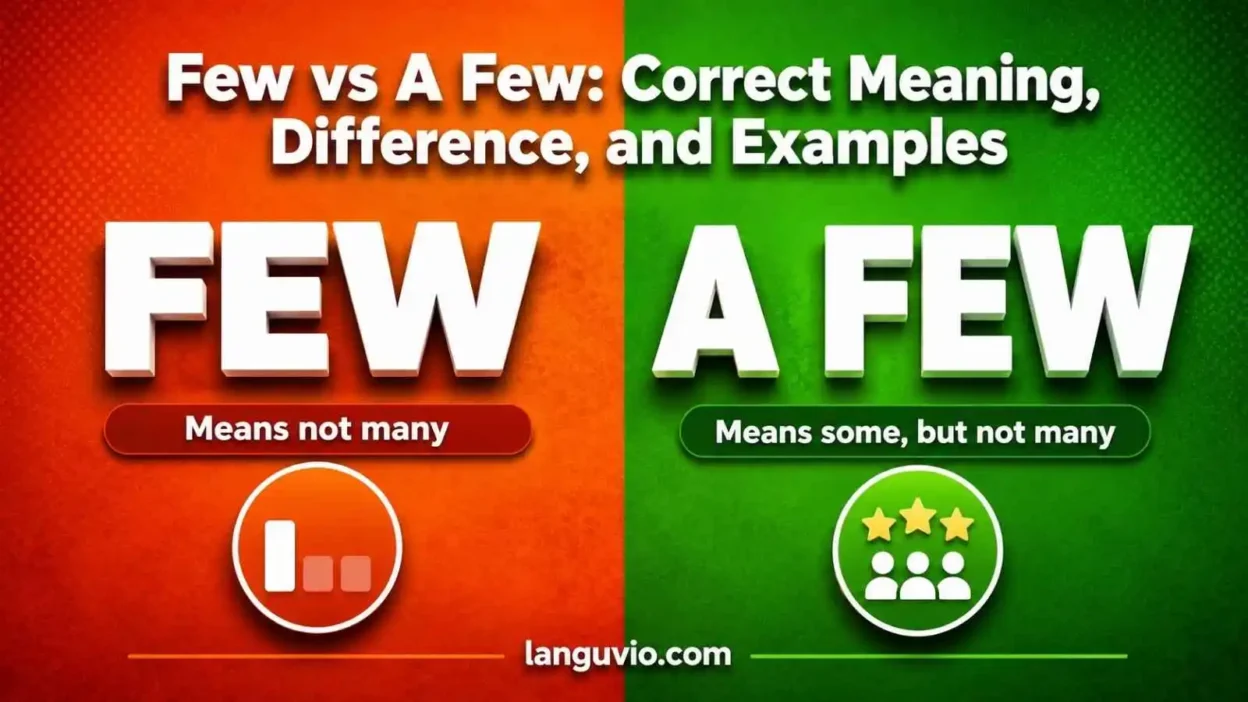
Few and a few are both correct, but they do not send the same message. The small word a changes the tone of the sentence. That is why “few seats were open” does not feel the same as “a few seats were open.”
Both expressions refer to a small number of countable things or people. However, few often points to lack, shortage, or disappointment. A few points to some amount being available, useful, or enough for the situation.
Quick Answer
Use few when you mean “not many” and want to stress that the number is small, limited, or not enough. Use a few when you mean “some” and want to show that a small number exists. Both are used with plural countable nouns, such as books, people, days, ideas, and options.
Why People Confuse Them
People confuse few and a few because both describe a small number. In many sentences, the actual number may be the same. The difference is the attitude behind the number.
Look at these two sentences:
Few employees stayed late.
A few employees stayed late.
The first sentence suggests that the number was lower than expected. The second sentence suggests that some employees did stay, even if the number was small.
That small shift matters. Few sounds more negative or limiting. A few sounds more positive, neutral, or reassuring.
Key Differences At A Glance
| Context | Best Choice | Why |
| You want to stress that the number is too small | few | It points to lack or shortage. |
| You want to say some exist | a few | It points to presence, not absence. |
| You are disappointed by the number | few | It suggests “not enough.” |
| You are relieved that there are some | a few | It suggests “at least some.” |
| You are using a plural countable noun | either | Both can modify plural countable nouns. |
| You are using an uncountable noun | neither | Use little or a little instead. |
| You want a warmer, more hopeful tone | a few | It sounds less negative. |
| You want a stricter or more formal tone | few | It often sounds more serious. |
Meaning and Usage Difference
Few means “not many.” It often suggests that the number is smaller than wanted, needed, or expected.
Examples:
Few customers complained.
This means not many customers complained. The sentence may suggest the complaints were limited.
Few students understood the instructions.
This sounds like a problem because not many students understood.
A few means “some” or “a small number.” It tells the reader that a small amount exists.
Examples:
A few customers complained.
This means some customers complained. The sentence does not sound as strongly negative as “few customers complained.”
A few students understood the instructions.
This suggests that some students understood, even if many did not.
Both few and a few work with plural countable nouns:
few tickets
a few tickets
few reasons
a few reasons
few people
a few people
Do not use them with uncountable nouns such as water, money, traffic, advice, or furniture. For those, use little or a little.
Correct: We had a few minutes before the meeting.
Incorrect: We had a few time before the meeting.
Correct: We had a little time before the meeting.
Tone, Context, and Formality
Few often sounds more serious, formal, or negative. It can make a sentence feel sharper because it focuses on scarcity.
A few sounds more natural in everyday conversation when the speaker simply means “some.” It often feels softer and more practical.
Compact comparison:
• Few: small number, usually not enough, often negative.
• A few: small number, at least some, often neutral or positive.
• Few: “Few people joined the call” sounds disappointing.
• A few: “A few people joined the call” sounds more matter-of-fact.
• Few: better when the shortage is the point.
• A few: better when the presence of some is the point.
Pronunciation does not need much attention here. Few and a few use the same main word sound, “fyoo.” The difference is not pronunciation. The difference is the article a and the meaning it adds.
Which One Should You Use?
Use few when your point is that the number is low.
Examples:
- Few restaurants were open after midnight.
- Only few voters knew about the local measure.
- Not many teams finished the project on time.
Use a few when your point is that some exist.
Examples:
- A few restaurants were open after midnight.
- Several voters asked good questions.
- Some teams finished the project early.
A simple test helps: replace the phrase with “not many” or “some.”
If “not many” fits, use few.
Few people replied.
Not many people replied.
If “some” fits, use a few.
A few people replied.
Some people replied.
When One Choice Sounds Wrong
Few can sound too negative when you mean to be encouraging.
Too negative: Few people signed up, so we can start the class.
Better: A few people signed up, so we can start the class.
The class can start because some people signed up. A few fits that positive meaning better.
A few can sound too soft when you want to stress a shortage.
Too soft: A few nurses were available during the emergency.
Better: Few nurses were available during the emergency.
The problem is the shortage, so few is stronger and clearer.
The choice depends on what you want the reader to notice: the lack or the presence.
Common Mistakes (and Quick Fixes)
Mistake 1: Using few when the meaning is positive.
Incorrect: We have few options, so we can choose one today.
Correct: We have a few options, so we can choose one today.
If having options is helpful, use a few.
Mistake 2: Using a few with an uncountable noun.
Incorrect: I need a few advice before I decide.
Correct: I need a little advice before I decide.
Correct: I need a few tips before I decide.
Advice is uncountable. Tips is countable.
Mistake 3: Treating a few as an exact number.
A few usually means a small number, but it is not always exactly three. It depends on the noun and situation.
A few means a small number, but the exact number depends on the context.
For example, a few fries may mean several fries.
In another context, a few houses may mean two or three houses.
The phrase a few months usually means a small number of months.
Mistake 4: Ignoring the tone.
Few friends visited him.
A few friends visited him.
The first sentence sounds lonely or disappointing. The second sounds warmer because some friends came.
Everyday Examples
Few people read the full policy before clicking agree.
A few people asked questions after the presentation.
Few stores had the jacket in stock.
A few stores still had the jacket in stock.
Few parents volunteered for the trip.
A few parents volunteered to help with snacks.
Few apps worked during the outage.
A few apps came back online after lunch.
Few houses on the block had power.
A few houses on the block had their lights on.
Few students turned in the form by Friday.
A few students turned in the form early.
Few meetings end before the scheduled time.
A few meetings ended early this week.
Few guests stayed after dinner.
A few guests stayed to help clean up.
Dictionary-Style Word Details
Verb
• Few: Not commonly used as a verb in standard US English.
• A few: Not used as a verb. It is a phrase built from the article a plus few.
Noun
• Few: Can work as a noun or pronoun when it stands for a small group, as in “Only a few arrived early” or “The few who stayed helped clean up.”
• A few: Often works as a pronoun when the noun is understood, as in “I saved a few” meaning “I saved a few of them.”
Synonyms
• Few: closest plain alternatives include not many, hardly any, only a small number, and a limited number. Clear opposites include many and numerous.
• A few: closest plain alternatives include some, several, a small number, and a handful of. Clear opposites depend on context, but none, no, and many may contrast with it in different sentences.
These alternatives are not always exact replacements. For example, several often suggests more than a few in everyday use.
Example Sentences
• Few: Few drivers noticed the new sign.
• Few: The report gave few details about the delay.
• Few: Few people expected the store to close so soon.
• Few: She had few chances to practice before the audition.
• A few: A few drivers stopped to help.
• A few: The report gave a few details about the delay.
• A few: A few people waited outside the store.
• A few: She had a few chances to practice before the audition.
Word History
• Few: Few is an old English word meaning a small number. Its exact older development is a dictionary topic, but the modern use is stable: it refers to a small number and often carries a limiting tone.
• A few: A few developed from the article a placed before few. In modern English, that article changes the sense from “not many” toward “some.”
The useful history for today’s writer is simple: the article a changes the reader’s impression.
Phrases Containing
• Few: few people, few options, few details, few chances, few reasons, few and far between, quite few in limited contexts, no fewer than.
• A few: a few days, a few minutes, a few people, a few ideas, a few times, a few of them, quite a few, a good few.
Be careful with quite a few. It does not mean “very few.” In everyday English, quite a few usually means a fairly large number.
FAQs
Is “few” or “a few” correct?
Both are correct, but they mean slightly different things. Use few when you want to stress that the number is small or not enough. Use a few when you mean that some people or things exist. For example, “few people came” sounds disappointing, while “a few people came” sounds more neutral or positive.
What is the main difference between few and a few?
The main difference is tone. Few means “not many” and often suggests a shortage. A few means “some” and often suggests that the small number is useful or enough. The word a makes the sentence feel more positive.
Can I use few and a few with uncountable nouns?
No. Use few and a few with plural countable nouns, such as books, people, days, or ideas. Do not use them with uncountable nouns like water, advice, money, or traffic. Say “a little advice,” not “a few advice.”
Does “a few” mean exactly three?
No. A few means a small number, but it does not always mean exactly three. The exact number depends on the context. “A few minutes” may mean two or three minutes, while “a few people” may mean a small group.
Why does “few” sound negative?
Few sounds negative because it focuses on what is missing. If you say “few students passed,” the sentence suggests that the result was poor. If you say “a few students passed,” the sentence focuses on the fact that some students did pass.
Which phrase should I use in everyday writing?
Use a few for most casual or neutral situations. Use few when you want to emphasize a small number, a problem, or a lack of something.
Conclusion
Few and a few are both standard, but they do different jobs. Use few when you want to stress that the number is small, limited, or not enough. Use a few when you want to say that some people or things exist.
The easiest test is this: few means “not many,” while a few means “some.” That small article changes the whole tone of the sentence.
Both are correct, but they mean slightly different things. Use few when you want to stress that the number is small or not enough. Use a few when you mean that some people or things exist. For example, “few people came” sounds disappointing, while “a few people came” sounds more neutral or positive.
The main difference is tone. Few means “not many” and often suggests a shortage. A few means “some” and often suggests that the small number is useful or enough. The word a makes the sentence feel more positive.
No. Use few and a few with plural countable nouns, such as books, people, days, or ideas. Do not use them with uncountable nouns like water, advice, money, or traffic. Say “a little advice,” not “a few advice.”
No. A few means a small number, but it does not always mean exactly three. The exact number depends on the context. “A few minutes” may mean two or three minutes, while “a few people” may mean a small group.
Few sounds negative because it focuses on what is missing. If you say “few students passed,” the sentence suggests that the result was poor. If you say “a few students passed,” the sentence focuses on the fact that some students did pass.
Use a few for most casual or neutral situations. Use few when you want to emphasize a small number, a problem, or a lack of something.