Night and knight sound exactly alike, but they do not mean the same thing. That is why this pair causes so many spelling mistakes in schoolwork, captions, stories, and everyday messages.
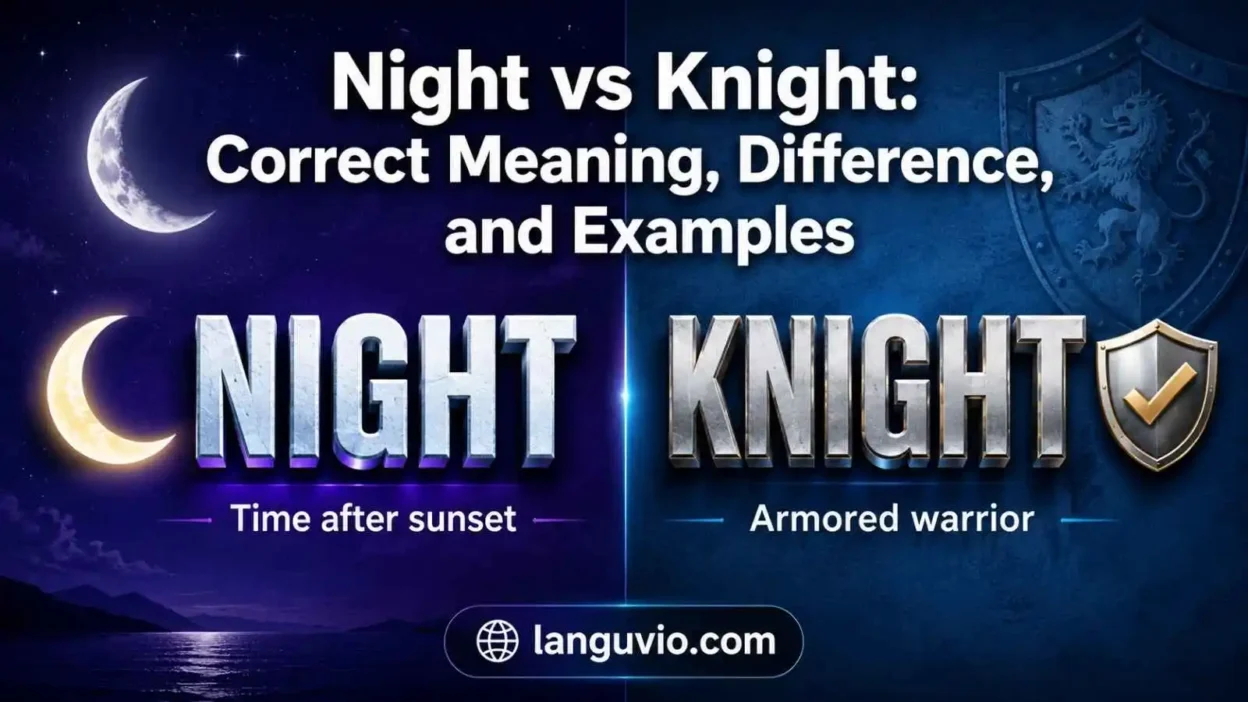
Use night when you mean the dark part of the day, evening, or a time when people usually sleep. Use knight when you mean a titled person, a medieval warrior, a chess piece, or the verb meaning to give someone the rank of knight.
The choice is not about style. It is about meaning. A sentence about stars, sleep, Friday evening, or darkness needs night. A sentence about armor, chivalry, royalty, fantasy stories, or chess needs knight.
Quick Answer
Night is the correct word for the dark time between evening and morning.
Knight is the correct word for a person with a special rank, a medieval warrior, a chess piece, or the action of giving someone that rank.
They are homophones. In everyday pronunciation, both sound like “nite.” The spelling changes the meaning completely.
Why People Confuse Them
People confuse night and knight because they sound the same. The k in knight is silent, and the gh in both words is not pronounced.
That means your ear cannot tell the difference. Your sentence has to do the work.
For example, “I stayed up all night” sounds normal because it is about time. “I stayed up all knight” looks wrong because a person or chess piece cannot replace the time of day.
The best clue is context. Ask what the sentence is about. If it is about darkness or evening, choose night. If it is about a warrior, title, honor, or chess, choose knight.
Key Differences At A Glance
- Night means the dark part of the day.
- Knight means a titled person, a medieval warrior, or a chess piece.
- Night is mostly a noun.
- Knight is a noun and can also be a verb.
- Both words sound like “nite.”
- They are never interchangeable in standard writing.
Meaning and Usage Difference
Night usually refers to the time when it is dark outside, especially between evening and morning. It can also mean a specific evening, as in “movie night” or “opening night.”
Knight usually refers to a person given a special rank or honor. In historical and fantasy writing, it often means a mounted warrior connected with armor, castles, and chivalry. In chess, a knight is the horse-shaped piece that moves in an L shape.
The pronunciation matters because both words sound the same. Say them as “nite.” The spelling is the only visible clue in writing.
Tone, Context, and Formality
Night is common in casual, academic, professional, and creative writing. It fits normal daily life: sleep, work schedules, weather, travel, events, and plans.
Knight sounds more specific. It appears in history lessons, fantasy stories, chess writing, royal honors, and figurative phrases like “knight in shining armor.”
Neither word is more formal by itself. The context changes the feel. “Night shift” sounds ordinary and practical. “A noble knight entered the hall” sounds historical or story-like. “He was knighted for his service” sounds formal because it refers to an official honor.
Which One Should You Use?
| Context | Best Choice | Why |
| Darkness after sunset | night | It names the dark part of the day. |
| Sleep or late hours | night | It refers to time, not a person. |
| A school dance or event | night | It can mean a specific evening. |
| A medieval warrior | knight | It names the person or rank. |
| A royal honor | knight | It refers to someone given a title. |
| A chess piece | knight | It names the horse-shaped chess piece. |
| An action of giving a title | knight | The verb form is knight or knighted. |
When One Choice Sounds Wrong
Night sounds wrong when the sentence needs a person, title, or chess piece.
Wrong: The brave night rode into battle.
Correct: The brave knight rode into battle.
Knight sounds wrong when the sentence is about time, darkness, or an evening event.
Wrong: We got home late at knight.
Correct: We got home late at night.
A helpful test is simple: can you replace the word with evening or darkness? If yes, use night. Can you replace it with warrior, title holder, or chess piece? If yes, use knight.
Common Mistakes (and Quick Fixes)
One common mistake is using knight just because the word sounds dramatic. “A cold knight” only works if you mean a cold person with that title. For weather or time, write “a cold night.”
Another mistake is forgetting that knight has a silent k. Do not spell the person as nite or night. In a fantasy story, the armored character is a knight.
Writers also mix the words in captions. “Date knight” is wrong unless you are making a joke about a medieval warrior. For a romantic evening, write “date night.”
Everyday Examples
I could barely sleep last night because the storm was so loud.
We are having taco night at my sister’s house on Friday.
The parking lot gets quiet at night.
The knight lifted his shield before entering the castle.
She moved her knight to the center of the chessboard.
The actor was knighted for his long career in the arts.
That character acts like a knight in shining armor, but the story makes him more complicated.
Dictionary-Style Word Details
Verb
night: Not commonly used as a verb in standard US English. Use it as a noun in normal writing.
knight: Can be used as a verb meaning to give someone the rank or title of knight. It is often used in the passive form, such as “was knighted.”
Example: The musician was knighted for his service to the arts.
Noun
night: A noun meaning the dark part of the day, the time people often sleep, or a specific evening.
Example: We left before night.
knight: A noun meaning a titled person, a medieval warrior, or a chess piece.
Example: The knight protected the king in the story.
Synonyms
night: Closest simple alternatives include evening, nighttime, darkness, dusk, and nightfall. A clear antonym is day.
knight: Closest simple alternatives depend on context. For history or stories, warrior, chevalier, champion, or horseman may fit. For chess, there is no exact everyday synonym; it is simply a knight. A direct antonym does not clearly fit the word in most uses.
Example Sentences
night: The baby finally slept through the night.
night: Opening night sold out in less than an hour.
knight: The museum displayed armor worn by a knight.
knight: In chess, the knight can jump over other pieces.
Word History
night goes back to older English forms connected with the idea of darkness or the dark part of the day.
knight goes back to older English forms connected with a boy, servant, or attendant before the word developed its later rank and military meaning.
Their spellings and histories are different. Their matching modern sound does not make them the same word.
Phrases Containing
night: good night, last night, night shift, night owl, movie night, at night, late night, all night, call it a night.
knight: knight in shining armor, medieval knight, white knight, knight errant, chess knight, knighted by the king, knighted for service.
FAQs
Use night when you mean the dark part of the day. Use knight when you mean a titled person, a medieval warrior, a chess piece, or the verb meaning to give someone the rank of knight.
Yes. Night and knight are pronounced the same in modern English. Both sound like “nite.” The difference is only in spelling and meaning.
Night means the dark time between evening and morning. It can also mean a specific evening, such as “movie night,” “date night,” or “opening night.”
Knight means a person who has been given a special title or rank. It can also mean a medieval warrior or the horse-shaped piece in chess.
The k in knight is silent in modern English. Older forms of English pronounced more of the word, but today the standard pronunciation sounds like “nite.”
No. The correct phrase is late at night because it refers to a time of day. Knight would only work if the sentence were about a titled person, warrior, or chess piece.
Usually, no. The correct phrase is date night when you mean a planned romantic evening. Date knight would only work as a joke or wordplay about a knight.
Yes. Knight can be a verb meaning to give someone the title of knight. For example: “The actor was knighted for his work.”
Night is most commonly a noun, as in “The night was cold.” It can also work before another noun in phrases like “night shift” or “night class.”
Connect night with darkness and sleep. Connect knight with armor, honor, castles, royalty, or chess. If your sentence is about time, use night. If it is about a person, title, or chess piece, use knight.
Conclusion
Night and knight are easy to mix up because they sound identical, but the meanings are completely different. Use night for the dark part of the day, sleep, evening plans, and events. Use knight for a titled person, medieval warrior, chess piece, or the act of giving that title.
The quickest fix is to check the sentence meaning. Darkness needs night. Armor, honor, castles, royalty, or chess needs knight. Once you connect each spelling to its meaning, the mistake becomes much easier to avoid.