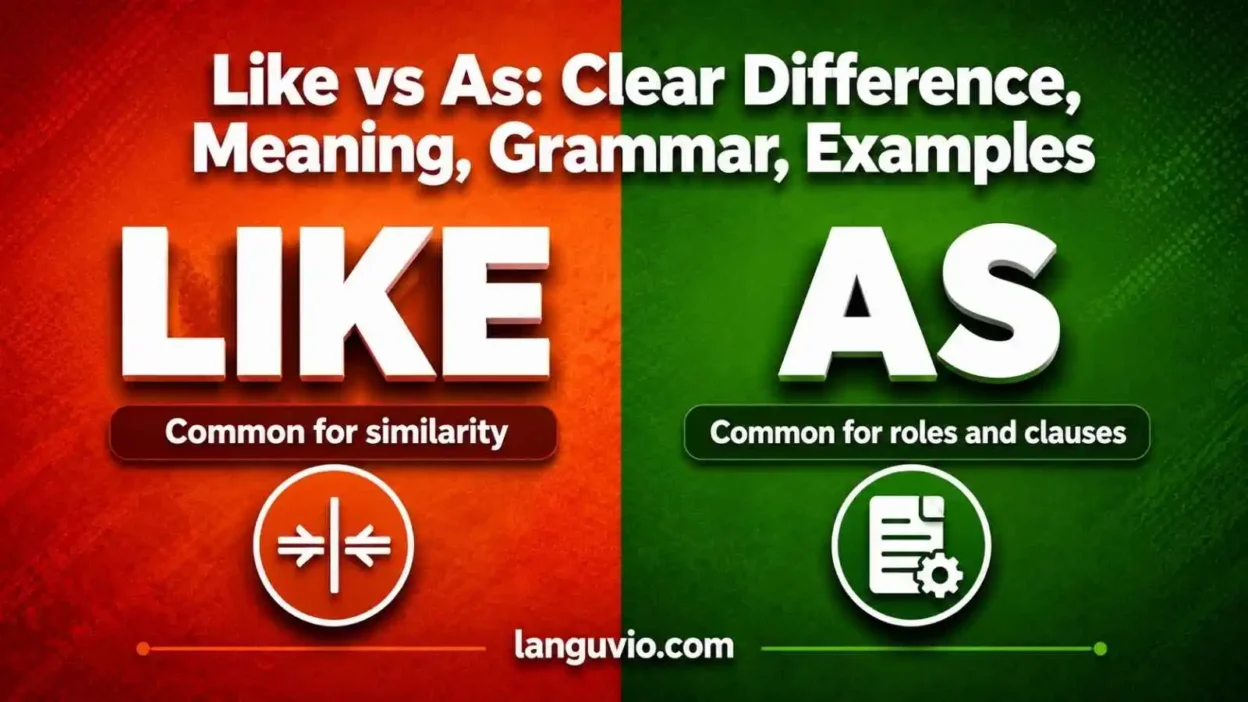
Like vs as can be confusing because both words can compare things. You may hear “She sings like a pro” and “Sing as I showed you,” and both sentences sound natural.
The difference depends on structure and meaning. Use like for similarity, especially before a noun or pronoun. Use as for roles, jobs, manner, and many clauses. In casual speech, like often appears before a clause, but as is usually safer in polished writing.
Quick Answer
Use like when you mean “similar to” or when a noun, pronoun, or noun phrase follows. Use as when you mean “in the role of,” “in the way that,” or when a full clause follows. In casual speech, “like I said” is common, but “as I said” is cleaner in formal writing.
Why People Confuse Them
People confuse like and as because both can introduce comparisons. The sentence may sound right either way, especially in conversation.
Another reason is that modern speech often uses like where traditional grammar expects as. For example, many Americans say, “Do it like I showed you.” That sounds normal in casual speech. In careful writing, “Do it as I showed you” is the better choice.
The confusion grows because like has several roles. It can be a verb, as in “I like coffee.” It can also show similarity, as in “This tastes like coffee.” For this comparison, the similarity use matters most.
Key Differences At A Glance
| Context | Best Choice | Why |
| Comparing one thing to another | like | Like means “similar to.” |
| Before a noun or pronoun | like | Like usually works before a noun, pronoun, or noun phrase. |
| After sense verbs | like | We say looks like, sounds like, smells like, tastes like, and feels like. |
| Showing a job or role | as | As means “in the role of” or “in the capacity of.” |
| Before a clause in careful writing | as | As connects the comparison to a subject and verb. |
| In “as…as” comparisons | as | This fixed structure needs as on both sides. |
| In “the same…” comparisons | as | The standard phrase is the same as. |
| Before “if” or “though” | as | As if and as though are standard expressions. |
The fastest rule is simple: like points to similarity; as points to role, manner, or structure.
Meaning and Usage Difference
Like often means “similar to.” It usually comes before a noun, pronoun, or noun phrase.
Examples:
- This jacket feels like leather.
- She runs like her older sister.
- That excuse sounds like a problem.
As often means “in the role of” or “in the way that.” It can introduce a role, job, function, or clause.
Examples:
- He works as a nurse.
- As your manager, I need to review the report.
- Please save the file as I showed you.
A small change can change the meaning.
“As your friend, I’m being honest” means I am your friend.
“Like your friend, I’m being honest” means I am acting in a similar way to your friend.
That is why like and as are not always interchangeable.
| Feature | like | as |
| Core idea | Similar to | In the role of; in the way that |
| Common pattern | like + noun/pronoun | as + role or clause |
| Example | She looks like her mom. | She works as a designer. |
| Formal writing | Fine for similarity | Preferred before many clauses |
| Common mistake | Using as after sense verbs | Using like for formal clause links |
Tone, Context, and Formality
Like sounds natural in everyday English. It is the normal choice after look, sound, smell, taste, feel, and seem when you compare one thing to another.
Examples:
- It looks like rain.
- This soup tastes like garlic.
- That sounds like a good plan.
Use as when you want to explain how something happens or how something should be done. It often sounds more precise than like in these situations.
Examples:
- Do it as the instructions explain.
- Leave the room as you found it.
- She answered as if she already knew.
In casual American speech, people often say “like I said,” “like you told me,” and “like we planned.” These phrases are widely understood. However, “as I said,” “as you told me,” and “as we planned” sound cleaner in formal writing.
Which One Should You Use?
Choose like when you compare people, things, sounds, smells, tastes, feelings, or appearances.
Use like in sentences such as:
This neighborhood feels like home.
He talks like his dad.
The phone case looks like real wood.
It smells like fresh bread.
Choose as when you name a role, job, function, or official capacity.
Use as in sentences such as:
She joined the company as an analyst.
Use this box as a temporary desk.
As a parent, he wanted a safer option.
I’m speaking as your coach, not as your friend.
Choose as before a full clause when you want polished, standard writing.
Better in formal writing: Write the answer as your teacher explained.
More casual: Write the answer like your teacher explained.
When One Choice Sounds Wrong
Some sentences sound wrong because the word after like or as does not fit the structure.
Wrong: This coffee tastes as chocolate.
Correct: This coffee tastes like chocolate.
Wrong: She works like a server at the cafe.
Correct: She works as a server at the cafe.
Wrong: Do it like the policy says.
Better in careful writing: Do it as the policy says.
Wrong: My bag is the same like yours.
Correct: My bag is the same as yours.
Wrong: He is not as his brother.
Correct: He is not like his brother.
The wrong choice often comes from matching only the meaning. Match the structure too.
Common Mistakes (and Quick Fixes)
Mistake: Using as after look, sound, smell, taste, or feel.
Fix: Use like for sense-based similarity.
Wrong: It sounds as a scam.
Correct: It sounds like a scam.
Mistake: Using like for jobs or roles.
Fix: Use as when someone serves in a role.
Wrong: Maya works like a tutor.
Correct: Maya works as a tutor.
Mistake: Using like in the same like.
Fix: Use the same as.
Wrong: Your schedule is the same like mine.
Correct: Your schedule is the same as mine.
Mistake: Using like in as…as comparisons.
Fix: Keep the full as…as structure.
Wrong: He is as fast like his cousin.
Correct: He is as fast as his cousin.
Mistake: Treating casual speech as formal writing.
Fix: Use as before clauses when the tone needs to be polished.
Casual: Like I mentioned, we changed the date.
Polished: As I mentioned, we changed the date.
Everyday Examples
I want a backpack like yours.
She looks like someone I met in Chicago.
That song sounds like a summer hit.
This candle smells like vanilla.
The couch feels like velvet.
He acted like a kid at the arcade.
Use the folder as a label holder.
She works as a dental assistant.
As your neighbor, I wanted to let you know.
Do exactly as the recipe says.
Leave the documents as they are.
The meeting ended as we expected.
It felt as if the day would never end.
He is not as patient as his sister.
Our new logo is the same as the old one, but brighter.
Like many students, she studies better with music.
As I said earlier, the deadline moved to Friday.
The hallway looked like a hotel lobby.
He used his phone as a flashlight.
She explained it as clearly as she could.
Dictionary-Style Word Details
Verb
Like: Like is commonly used as a verb meaning to enjoy, prefer, want, or approve of something. Example: “I like this idea.”
As: As is not commonly used as a verb in standard US English. In this comparison, it works mainly as a conjunction, preposition, or adverb.
Noun
Like: Like can be a noun in uses such as “likes and dislikes” or “the like.” Example: “Save this file with others like it.”
As: As has a rare noun use outside everyday grammar, but that use does not help with the like vs as choice. For normal writing, do not treat as as a noun.
Synonyms
Like: Closest plain alternatives for the comparison use include similar to, resembling, and in the style of. These are not always direct replacements, but they express the same basic idea.
As: Closest plain alternatives include in the role of, in the capacity of, the way that, and in the manner that. The best choice depends on the sentence.
Clear antonyms do not work well for this pair because like and as are structure words in many sentences, not simple opposites.
Example Sentences
Examples With Like
This jacket looks like real leather.
She laughs in the same way her cousin does.
The moment feels like a fresh start.
The new app works like the old one.
Examples With As
He works as a firefighter.
Please reply as soon as you can.
Follow the instructions as the sign says.
She spoke as if nothing had happened.
Word History
Like and as both have long histories in English and both have developed several uses over time. That history helps explain why the pair can overlap today.
For modern writers, origin is less useful than structure. Ask what follows the word and what meaning you need: similarity, role, manner, or a fixed phrase.
Phrases Containing
Like: looks like, sounds like, feels like, tastes like, smells like, seems like, just like, more like, kind of like, and the like, the likes of.
As: as if, as though, as well as, as soon as, as far as, as long as, as much as, the same as, as usual, as I said, as a result, as a teacher.
These phrases matter because many of them are fixed. For example, the standard phrase is “the same as,” not “the same like.”
FAQs
Is it correct to say “like I said”?
Yes, “like I said” is common in casual American English. People use it in speech, texts, and relaxed writing. However, “as I said” is better in formal writing because as works more cleanly before a full clause.
What is the main difference between like and as?
Use like for similarity. Use as for a role or way of doing something.
Example: She works as a teacher.
Example: She sings like a teacher.
Do I use like or as after look, sound, smell, taste, and feel?
Use like after sense verbs when you compare something. Say “It looks like rain,” “That sounds like a mistake,” or “This soup tastes like garlic.” In these examples, like means “similar to.”
Should I write “the same as” or “the same like”?
The correct phrase is the same as. Say “Your answer is the same as mine,” not “the same like mine.” This is a fixed phrase in standard English.
Is like always informal?
No. Like is standard when it shows similarity, as in “She looks like her sister.” It only becomes more informal when it replaces as before a full clause, such as “Do it like I showed you.”
Can as mean “because”?
As can also mean because: As it was late, we went home.
But in this guide, as mainly means “in the role of” or “in the way that.”
Which is better for formal writing: like or as?
Use as before clauses in formal writing. For example, “As we discussed, the meeting starts at 10” sounds more polished than “Like we discussed.”
Conclusion
Like vs as is easier when you focus on meaning and structure together. Use like for similarity, especially before a noun, pronoun, or noun phrase. Use as for roles, jobs, functions, manner, and many clauses.
In everyday speech, like before a clause is common. In polished writing, as is usually the safer choice. When in doubt, check what comes next. If you mean “similar to,” choose like. If you mean “in the role of” or “in the way that,” choose as.
Yes, “like I said” is common in casual American English. People use it in speech, texts, and relaxed writing. However, “as I said” is better in formal writing because as works more cleanly before a full clause.
Use like for similarity. Use as for a role or way of doing something.
Example: She works as a teacher.
Example: She sings like a teacher.
Use like after sense verbs when you compare something. Say “It looks like rain,” “That sounds like a mistake,” or “This soup tastes like garlic.” In these examples, like means “similar to.”
The correct phrase is the same as. Say “Your answer is the same as mine,” not “the same like mine.” This is a fixed phrase in standard English.
No. Like is standard when it shows similarity, as in “She looks like her sister.” It only becomes more informal when it replaces as before a full clause, such as “Do it like I showed you.”
As can also mean because: As it was late, we went home.
But in this guide, as mainly means “in the role of” or “in the way that.”
Use as before clauses in formal writing. For example, “As we discussed, the meeting starts at 10” sounds more polished than “Like we discussed.”