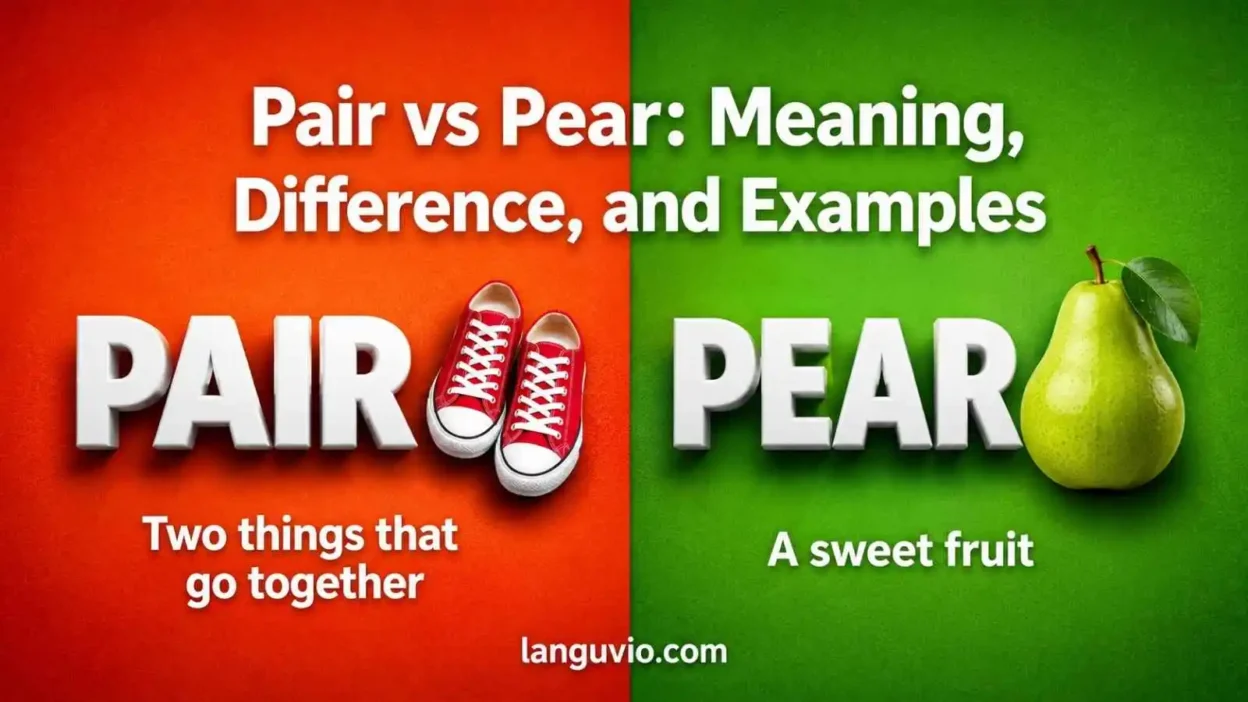
Pair vs pear is a common word-choice problem because the two words sound the same in American English. However, they mean completely different things.
Use pair when you mean two things that go together, two people connected in some way, or the action of putting things together. On the other hand, use pear when you mean the fruit or the tree that grows that fruit.
These words are not interchangeable. For example, a pair of shoes is correct, but a pear of shoes is wrong. Likewise, a ripe pear is correct, while a ripe pair only makes sense as a joke.
Quick Answer
Pair means two matching, connected, or related things. It can also mean to put two things or people together.
Pear means a sweet fruit that is usually wider at the bottom and narrower near the stem. In addition, it can refer to the tree that grows pears.
Here is the easiest way to remember the difference:
If you mean two, choose pair.
If you mean fruit, choose pear.
Examples:
Correct: I bought a new pair of sneakers.
After lunch, she ate a juicy pear.
For the project, the teacher will pair students.
Incorrect: I bought a new pear of sneakers.
Incorrect: She ate a juicy pair after lunch.
Why People Confuse Them
People confuse pair and pear because they are homophones. In other words, they sound alike but have different spellings and meanings.
In speech, the meaning is usually clear from context. For instance, when someone says, “I need a pair,” you probably think of two items. However, when someone says, “I ate a pear,” you think of fruit.
The confusion usually happens in writing. Since the words sound the same, it is easy to choose the wrong spelling.
Fortunately, the fix is simple. Connect pair with two, and connect pear with fruit.
Key Differences At A Glance
| Context | Best Choice | Why |
| Two socks, shoes, gloves, or earrings | pair | It means two matching or connected things. |
| Two people working together | pair | It can mean two people as a unit. |
| Matching students or partners | pair | As a verb, it means to put together. |
| A sweet fruit | pear | It names the fruit. |
| A tree that grows pears | pear | It can also name the tree. |
| “A ___ of jeans” | pair | Jeans are treated as one item with two joined parts. |
| “A ripe ___” | pear | Ripe describes fruit here. |
Meaning and Usage Difference
The main difference is meaning. Pair is about two things, matching things, or connected things. Pear, meanwhile, is about fruit.
As a noun, pair can refer to two items that belong together.
Examples:
A pair of socks
A pair of glasses
A pair of students
A pair of tickets
In addition, pair can work as a verb. When used this way, it means to match, join, or connect two people or things.
Examples:
Please pair the socks.
The app will pair with your headphones.
The coach paired rookies with experienced players.
By contrast, pear is much narrower. It is normally a noun, and it refers to a fruit or the tree that grows that fruit.
Examples:
I sliced a pear for breakfast.
The pear tree bloomed this spring.
This salad has walnuts, cheese, and pear.
Because both words sound alike, spelling carries the meaning in written English.
Tone, Context, and Formality
There is no major formality difference between pair and pear. Both are normal everyday words. Therefore, the choice depends on meaning, not tone.
Pair appears in many common contexts, including clothing, school, work, sports, and technology.
Examples:
a pair of pants
a pair of teammates
pair your phone with the speaker
pair the new employee with a mentor
Pear, however, appears mostly in food, grocery, cooking, gardening, and farming contexts.
Examples:
pear slices
pear tree
pear jam
baked pear
Neither word sounds especially formal or casual. Instead, each word simply belongs to a different meaning.
Quick comparison:
• Pair means two things, two people, or the act of matching.
• Pear means a fruit or the tree that grows it.
• Pair can be a noun or a verb.
• Pear is normally a noun.
• Pair fits many everyday topics.
• Pear mostly fits food, plants, and cooking.
Which One Should You Use?
Choose pair when the sentence involves two items, two people, matching, grouping, or connecting.
Examples:
I need a pair of clean socks.
They make a strong pair in doubles tennis.
Can you pair these earbuds with my laptop?
Choose pear when the sentence involves the fruit or the tree.
Examples:
This pear is sweet.
We planted a pear tree in the yard.
Add thin pear slices to the salad.
So, the decision is usually quick. If the sentence has the idea of two, matching, or joining, pair is correct. If the sentence is about fruit, pear is correct.
When One Choice Sounds Wrong
The wrong word often creates a sentence that looks strange or funny. As a result, checking the meaning can help you catch the mistake fast.
Incorrect: I packed a pear of shoes.
Correct: I packed a pair of shoes.
Shoes come in twos, so pair is right.
Incorrect: I ate a pair for dessert.
Correct: I ate a pear for dessert.
Since dessert can be fruit, pear is right.
Incorrect: The teacher will pear us into groups.
Correct: The teacher will pair us into groups.
Here, the sentence means “put us together,” so pair is the correct verb.
Incorrect: The farmer grows pairs in the orchard.
Correct: The farmer grows pears in the orchard.
Because the sentence refers to fruit, pears is the correct plural noun.
Common Mistakes (and Quick Fixes)
A common mistake is using pear when the meaning is “two things.”
Incorrect: a pear of gloves
Correct: a pair of gloves
Another mistake is using pair when the sentence means the fruit.
Incorrect: a ripe pair
Correct: a ripe pear
Writers also sometimes forget that pair can be a verb.
Incorrect: The program will pear volunteers with students.
Correct: The program will pair volunteers with students.
In addition, there is another homophone: pare. It means to trim or cut away. Although it sounds the same, it is not the same as pair or pear.
Example:
You can pare a pear, but you cannot pear a pair.
That sentence is playful, but it shows the difference clearly.
Everyday Examples
Here are natural examples with pair:
I bought a new pair of running shoes.
She found a matching pair of earrings.
Together, the two cousins make a funny pair.
Please pair each new hire with a trainer.
For some reason, my headphones would not pair with my phone.
We ordered a pair of tickets for the concert.
Yesterday, he wore a pair of black jeans.
During practice, the coach paired me with a stronger player.
Here are natural examples with pear:
I packed a pear in my lunch.
After lunch, the pear was soft and sweet.
She made a salad with pear and walnuts.
At the store, we bought apples, bananas, and pears.
Every fall, the old pear tree still gives fruit.
He sliced a pear for the baby.
For dessert, the restaurant served baked pear with cinnamon.
In the produce aisle, the grocery store had green and red pears.
Dictionary-Style Word Details
Verb
• Pair: Commonly used as a verb. It means to put two people or things together, match them, or connect them.
Examples:
The teacher will pair students for the activity.
I need to pair my phone with the speaker.
• Pear: Not commonly used as a verb in standard US English. Instead, use pear as a noun for the fruit or tree.
Noun
• Pair: A noun meaning two matching, connected, or related things or people.
Examples:
a pair of shoes
a pair of friends
a pair of tickets
• Pear: A noun meaning a fruit or the tree that grows it.
Examples:
a ripe pear
a pear tree
a bowl of pears
Synonyms
• Pair: Closest plain alternatives include couple, duo, twosome, set of two, and match. However, these words do not always replace pair perfectly. For example, “a pair of pants” is normal, but “a duo of pants” is not.
• Pear: There is no exact everyday synonym for pear as a fruit name. The closest plain alternative is fruit, but that word is broader and less specific.
Antonyms do not fit neatly for either word. In some contexts, pair can contrast with single. However, single is not a full opposite in every use. Pear does not have a true everyday antonym.
Example Sentences
• Pair: I left a pair of gloves in the car.
• Pair: The manager paired the new worker with an experienced teammate.
• Pair: That pair of earrings would look great with your dress.
• Pear: I ate a pear with lunch.
• Pear: The recipe calls for two ripe pears.
• Pear: A pear tree grows near the fence.
Word History
• Pair: The word comes through older French and Latin roots connected with the idea of equal or matching things. That background fits the modern meaning of two related items.
• Pear: The word goes back through older English and Latin forms for the fruit. However, the deeper origin is not fully certain, so it is safest to focus on the modern meaning instead of making a strong claim about its earliest source.
Phrases Containing
• Pair:
a pair of shoes
a pair of pants
a pair of glasses
pair up
pair off
pair with
safe pair of hands
two pair
• Pear:
pear tree
pear juice
pear slices
pear jam
pear-shaped
prickly pear
Asian pear
poached pear
FAQs
Use pair when you mean two things that go together. Use pear when you mean the fruit. For example, “a pair of shoes” is correct, while “a pear of shoes” is wrong.
Pair means two matching, connected, or related things. It can also mean to put two things together. Pear means a sweet fruit or the tree that grows that fruit.
Yes. In American English, pair and pear are usually pronounced the same. Because they sound alike, writers often confuse them in spelling.
Yes. A pair of shoes is correct because shoes usually come as two matching items. A pear of shoes is incorrect because pear means fruit.
Yes. Pair can be a verb meaning to match, join, or connect two things or people. For example, “The teacher will pair students for the project.”
No, pear is not commonly used as a verb in standard US English. It is normally a noun that means the fruit or the tree.
Remember this simple rule: pair means two, and pear means fruit. If the sentence is about matching, joining, or two things, use pair. If it is about something you can eat, use pear.
Here is a correct example: “I bought a new pair of jeans.” In this sentence, pair is correct because jeans are treated as one item with two joined parts.
Here is a correct example: “She packed a pear in her lunch.” In this sentence, pear is correct because it means the fruit.
Pear tree is correct. A pear tree is a tree that grows pears. Pair tree is incorrect unless it is being used as a made-up name or a joke.
Conclusion
The difference between pair vs pear is simple once you connect each word to its meaning.
Use pair for two things, two people, matching, or connecting. Since pair can be a noun or a verb, it works in sentences like “a pair of shoes” and “pair the students.”
Use pear for the fruit or the tree. It is normally a noun, so it works in phrases like “a ripe pear” or “a pear tree.”
In the end, remember this quick rule: pair means two, while pear means fruit. That one check will help you choose the correct word in almost every sentence.