Their and there sound the same, but they do different jobs in a sentence. That is why the mistake is so common in texts, emails, school writing, and social posts.
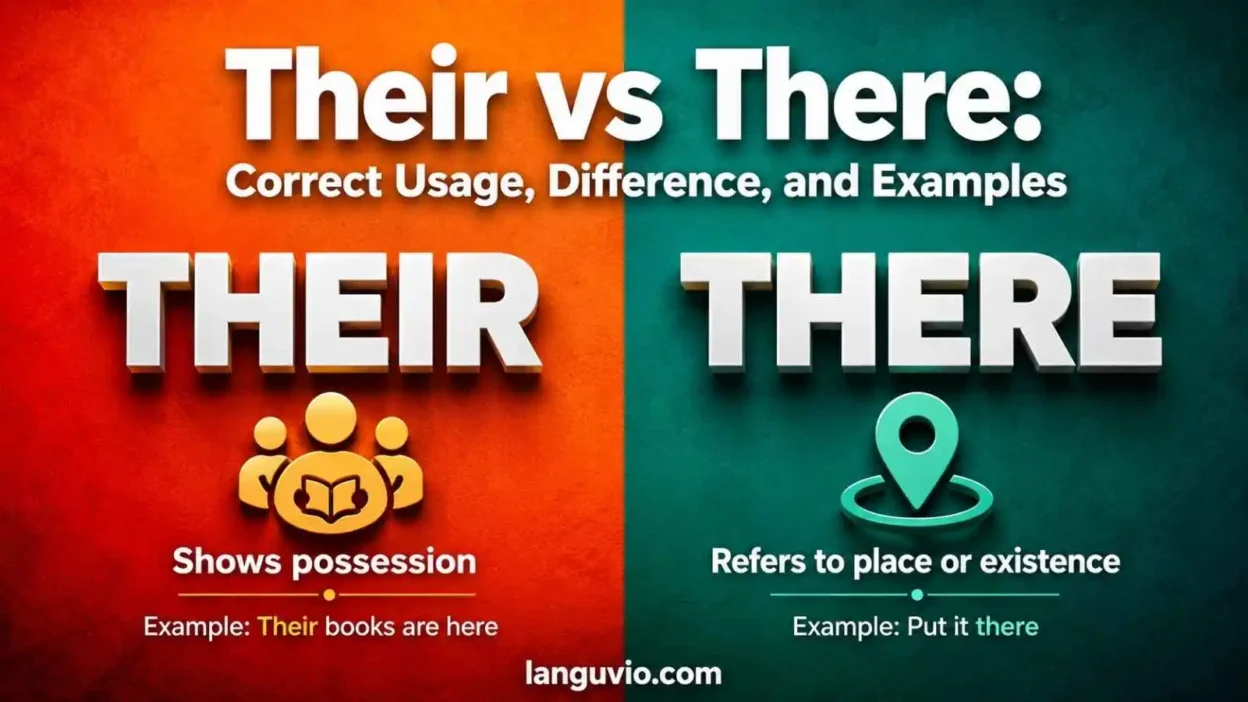
The simplest way to choose is this: use their when something belongs to people, animals, things, or a person using they. Use there when you mean a place, a point, or the existence of something.
Quick Answer
Use their for ownership: The students forgot their books. Use there for place, position, or existence: Put the books over there. There are three books on the desk. Their almost always comes before a noun. There often answers “where?” or starts sentences with is, are, was, or were.
Why People Confuse Them
Their and there are homophones. That means they usually sound alike in everyday American English, even though they have different meanings and spellings.
They also look similar. Both start with th and end with r. In fast writing, people often type the sound they hear instead of checking the grammar job the word is doing.
Another reason is that there does more than one job. It can point to a place, as in over there. It can also introduce a sentence, as in There is a meeting at noon. That second use does not feel like a physical place, so writers sometimes hesitate.
Key Differences At A Glance
| Context | Best Choice | Why |
| Something belongs to a group | their | It shows ownership before a noun. |
| Something belongs to one person who uses they | their | It is the possessive form connected to they. |
| A place or location | there | It points to where something is. |
| A point in a process or conversation | there | It means “at that point.” |
| A sentence starts with is, are, was, or were | there | It introduces existence or occurrence. |
| Before a noun like car, idea, house, or team | their | It tells whose noun it is. |
Meaning and Usage Difference
Their is a possessive word. It tells the reader that something belongs to, relates to, or is connected with someone or something already mentioned.
Examples:
Their car is parked outside.
The players thanked their coach.
Each student should check their email.
There often points to a place.
Examples:
The keys are over there.
We stayed there last summer.
Put the package there by the door.
There can also introduce the existence of something.
Examples:
There is a problem with the order.
There are two seats left.
Was there a reason for the delay?
A helpful test: if you can ask “whose?” use their. If you can ask “where?” or start with “there is” or “there are,” use there.
Compact comparison:
• Their = ownership or connection
• There = place, point, or existence
• Their usually needs a noun after it
• There can stand alone or introduce a sentence
• Both usually sound the same, so spelling must come from meaning
Tone, Context, and Formality
Their and there are both standard in casual, professional, and academic writing. The difference is not tone. The difference is meaning and grammar.
Their fits formal and informal writing when ownership is clear.
Correct: Employees must submit their forms by Friday.
Correct: The neighbors moved their car.
There also fits all levels of writing when it points to a place or introduces existence.
Correct: The report is there on the desk.
Correct: There are several ways to solve the issue.
Neither word is more formal than the other. However, using the wrong one can make a sentence look careless because the error is easy to spot.
Which One Should You Use?
Use their when the next idea belongs to someone or something.
Choose their in these patterns:
Their + noun
Their + adjective + noun
Their + noun phrase
Examples:
their house
their new apartment
their final decision
Use there when you mean location, direction, a point, or existence.
Choose there in these patterns:
over there
there is
there are
there was
from there
right there
Examples:
The bus stops there.
There is no update yet.
We can continue from there.
When One Choice Sounds Wrong
Their sounds wrong when the sentence needs a place or an existence word.
Wrong: The files are over their.
Correct: The files are over there.
Wrong: Their are five people waiting.
Correct: There are five people waiting.
There sounds wrong when the sentence needs ownership.
Wrong: The team lost there focus.
Correct: The team lost their focus.
Wrong: Ask the guests for there names.
Correct: Ask the guests for their names.
The fastest fix is to look at the word after the blank. If a noun follows, their may be right. If is, are, was, were, or a place phrase follows, there is usually right.
Common Mistakes (and Quick Fixes)
Mistake: Using their before is or are.
Wrong: Their is a new rule.
Correct: There is a new rule.
Mistake: Using there before a noun that belongs to someone.
Wrong: I like there idea.
Correct: I like their idea.
Mistake: Using their for a location.
Wrong: We parked their.
Correct: We parked there.
Mistake: Forgetting that their can refer to one person when the person uses they.
Correct: Jordan left their laptop in the office.
Mistake: Treating there as only a physical place.
Correct: There was a long pause after the question.
Correct: Stop there before you make the sentence too long.
Everyday Examples
Their examples:
The kids cleaned their rooms before dinner.
The company changed their return policy.
The dogs wagged their tails when we got home.
Someone left their phone at the front desk.
The neighbors invited us to their cookout.
There examples:
The charger is over there by the couch.
There are fresh bagels in the kitchen.
We went there after the game.
There was a typo in the headline.
Pause there and read the sentence again.
Side-by-side examples:
Their bikes are over there.
There is a note on their door.
Their meeting starts when everyone gets there.
The students put their backpacks there.
There were questions about their plan.
Dictionary-Style Word Details
Verb
Their: Not used as a verb in standard US English. You cannot their something.
There: Not commonly used as a verb in standard US English. It works mainly as an adverb, pronoun-like sentence opener, noun, adjective, or interjection, depending on the sentence.
Noun
Their: Not used as a noun in standard US English. It works before a noun to show possession or connection.
There: Can be a noun in limited expressions where it means “that place” or “that point.” Example: We can take it from there.
Synonyms
Their: It has no exact synonym because it is a possessive form. Closest plain alternatives are belonging to them, belonging to that person, or connected with them.
There: Closest plain alternatives depend on the meaning. For place, use in that place, at that place, or to that place. For contrast, the opposite of there is often here.
Example Sentences
Examples With “Their”
- The couple’s apartment has a great view.
- The managers shared their feedback after the meeting.
- Every customer should keep their receipt.
Examples With “There”
- We sat there for twenty minutes.
- A coffee shop is there on the corner.
- I agree with you there.
Word History
Their: Their came into English through Middle English, with roots connected to Old Norse forms. Today, it is the possessive form linked to they.
There: There comes from older English forms connected with place and position. Its core meaning still points to a place, point, or situation.
Phrases Containing
Their: their own, on their own, at their expense, their best, their way, their decision, their responsibility.
There: over there, right there, there is, there are, from there, here and there, then and there, there you go.
FAQs
What is the difference between their and there?
Their shows ownership. It means something belongs to or is connected with people, animals, things, or one person who uses they. Example: The students finished their project. There points to a place, position, point, or existence. Example: The project is over there. There is also a deadline today.
When should I use their?
Use their when you can ask “whose?” about the noun that follows. For example, in their car, their house, their idea, and their mistake, the word their tells who owns or is connected to the noun.
When should I use there?
Use there when you mean “in that place,” “at that point,” or when you start a sentence with there is, there are, there was, or there were. Examples: Sit there. There are three messages waiting.
Is their ever used for one person?
Yes. Their can refer to one person when the person’s gender is unknown, not important, or when that person uses they. Example: Someone left their jacket in the lobby.
Is it “their is” or “there is”?
The correct phrase is usually there is. Example: There is a problem with the order. Their is only correct when their belongs to a longer noun phrase, such as their issue is serious.
How can I remember their vs there?
Connect their with ownership: their name, their home, their plan. Connect there with place or existence: over there, there is, there are. A quick test helps: use their for “whose?” and there for “where?” or “there is/there are.”
Conclusion
Their vs there is not a style choice. Use their when you mean ownership or connection. Use there when you mean a place, a point, or the existence of something.
A quick check usually solves the problem. Ask “whose?” for their. Ask “where?” or check for there is and there are for there. Once you connect each word to its grammar job, the choice becomes much easier.
Their shows ownership. It means something belongs to or is connected with people, animals, things, or one person who uses they. Example: The students finished their project. There points to a place, position, point, or existence. Example: The project is over there. There is also a deadline today.
Use their when you can ask “whose?” about the noun that follows. For example, in their car, their house, their idea, and their mistake, the word their tells who owns or is connected to the noun.
Use there when you mean “in that place,” “at that point,” or when you start a sentence with there is, there are, there was, or there were. Examples: Sit there. There are three messages waiting.
Yes. Their can refer to one person when the person’s gender is unknown, not important, or when that person uses they. Example: Someone left their jacket in the lobby.
The correct phrase is usually there is. Example: There is a problem with the order. Their is only correct when their belongs to a longer noun phrase, such as their issue is serious.
Connect their with ownership: their name, their home, their plan. Connect there with place or existence: over there, there is, there are. A quick test helps: use their for “whose?” and there for “where?” or “there is/there are.”