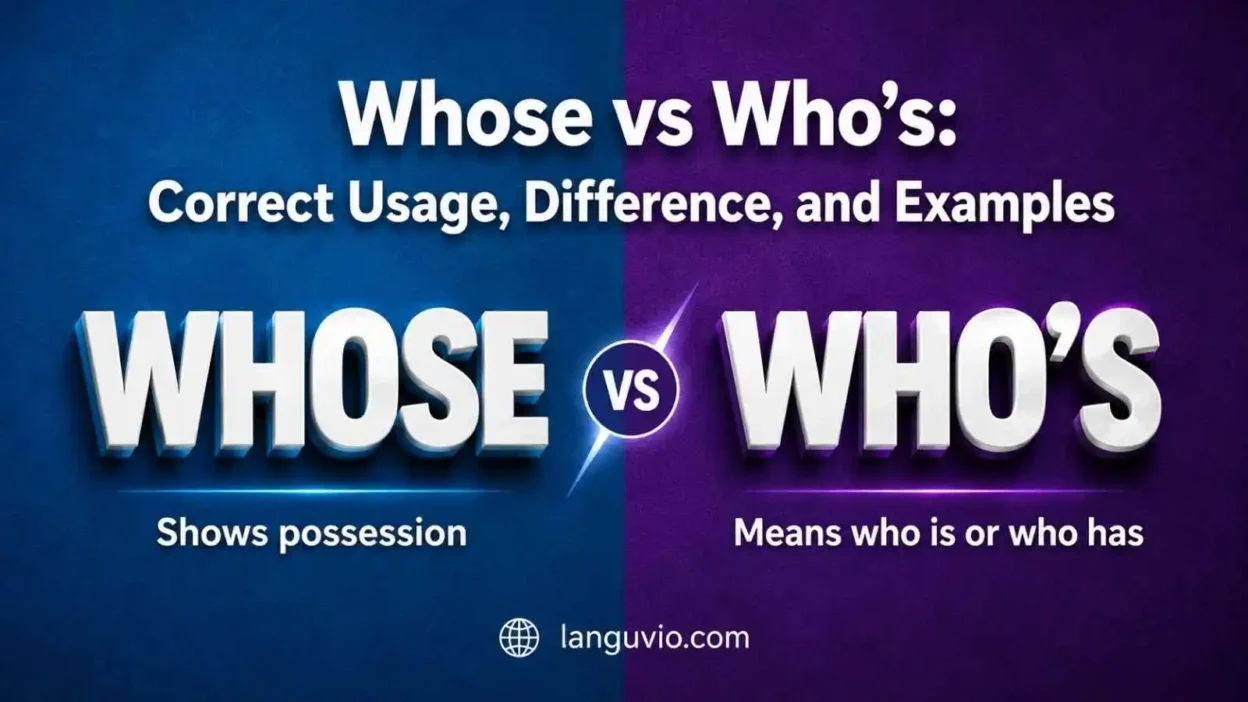
Whose vs who’s is a common mix-up because the two words sound the same. The apostrophe also makes who’s look possessive, which leads many writers to choose it in sentences about ownership.
The difference is simple once you know the job each word does. Use whose for possession, belonging, or connection. Use who’s only when you mean who is or who has. The two words are not interchangeable.
Quick Answer
Use whose when you mean “belonging to whom” or “of which.” Use who’s when you can replace it with who is or who has. Write “Whose phone is this?” because the sentence asks about ownership. Write “Who’s calling?” because it means “Who is calling?”
Why People Confuse Them
People confuse whose and who’s for two main reasons.
First, they sound alike. Both are usually pronounced like “hooz,” so speech does not show the difference. You have to choose by meaning, not by sound.
Second, apostrophes often show possession in nouns, as in “Maya’s laptop” or “the teacher’s desk.” That pattern can make who’s look like the possessive form. However, who’s is not possessive. The apostrophe marks missing letters in a contraction.
That same pattern appears in it’s and its. It’s means it is or it has. Its shows possession. In the same way, who’s means who is or who has, while whose shows possession.
Key Differences At A Glance
| Context | Best Choice | Why |
| Asking who owns something | whose | It means “belonging to whom.” |
| Asking who is doing something | who’s | It means “who is.” |
| Asking who has done something | who’s | It means “who has.” |
| Showing a person connected to a noun | whose | It works before a noun, as in “whose car.” |
| Introducing a clause about possession or connection | whose | It can link a person or thing to something related. |
| Casual speech with a shortened form | who’s | It is a contraction and sounds natural in conversation. |
| Formal writing where contractions are avoided | whose or who is/who has | Whose is fine, but who’s may be expanded. |
Meaning and Usage Difference
Whose is the possessive form connected to who. It asks or tells which person something belongs to, comes from, or is connected with.
Examples:
Whose backpack is on the couch?
I met a designer whose work is all over the city.
Do you know whose idea this was?
Whose can come before a noun, as in “whose backpack.” It can also stand alone when the noun is already clear.
Examples:
Whose is this?
If both jackets look alike, whose is on the chair?
Who’s is a contraction. It shortens who is or who has.
Examples:
Who’s coming to dinner?
Who’s been using my charger?
She’s the person who’s leading the meeting.
A good test is to expand who’s. If who is or who has fits, use who’s. If neither one fits, use whose.
Correct: Who’s ready?
Test: Who is ready?
Correct: Whose keys are these?
Test: Who is keys are these? That fails, so whose is correct.
Tone, Context, and Formality
Whose is neutral. You can use it in casual writing, school papers, workplace emails, legal wording, and formal prose.
Who’s is more conversational because it is a contraction. It is normal in texts, dialogue, casual emails, and friendly articles. In very formal writing, you may choose who is or who has instead.
Compare:
Casual: Who’s handling the client call?
More formal: Who is handling the client call?
Both are correct. The difference is tone, not meaning.
Whose can also refer to things in relative clauses when the sentence needs a possessive link.
Example:
The company whose policy changed sent an update.
That use is standard and often smoother than a longer rewrite. Still, at the start of a direct question, whose usually asks about a person or owner.
Which One Should You Use?
Choose whose when the sentence asks about ownership, responsibility, authorship, connection, or belonging.
Use whose with nouns like name, phone, car, turn, idea, fault, side, office, schedule, and account.
Examples:
Whose
Whose turn is it?
Can you tell me whose name is on the lease?
Do we know whose account was charged?
Choose who’s when the sentence needs a subject plus a verb. It usually appears before an action, state, or helping verb.
Examples:
Who’s
Who’s going with us?
Do you know who’s in charge today?
Can you tell who’s been waiting the longest?
The fastest rule is this: expand who’s. If the sentence still works with who is or who has, the apostrophe is correct. If the sentence becomes awkward or impossible, use whose.
When One Choice Sounds Wrong
Who’s sounds wrong when the sentence needs possession.
Wrong: Who’s laptop is on the table?
Why it fails: “Who is laptop” does not make sense.
Correct: Whose laptop is on the table?
Wrong: I don’t know who’s dog got loose.
Why it fails: “who is dog” does not fit.
Correct: I don’t know whose dog got loose.
Whose sounds wrong when the sentence needs who is or who has.
Wrong: Whose coming to the meeting?
Why it fails: The sentence does not ask about ownership.
Correct: Who’s coming to the meeting?
Wrong: Whose been calling you?
Why it fails: The sentence means “who has been calling you.”
Correct: Who’s been calling you?
Common Mistakes (and Quick Fixes)
Mistake 1: Using who’s before a noun about ownership.
Wrong: Who’s car is blocking the driveway?
Correct: Whose car is blocking the driveway?
Quick fix: If a noun follows and the meaning is ownership, choose whose.
Mistake 2: Using whose before a verb phrase.
Wrong: Whose going to pick up lunch?
Correct: Who’s going to pick up lunch?
Quick fix: If who is fits, choose who’s.
Mistake 3: Forgetting that who’s can mean who has.
Wrong: Whose seen my headphones?
Correct: Who’s seen my headphones?
Quick fix: If who has fits, choose who’s.
Mistake 4: Treating has as ownership after who’s.
Wrong: Who’s the blue truck?
Better: Whose is the blue truck?
Better: Who has the blue truck?
Quick fix: Who’s can mean who has only when has works as a helping verb, as in “who’s been,” “who’s seen,” or “who’s finished.”
Mistake 5: Avoiding whose for things in all cases.
Awkward: The laptop, the screen of which cracked, is still under warranty.
Better: The laptop whose screen cracked is still under warranty.
Quick fix: In relative clauses, whose can show a possessive link for people, animals, groups, and things.
Everyday Examples
Here is a compact side-by-side comparison.
| Feature | whose | who’s |
| Main job | Shows possession or connection | Shortens who is or who has |
| Apostrophe | No apostrophe | Has an apostrophe |
| Common position | Before a noun or standing alone | Before a verb, adjective, noun phrase, or helping verb |
| Simple test | Means “belonging to whom” | Expands to “who is” or “who has” |
More natural examples:
Whose jacket did you leave in my car?
Who’s driving to the airport tomorrow?
Whose birthday are we celebrating?
Who’s been editing the shared document?
I found a wallet, but I don’t know whose it is.
That’s the neighbor whose dog barks at every delivery truck.
Who’s responsible for locking the office tonight?
The school whose team won the state title held a parade.
Whose side are you on?
Who’s ready for the next round?
Notice the pattern. Whose points to a noun or a possessive relationship. Who’s points to an action, identity, state, or completed action with has.
Dictionary-Style Word Details
Verb
• whose: Not used as a verb in standard US English. It functions mainly as a possessive determiner or pronoun.
• who’s: Not a verb by itself. It is a contraction that includes a verb: who is or who has.
Examples:
Whose idea was this?
Who’s leading the project?
Noun
• whose: Not commonly used as a noun. It can stand alone as a pronoun when the noun is understood, as in “Whose is this?”
• who’s: Not used as a noun in the whose vs who’s choice. It is a contraction.
Examples:
Whose are these gloves?
Who’s at the front desk?
Synonyms
• whose: Exact one-word synonyms are limited. Closest plain alternatives include “belonging to whom,” “of whom,” and “of which,” depending on the sentence.
• who’s: No true synonym as a single word. Closest plain alternatives are the expanded forms “who is” and “who has.”
Antonyms do not clearly fit either word because these terms do grammatical jobs rather than naming opposite ideas.
Example Sentences
Whose
Whose phone keeps buzzing during the movie?
I spoke with the student whose essay won the contest.
The restaurant whose patio overlooks the river is booked tonight.
Who’s
Who’s joining the video call at 3 p.m.?
She’s the one who’s been training the new team members.
Can you tell me who’s in charge of the playlist?
Word History
• whose: Whose comes from the older possessive form connected to who. Its main job has stayed tied to possession, belonging, and relationship.
• who’s: Who’s formed as a contraction of who is or who has. The apostrophe marks missing letters, not ownership.
For practical writing, the history matters less than the replacement test. If who is or who has works, choose who’s. If the sentence needs possession, choose whose.
Phrases Containing
• whose: whose turn, whose idea, whose fault, whose name, whose phone, whose side, whose team, whose job, whose house, whose account
• who’s: who’s there, who’s calling, who’s coming, who’s ready, who’s next, who’s been, who’s seen, who’s in charge, who’s available, who’s responsible
These phrases show the pattern clearly. Whose usually points to a noun or a relationship. Who’s usually leads into a verb, state, or completed action.
FAQs
Is it “whose” or “who’s”?
Use whose when you mean ownership, belonging, or connection. Use who’s when you mean who is or who has. For example, “Whose phone is this?” asks who owns the phone. “Who’s calling?” means “Who is calling?”
Is “who’s” possessive?
No. Who’s is not possessive. The apostrophe shows a contraction, not ownership. It always means who is or who has. The possessive form is whose, as in “Whose jacket is on the chair?”
Is it “whose turn” or “who’s turn”?
The correct phrase is whose turn. Turn belongs to or is assigned to someone, so the sentence needs the possessive form. Write, “Whose turn is it?” not “Who’s turn is it?”
Is it “whose name” or “who’s name”?
Use whose name. The phrase asks which person a name belongs to or is connected with. For example, “Whose name is on the reservation?” is correct.
Can “whose” refer to things?
Yes. Whose can refer to people, animals, groups, and things when it shows a possessive link. For example, “The company whose policy changed sent an email” is standard English.
How can I remember whose vs who’s?
Replace who’s with who is or who has. If the sentence still makes sense, use who’s. If it does not, use whose. For example, “Who’s ready?” becomes “Who is ready?” so who’s is correct. “Who’s keys are these?” becomes “Who is keys are these?” so it should be whose.
Are whose and who’s pronounced the same?
Yes. In everyday speech, whose and who’s usually sound the same. That is why writers must choose based on meaning, not sound.
Conclusion
Whose and who’s sound the same, but they do different jobs. Whose shows possession, belonging, responsibility, or connection. Who’s is only a contraction of who is or who has.
Use the expansion test whenever you are unsure. Replace who’s with who is or who has. If the sentence works, who’s is correct. If it does not, use whose. That one check fixes most mistakes.
Use whose when you mean ownership, belonging, or connection. Use who’s when you mean who is or who has. For example, “Whose phone is this?” asks who owns the phone. “Who’s calling?” means “Who is calling?”
No. Who’s is not possessive. The apostrophe shows a contraction, not ownership. It always means who is or who has. The possessive form is whose, as in “Whose jacket is on the chair?”
The correct phrase is whose turn. Turn belongs to or is assigned to someone, so the sentence needs the possessive form. Write, “Whose turn is it?” not “Who’s turn is it?”
Use whose name. The phrase asks which person a name belongs to or is connected with. For example, “Whose name is on the reservation?” is correct.
Yes. Whose can refer to people, animals, groups, and things when it shows a possessive link. For example, “The company whose policy changed sent an email” is standard English.
Replace who’s with who is or who has. If the sentence still makes sense, use who’s. If it does not, use whose. For example, “Who’s ready?” becomes “Who is ready?” so who’s is correct. “Who’s keys are these?” becomes “Who is keys are these?” so it should be whose.
Yes. In everyday speech, whose and who’s usually sound the same. That is why writers must choose based on meaning, not sound.