Could and would are both common modal verbs, so they often appear in similar sentence patterns. That is why they can confuse even strong English speakers. You might hear Could you help me? and Would you help me? and wonder whether both are correct.
The answer depends on meaning. Could often points to ability, possibility, permission, or an available option. Would often points to willingness, preference, habit, or an imagined result. This guide explains the difference in clear US English with practical examples.
Quick Answer
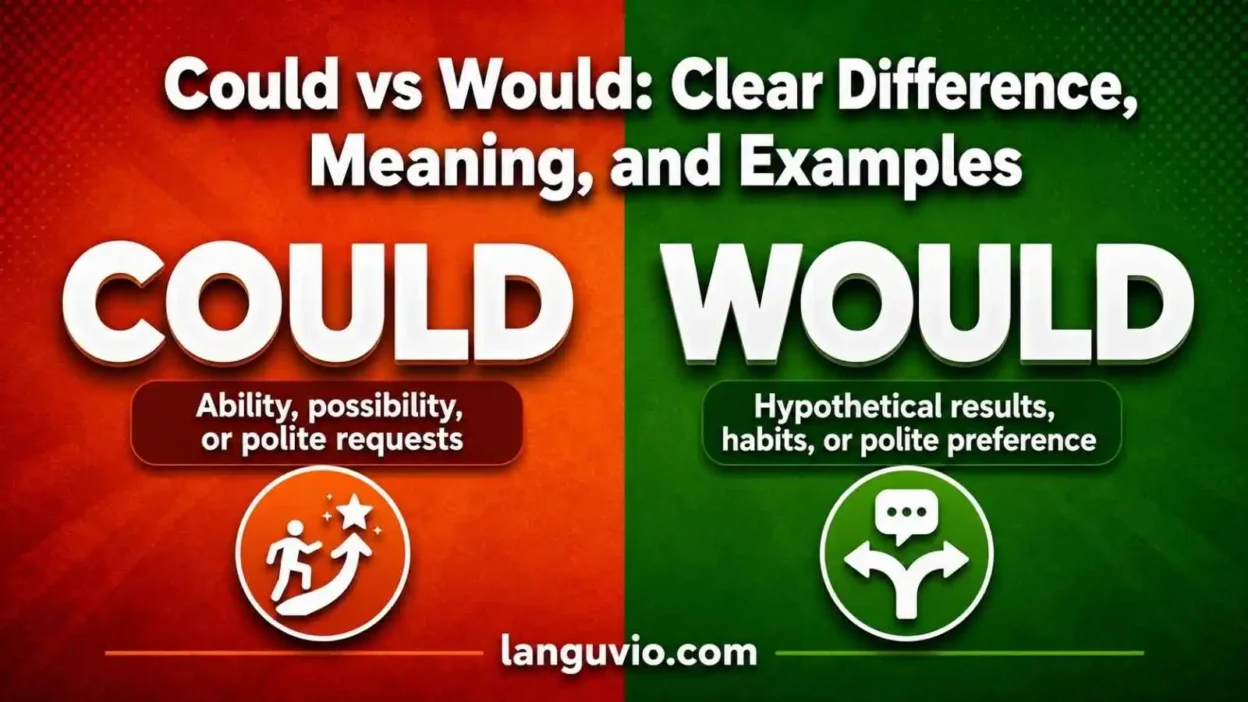
Use could when you mean “was able to,” “might be able to,” “was allowed to,” or “is possible.” Use would when you mean “was willing to,” “was going to,” “used to,” or “would happen if something else were true.” Both can make requests polite, but they do not always carry the same focus.
Why People Confuse Them
People confuse could and would because both are modal auxiliary verbs. They come before the main verb and help shape the meaning.
Correct:
I could call you later.
I would call you later.
The structure is the same, but the meaning changes. Could suggests a possible option. Would suggests a likely choice under some condition.
They also overlap in polite requests:
Could you send the file?
Would you send the file?
Both are polite. However, could often asks whether the action is possible, while would often asks whether the person is willing to do it.
Key Differences At A Glance
| Context | Best Choice | Why |
| Past ability | could | It means someone was able to do something. |
| Present or future possibility | could | It shows something may happen or may be possible. |
| Permission | could | It can mean someone was allowed to do something. |
| Polite request about ability | could | It asks if someone can do the action. |
| Willingness | would | It shows choice, agreement, or refusal. |
| Imagined result | would | It shows what happens in a possible or unreal situation. |
| Past habit | would | It can describe repeated actions in the past. |
| Polite offer | would | It often appears in offers such as “Would you like…?” |
Meaning and Usage Difference
Could is connected to can. It often means “was able to” in the past.
When I was younger, I could run five miles easily.
It can also show possibility.
The meeting could end early.
In that sentence, could does not mean past ability. It means the meeting may possibly end early.
Could can also ask for permission or make a polite request.
Permission:
• Could I leave early today?
Polite request:
• Could you check this report?
Would is connected to will. It often shows what someone was willing to do, planned to do, or expected to do from a past point of view.
She said she would call after work.
It also appears in imagined situations.
I would help if I had more time.
Here, would does not mean the person is helping now. It shows what the person says they would do under a condition.
Here is the compact comparison:
| Feature | could | would |
| Core idea | ability, permission, possibility | willingness, preference, imagined result |
| Related form | can | will |
| Common request | Could you help me? | Would you help me? |
| Common past form | could have | would have |
Tone, Context, and Formality
Both could and would can sound polite. In everyday US English, Could you…? is a common polite request.
Could you give me a minute?
This sounds respectful because it softens the request.
Would you…? can also sound polite, especially when asking for someone’s willingness.
Would you give me a minute?
The difference is small in many requests. Still, could leans toward ability or possibility, while would leans toward willingness or choice.
In offers, would is usually more natural.
Natural:
Would you like some coffee?
Less natural:
Could you like some coffee?
That second sentence sounds wrong because liking something is not an ability the listener performs on request.
Which One Should You Use?
Use could when the sentence is about ability.
She could read before kindergarten.
Use could when the sentence is about possibility.
We could get snow this weekend.
Use could when asking if something is possible.
Could we meet at 3 instead?
Use would when the sentence is about an imagined result.
I would buy that car if it cost less.
Use would when the sentence is about willingness.
He would not answer the question.
Use would when making a polite offer.
Would you like a receipt?
Use would for repeated past actions when the time frame is clear.
When we lived in Denver, we would hike every Saturday.
When One Choice Sounds Wrong
Sometimes both words fit the grammar, but only one fits the meaning.
Wrong:
When I was seven, I would swim across the pool.
This can work only if you mean a repeated past habit. If you mean ability, use could.
Better:
When I was seven, I could swim across the pool.
Wrong:
I could order the pasta if it were cheaper.
This sentence is not always wrong, but it suggests ability or possibility. If you mean your choice in an imagined situation, would is clearer.
Better:
I would order the pasta if it were cheaper.
Wrong:
Could you like a window seat?
Better:
Would you like a window seat?
Use would like for polite wants or offers.
Common Mistakes (and Quick Fixes)
Mistake 1: Using would for past ability
Wrong: I would speak Spanish when I was a kid.
Right: I could speak Spanish when I was a kid.
Fix: Use could for past ability.
Mistake 2: Using could for a polite offer with like
Wrong: Could you like dessert?
Right: Would you like dessert?
Fix: Use would like when offering something.
Mistake 3: Writing could of
Wrong: I could of helped.
Right: I could have helped.
Fix: Use have, not of, after could.
Mistake 4: Writing would of
Wrong: She would of called.
Right: She would have called.
Fix: Use would have before a past participle.
Mistake 5: Treating all polite requests as identical
Correct: Could you open the door?
Correct: Would you open the door?
Fix: Both are polite, but could points more to ability, and would points more to willingness.
Everyday Examples
Could for past ability:
My brother could fix bikes when he was ten.
Would for past habit:
Every summer, we would visit our grandparents in Ohio.
Could for possibility:
The package could arrive tomorrow.
Would for imagined result:
I would take the job if the commute were shorter.
Could for permission:
Our teacher said we could use notes on the quiz.
Would for willingness:
I asked him to wait, but he would not stay.
Could in a polite request:
Could you send me the address?
Would in a polite request:
Would you send me the address?
Could have for a missed possibility:
We could have left earlier, but we waited for traffic to clear.
Would have for an imagined past result:
I would have left earlier if I had known about the traffic.
Dictionary-Style Word Details
Verb
could: Could is a modal auxiliary verb. It is used before the base form of another verb. It can show past ability, permission, possibility, or a polite request.
Example: She could finish the project by Friday.
would: Would is a modal auxiliary verb. It is used before the base form of another verb. It can show willingness, imagined results, future-from-the-past, polite offers, or past habits.
Example: She would finish the project if she had more time.
Neither word works like a regular action verb. You do not write coulds, coulded, woulds, or woulded in standard use.
Noun
could: Not commonly used as a noun in standard US English. You may discuss the word itself, as in The could in this sentence shows possibility, but that is a grammar discussion, not everyday noun use.
would: Not commonly used as a noun in standard US English. You may discuss the word itself, as in The would in this sentence shows an imagined result, but that is not normal everyday noun use.
Synonyms
could: Closest plain alternatives include was able to, were able to, was allowed to, might, might be able to, and was possible. The best choice depends on the sentence.
would: Closest plain alternatives include was willing to, was going to, used to, wanted to, and would be likely to in some imagined contexts.
Exact antonyms do not work well for these modal verbs. In many real sentences, the negative forms are more useful: could not and would not.
Example Sentences
could:
I could hear music from the apartment next door.
You could try calling again after lunch.
Could we move the meeting to Monday?
would:
I would choose the blue one.
She said she would send the update tonight.
Would you mind closing the window?
Word History
could: Could developed as the past form linked to can. In modern English, it still keeps that past-ability use, but it also works for possibility, polite requests, and conditional meaning.
would: Would developed as the past form linked to will. In modern English, it still appears in past-related uses, but it also works in polite requests, imagined situations, offers, and past habits.
No exact first-use date is needed to understand the modern choice. The useful point is simple: could is tied to can, and would is tied to will.
Phrases Containing
could:
could have — shows a past possibility or missed chance.
could be — shows possibility.
could you — starts a polite request.
couldn’t help — means someone could not stop themselves from doing something.
would:
would have — shows an imagined past result.
would like — states a polite want or offer.
would you mind — starts a very polite request.
would rather — shows preference.
would-be — describes someone hoping or trying to be something.
FAQs
Is could or would more polite?
Both could and would can sound polite. Could often asks whether something is possible, as in Could you help me? Would often asks about willingness, as in Would you help me? In daily US English, both are respectful.
What is the main difference between could and would?
Could usually points to ability, permission, or possibility. Would usually points to willingness, preference, habit, or an imagined result. For example, I could go means going is possible. I would go means you choose to go under some condition.
Can I use could and would in the same sentence?
Yes, you can use both when each word has a clear role. Example: I would help if I could. Here, would shows willingness, and could shows ability or possibility.
Is “could of” correct?
No. Could of is not correct in standard English. Use could have instead. For example, write I could have called you, not I could of called you.
Is “would of” correct?
No. Would of is also incorrect. Use would have. For example, write She would have stayed longer, not She would of stayed longer.
Should I say “Could you” or “Would you”?
Use Could you when asking if someone can do something. Use Would you when asking if someone is willing to do something. In many polite requests, both sound natural.
What does “would have” mean?
Would have describes an imagined past result. Example: I would have gone if I had known. It means the action did not happen, but it could have happened under different conditions.
What does “could have” mean?
Could have shows a past possibility or missed chance. Example: We could have won the game. It means winning was possible, but it did not happen.
Conclusion
The clearest difference is this: could is about ability, permission, or possibility; would is about willingness, preference, habit, or an imagined result. Both can sound polite, so context matters.
Use could when you mean “can,” “was able to,” or “might be possible.” Use would when you mean “will,” “was willing to,” “used to,” or “if something happened, this result would follow.”
Both could and would can sound polite. Could often asks whether something is possible, as in Could you help me? Would often asks about willingness, as in Would you help me? In daily US English, both are respectful.
Could usually points to ability, permission, or possibility. Would usually points to willingness, preference, habit, or an imagined result. For example, I could go means going is possible. I would go means you choose to go under some condition.
Yes, you can use both when each word has a clear role. Example: I would help if I could. Here, would shows willingness, and could shows ability or possibility.
No. Could of is not correct in standard English. Use could have instead. For example, write I could have called you, not I could of called you.
No. Would of is also incorrect. Use would have. For example, write She would have stayed longer, not She would of stayed longer.
Use Could you when asking if someone can do something. Use Would you when asking if someone is willing to do something. In many polite requests, both sound natural.
Would have describes an imagined past result. Example: I would have gone if I had known. It means the action did not happen, but it could have happened under different conditions.
Could have shows a past possibility or missed chance. Example: We could have won the game. It means winning was possible, but it did not happen.