
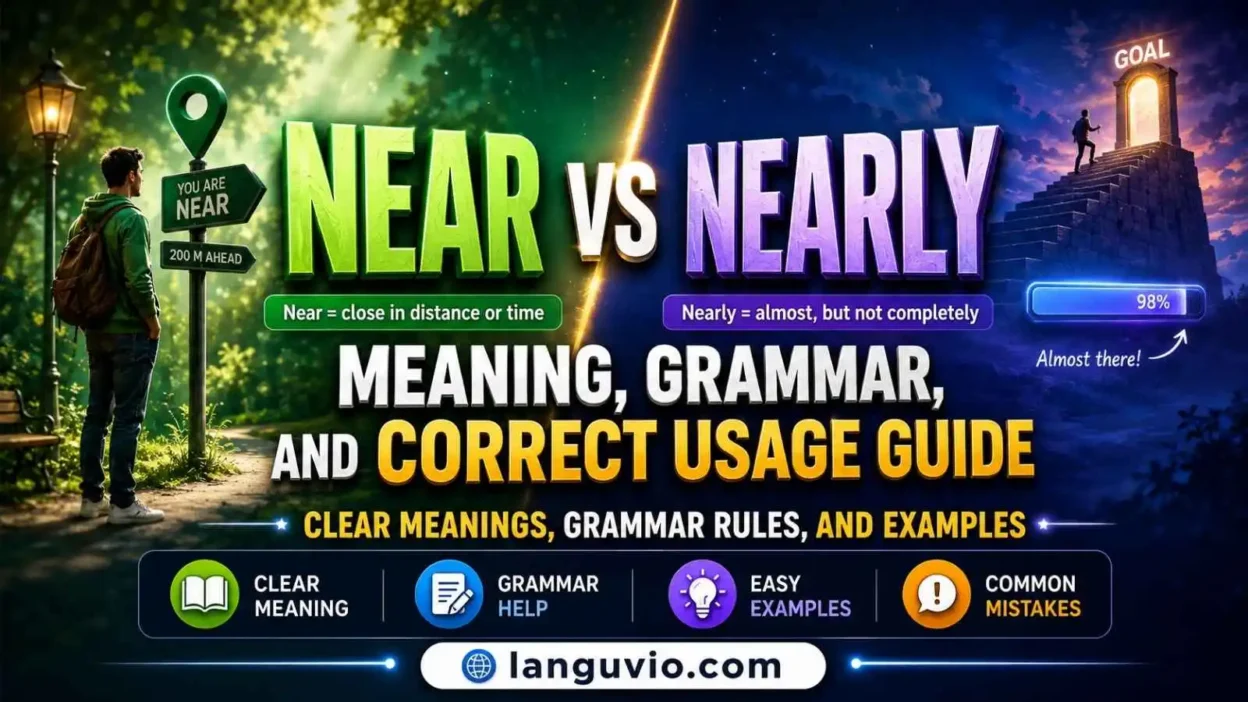
Near and nearly are both standard English words, but they usually perform different jobs.
Most often, near describes something that is close in place, time, relationship, or condition. Nearly usually means “almost” or “not completely.”
The distinction is useful, but it is not absolute. In some sentences, near can also mean “almost,” as in a near-perfect score or the task was near impossible. Understanding the sentence structure will help you choose naturally.
Quick Answer
Use near when something is close:
- The pharmacy is near my apartment.
- The deadline is near.
- The plane neared the airport.
Use nearly when you mean “almost” or “not quite”:
- I nearly forgot my wallet.
- The bottle is nearly empty.
- Nearly 200 people attended.
When both forms appear possible, nearly is generally the clearer neutral choice for “almost,” while near is common in established compounds and more compact expressions.
Why People Confuse Them
The words look and sound related because they are related. However, adding -ly does more than create another form with the same meaning.
Near has several grammatical roles. It can describe a location, a time, a condition, or movement toward something. It can be an adjective, adverb, preposition, or verb.
Nearly has a narrower role. It is an adverb that usually expresses degree. It tells us that an action, amount, quality, or condition came close to a point without fully reaching it.
Confusion also arises because near sometimes carries the same “almost” meaning as nearly. That overlap is real, but it does not make the words freely interchangeable.
Key Differences At A Glance
| Context | Best Choice | Why |
| Close to a place | near | It can come directly before a place or object. |
| Close in time | near | It describes an approaching time or event. |
| An action almost happened | nearly | It modifies the action expressed by the verb. |
| A condition is not fully reached | nearly | It means “almost” or “not completely.” |
| An approximate number or amount | nearly | It is the clearest general choice before quantities. |
| Movement toward a place or stage | near | It can function as a verb. |
| A compound such as “near-perfect” | near | It forms an established compound meaning “almost.” |
| Much less than needed | nearly | It appears in the expression “not nearly enough.” |
Meaning and Usage Difference
The central distinction is based on closeness versus degree.
- Near: not far away in distance, time, relationship, condition, or progress.
- Nearly: almost, but not fully, exactly, or completely.
- Overlap: near can sometimes mean “almost,” especially in compounds and compact expressions.
Consider a place:
The hotel is near the convention center.
Here, near introduces the place to which the hotel is close. Nearly cannot perform that job.
Now consider an action:
We nearly missed our flight.
The travelers came close to missing the flight but did not miss it. Nearly modifies the verb missed.
The words can also produce different structures around the same general idea:
The renovation is near completion.
The renovation is nearly complete.
Both sentences are correct. In the first, near comes before the noun completion. In the second, nearly modifies the adjective complete.
A similar distinction appears here:
The team earned a near-perfect score.
The team’s score was nearly perfect.
The first sentence uses the hyphenated compound near-perfect before a noun. The second uses nearly to modify perfect directly.
https://dictionary.cambridge.org/grammar/british-grammar/near-and-near-to
Tone, Context, and Formality
Both words are neutral and suitable for formal or everyday American English when used in their main roles.
Near sounds completely natural for location and approaching time:
Our office is near the courthouse.
Winter is drawing near.
Nearly is the standard neutral choice when a writer means “almost”:
The application is nearly finished.
Nearly every seat was occupied.
Using near to mean “almost” can sound shorter or more idiomatic:
The repair was near impossible.
That sentence is understandable and established. Still, nearly impossible will usually sound smoother in neutral edited prose:
The repair was nearly impossible.
Some near compounds are common across formal and informal contexts, including near-perfect, near-total, and near-fatal. By contrast, expressions such as damn near are strongly informal:
I damn near dropped my phone.
Which One Should You Use?
First, decide whether you are describing where or when something is located. If so, choose near.
We parked near the entrance.
The end of the semester is near.
Next, check whether you mean that something almost happened or almost reached a level. In most cases, choose nearly.
She nearly called the wrong client.
The tank is nearly full.
Use nearly as the safest general choice before numbers and amounts:
Nearly 50 employees joined the meeting.
Sales increased by nearly 20%.
Forms such as near 50 employees or a near-100% success rate do occur, especially in compact, technical, or promotional writing. However, nearly 50 employees and a nearly 100% success rate are clearer for general readers.
Choose near when it acts as a verb:
The train neared the station.
The project is nearing completion.
Finally, retain near in established noun phrases and compounds:
It was a near miss.
She received a near-perfect rating.
When One Choice Sounds Wrong
Substitution fails when near introduces a place or noun phrase:
Correct: The coffee shop is near the library.
Incorrect: The coffee shop is nearly the library.
The second sentence would suggest that the coffee shop is almost the same thing as the library, not that it is located close to it.
Nearly also cannot replace the adjective in the near future:
Correct: We expect an update in the near future.
Incorrect: We expect an update in the nearly future.
Use nearly when modifying an action:
Correct: I nearly spilled the coffee.
Unnatural in neutral prose: I near spilled the coffee.
A sentence may also need a grammatical change rather than a simple word replacement:
Correct: The deadline is near.
Correct: We are nearly at the deadline.
Incorrect: The deadline is nearly.
In the last version, nearly leaves the thought unfinished. The reader expects another word, such as here, over, or finished.
Common Mistakes (and Quick Fixes)
Mistake: The grocery store is nearly my house.
Fix: The grocery store is near my house.
Use near before the place to which something is close.
Mistake: We near finished the presentation.
Fix: We nearly finished the presentation.
Use nearly to modify the verb finished.
Mistake: Nearly all 300 guests attended.
Fix: Nearly all 300 guests attended is already correct.
Here, nearly modifies all, meaning that almost the entire group attended.
Mistake: The company will announce the change in the nearly future.
Fix: The company will announce the change in the near future.
Near future is the standard phrase.
Mistake: The driver nearly had a miss.
Fix: The driver had a near miss.
A near miss is an incident that came close to becoming a collision, failure, or disaster.
Mistake: I had a near miss of the bus.
Fix: I nearly missed the bus.
This sentence means that you almost failed to catch the bus. It does not describe a narrowly avoided accident.
Mistake: The project is nearly completion.
Fix: The project is near completion.
Also correct: The project is nearly complete.
A noun follows near, while the adjective complete can be modified by nearly.
Everyday Examples
The new clinic is near the high school. Our seats were near the front of the theater. With the holiday drawing near, shipping times became longer. The boat neared the dock just before sunset. A near-total power failure affected the building. The cyclist escaped a collision in a near miss.
I nearly left my keys at the restaurant. The movie is nearly three hours long. Her phone battery was nearly dead. Nearly everyone submitted the form on time. The new software is nearly ready for release. We had nearly enough paint to finish the room.
Compare these two sentences:
The hikers were near the summit.
They were physically close to the summit.
The hikers had nearly reached the summit.
They had almost completed the action of reaching it.
Another useful comparison is:
The store is near closing time.
Closing time is approaching.
The store is nearly closed.
The closing process is almost complete, or the store is close to ending business for the day.
Dictionary-Style Word Details
Verb
Near: Standard as a verb meaning to approach something in distance, time, age, amount, or progress. Its forms include nears, neared, and nearing.
The plane neared the runway.
She is nearing retirement.
Nearly: Not used as a verb in standard US English. It modifies verbs rather than functioning as one.
She nearly retired last year.
In that sentence, retired is the verb and nearly modifies it.
Noun
Near: Not commonly used as a standalone noun in standard US English. It normally serves another grammatical role in expressions such as near the door, the near future, or a near miss.
Nearly: Not used as a noun in standard US English.
Although neither word normally functions as a noun, both may appear next to nouns. Their grammatical jobs remain different:
near completion
nearly complete
Synonyms
Near: Meaning-matched alternatives depend on the sentence. For location, the closest plain alternatives include close to and not far from. For movement, approach may replace the verb. In its “almost” sense, almost or nearly may fit. Contextual opposites include far, far from, and distant.
Nearly: The closest alternatives are almost, practically, and sometimes virtually. These words are not identical in every context. Contextual opposites may include completely, fully, or exactly, depending on what has almost been reached.
Example Sentences
Near: The apartment is near the subway station. Please keep the emergency exit clear as the inspection date nears. We expect a decision in the near future. Her answer was near enough to receive partial credit. The patient made a near-complete recovery.
Nearly: The report is nearly finished. Nearly 80 customers responded to the survey. I nearly sent the message to the wrong group. The two designs are nearly identical. There is not nearly enough storage space in this room.
Word History
Near: The word has deep Germanic roots and developed from an older form connected with the meaning “nigh” or “close.” Over time, it became the ordinary modern word for closeness and developed several grammatical uses.
Nearly: This word was formed from near plus the adverb-forming ending -ly. Earlier meanings involved closeness, and the now-familiar sense of “almost” became established later.
Their shared history explains their visual similarity and their limited overlap. Modern grammar, however, gives them different primary functions.
Phrases Containing
Near: Common combinations include near future, near miss, near and dear, nowhere near, draw near, near completion, near-perfect, and near-total.
Nearly: Common combinations include nearly all, nearly finished, nearly impossible, nearly every day, nearly there, not nearly enough, and not nearly as much.
Notice the structural difference in these pairs:
a near miss
nearly missed the exit
near completion
nearly complete
a near-perfect result
a nearly perfect result
FAQs
What is the main difference between near and nearly?
Near usually shows closeness in place, time, or condition. Nearly means “almost” or “not completely.” For example, “The store is near my house” describes location, while “The store is nearly closed” means it is almost closed. The context and sentence structure determine the correct choice.
Can near and nearly be used interchangeably?
Not usually. Each word follows different sentence patterns. You can say “The school is near the park,” but not “The school is nearly the park.” However, some overlap exists in phrases such as “near impossible” and “nearly impossible,” though “nearly impossible” is often clearer.
Is near an adjective or an adverb?
Near can work as an adjective, adverb, preposition, or verb. In “the near future,” near is an adjective. When used in “come near,” it functions as an adverb. The phrase “near the station” uses near as a preposition, while “the train neared the platform” uses it as a verb.
Which is correct: near complete or nearly complete?
Nearly complete is the more natural choice when you mean “almost finished.” You may also say “near completion,” because completion is a noun. Therefore, “The project is nearly complete” and “The project is near completion” are both correct.
What is the difference between a near miss and nearly missed?
A near miss is a noun phrase for an event that almost caused an accident or failure. Nearly missed means someone almost failed to catch, notice, or hit something. For example, “The cars had a near miss” differs from “I nearly missed the bus.”
Conclusion
Use near for closeness in place, time, condition, or progress. It can also function as a verb and appears in established expressions such as near future, near miss, and near-perfect.
Use nearly when you mean “almost” or “not completely,” especially before verbs, adjectives, numbers, and words such as all and every.
Remember that some overlap exists. Near impossible is possible, but nearly impossible is usually the clearer neutral form. When the sentence involves a location or direct noun phrase, near is normally the required choice.
Near usually shows closeness in place, time, or condition. Nearly means “almost” or “not completely.” For example, “The store is near my house” describes location, while “The store is nearly closed” means it is almost closed. The context and sentence structure determine the correct choice.
Not usually. Each word follows different sentence patterns. You can say “The school is near the park,” but not “The school is nearly the park.” However, some overlap exists in phrases such as “near impossible” and “nearly impossible,” though “nearly impossible” is often clearer.
Near can work as an adjective, adverb, preposition, or verb.In “the near future,” near functions as an adjective. When used in “come near,” it acts as an adverb. The phrase “near the station” uses it as a preposition, while “the train neared the platform” uses near as a verb.
Nearly complete is the more natural choice when you mean “almost finished.” You may also say “near completion,” because completion is a noun. Therefore, “The project is nearly complete” and “The project is near completion” are both correct.
A near miss is a noun phrase for an event that almost caused an accident or failure. Nearly missed means someone almost failed to catch, notice, or hit something. For example, “The cars had a near miss” differs from “I nearly missed the bus.”