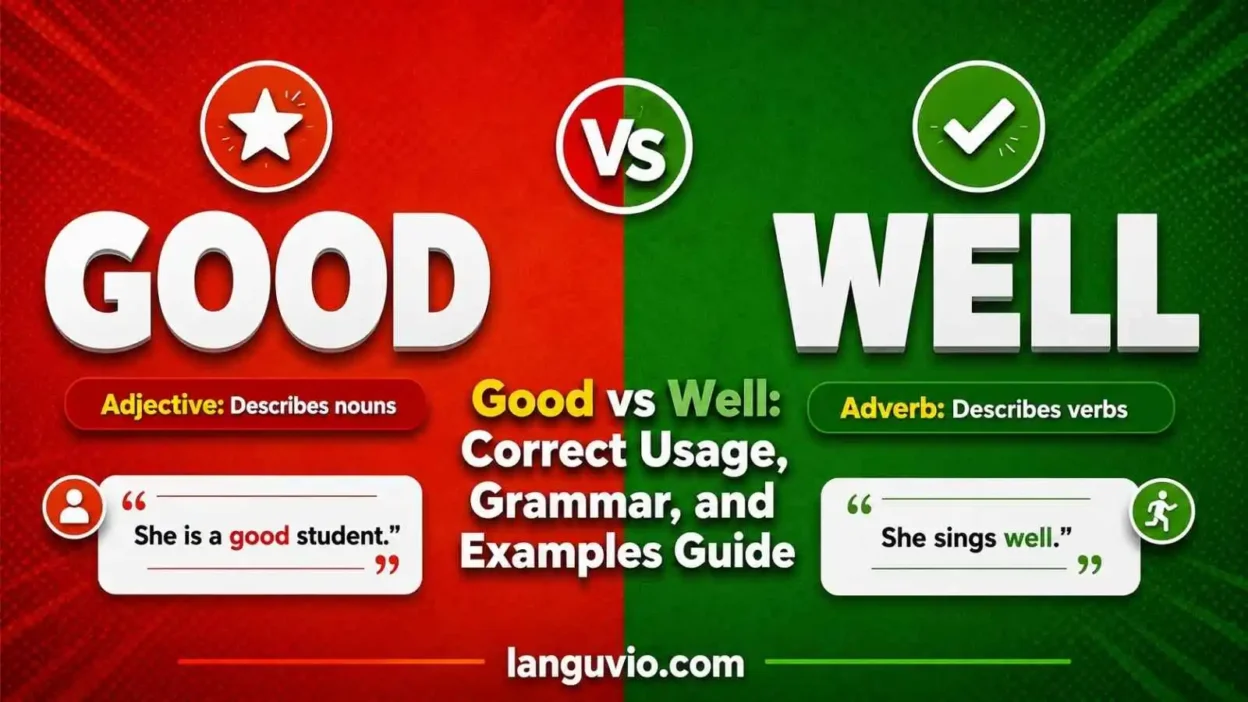
Good vs well is a common grammar question because both words can describe something positive. The safest basic rule is simple: use good to describe a person, place, thing, idea, or condition. Use well to describe how an action is done.
That rule helps most of the time, but it is not the whole story. Well can also describe health, and good can follow linking verbs such as be, seem, look, taste, and feel. That is why sentences like “I’m good” and “I did well” can both be correct in different situations.
Quick Answer
Choose good when you need an adjective: a good plan, good coffee, good news, or I’m good. Use well when you need an adverb: She writes well, the team played well, or the meeting went well. For health, well means “not sick”: I don’t feel well today.
Why People Confuse Them
People confuse good and well because both can answer a positive question.
If someone asks, “How are you?” a person may say, “I’m good” or “I’m well.” Both can work, but they do not always feel the same. “I’m good” usually means life is fine, mood is fine, or no help is needed. “I’m well” often sounds more formal or more focused on health.
Another reason is that feel is a linking verb. After a linking verb, an adjective can describe the subject. That is why “I feel good” is grammatical. The word good describes I, not the action of feeling.
The confusion grows when people use action verbs. In “She sings well,” well describes the action sings. “She sings good” is common in casual speech, but it is not the best choice in standard writing.
Key Differences At A Glance
| Context | Best Choice | Why |
| Describing a noun | good | Good is usually an adjective. |
| Describing an action | well | Well is usually an adverb. |
| Talking about health | well | Well can mean healthy or not sick. |
| Answering “How are you?” casually | good | “I’m good” is normal in conversation. |
| Answering about physical condition | well | “I’m well” points more clearly to health. |
| After linking verbs like seem, look, taste | good | The adjective describes the subject. |
| Formal writing about performance | well | It is the standard adverb for actions. |
Meaning and Usage Difference
Good usually means positive, suitable, pleasant, skillful, moral, or high quality. It describes nouns and pronouns.
Examples:
A good teacher explains hard ideas clearly.
That was a good decision.
The soup smells good.
In these examples, good describes a person, decision, or soup. It does not describe how an action happens.
Well usually means in a good, proper, skillful, or successful way. It often describes verbs.
Examples:
She teaches well.
The interview went well.
He handled the pressure well.
In these sentences, well describes the action. It tells how someone teaches, how the interview went, or how someone handled pressure.
A compact comparison:
• Good describes what something is like: a good answer.
• Well describes how something happens: answered well.
• Good can follow linking verbs: That looks good.
• Well can describe health: She is well now.
• Well is the safer choice for performance: They played well.
The most important point is function. Ask what the word is describing. If it describes a thing, person, idea, or condition, good is often right. If it describes an action, well is usually right.
Tone, Context, and Formality
In standard US English, well is the more polished choice when you describe performance or action.
Use:
She did well on the exam.
The campaign performed well.
The new hire communicates well.
In casual speech, you may hear:
She did good on the exam.
The team played good.
Those sentences are common in conversation, especially in relaxed settings. Still, in school, business, editing, and professional writing, well is usually the better choice for actions.
With greetings, the tone changes. “I’m good” is normal, friendly, and natural in everyday US English. It often means “I’m fine” or “I don’t need anything.”
“I’m well” is also correct, but it can sound more formal. It may also sound like you are talking about your health.
Use I’m good for a casual response.
Use I’m well when health is the focus or the tone is formal.
Which One Should You Use?
Use good when the word describes a noun or pronoun.
Correct:
This is a good laptop.
You made a good point.
The room looks good.
Use well when the word describes a verb or action.
Correct:
The laptop works well.
You explained your point well.
The event went well.
For health, well is often clearer.
Correct:
I don’t feel well.
She is well enough to return to work.
He looks well after his recovery.
For general mood or condition, good is natural.
Correct:
I feel good about the decision.
I’m good, thanks.
The plan sounds good to me.
The easiest test is this: if you can ask “What kind?” use good. If you can ask “How?” use well.
When One Choice Sounds Wrong
Some sentences sound wrong because the word is describing the wrong thing.
Say:
The food tastes good.
Not:
The food tastes well.
Here, tastes is a linking verb. The sentence describes the food, not the food’s ability to taste something.
Say:
She writes well.
Not:
She writes good.
Here, writes is an action verb. The sentence describes how she writes.
Say:
The presentation went well.
Not:
The presentation went good.
Here, went describes how the event happened, so well fits better.
Say:
That sounds good.
Not:
That sounds well.
Here, sounds links the subject to a description. The idea itself sounds good.
There are cases where both can be grammatical, but the meaning shifts.
“I feel good” can mean your mood, confidence, or general condition is positive.
“I feel well” usually points more directly to health.
Common Mistakes (and Quick Fixes)
Mistake: I did good on the test.
Quick fix: I did well on the test.
Mistake: The team played good.
Quick fix: The team played well.
Mistake: This coffee tastes well.
Quick fix: This coffee tastes good.
Mistake: She looks well in that jacket.
Quick fix: She looks good in that jacket.
Mistake: I don’t feel good after eating that.
Better health-focused version: I don’t feel well after eating that.
Mistake: He explained the issue good.
Quick fix: He explained the issue well.
Mistake: The plan sounds well.
Quick fix: The plan sounds good.
A special note: did good can be correct when it means “did something helpful or morally good.”
Correct:
The charity did good in the community.
That sentence does not mean the charity performed well on a task. It means the charity helped people.
Everyday Examples
I’m good, thanks. I already ordered lunch.
I’m not feeling well, so I’m staying home today.
The meeting went well, and the client approved the plan.
That sounds good to me.
You handled that call well.
This chair looks good in the office.
The new software works well on my laptop.
She is a good manager because she listens.
She manages the team well.
The movie was good, but the ending could have been stronger.
He is good at math.
He did well in math this semester.
The kitchen smells good.
The restaurant treated us well.
The proposal is good, but it needs cleaner examples.
You explained the proposal well.
Dictionary-Style Word Details
Verb
• good: Not commonly used as a verb in standard US English. In this comparison, good is mainly an adjective and sometimes a noun.
• well: Can be used as a verb in a separate sense, as in tears that well up. That meaning is not the same as well in “She writes well.”
Noun
• good: Can be a noun meaning benefit, value, or moral good. Example: The decision was made for the good of the team.
• well: Can be a noun meaning a deep hole or source of water. Example: The farm had an old well. That noun meaning is unrelated to the grammar choice in good vs well.
Synonyms
• good: Closest plain alternatives include fine, strong, useful, positive, pleasant, suitable, and high-quality. The best choice depends on context. Antonyms can include bad, poor, or unhelpful.
• well: Closest plain alternatives include skillfully, properly, successfully, effectively, and satisfactorily. For health, close alternatives include healthy or recovered. Antonyms can include badly, poorly, or unwell.
Example Sentences
• good: That was a good answer.
• good: The office looks good after the renovation.
• good: I feel good about the final draft.
• well: You answered the question well.
• well: The office renovation went well.
• well: I do not feel well this morning.
Word History
• good: The word has a long history in English and has been used for quality, value, benefit, and moral approval for a very long time. For this comparison, the history is less important than its modern role as an adjective.
• well: The word also has a long history in English and has developed several roles, including adverb, adjective, noun, and verb. In this comparison, its main modern role is as an adverb for how something is done, plus an adjective for health.
Phrases Containing
• good: good at, good for, good idea, good news, feel good, look good, sound good, for good
• well: do well, go well, play well, work well, feel well, well done, as well, well suited
FAQs
Is It Correct To Say “I’m Good”?
Yes, “I’m good” is correct in normal US English. It usually means “I’m fine,” “I’m okay,” or “I don’t need anything.” For example, if someone asks, “Do you need help?” you can say, “No, I’m good.” In formal writing or when talking about health, “I’m well” may sound more polished.
Is It “I Did Good” Or “I Did Well”?
Use “I did well” when you mean you performed successfully. For example, “I did well on the test” is the standard choice. “I did good” can be correct only when “good” means helpful or moral action, as in “The volunteers did good in the community.”
Is Good An Adjective Or An Adverb?
Good is mainly an adjective. It describes nouns and pronouns, as in “a good idea,” “good food,” or “You look good.” In casual speech, some people use good as an adverb, but well is the better choice in standard writing.
Is Well An Adjective Or An Adverb?
Well is usually an adverb. It describes how an action is done, as in “She writes well” or “The meeting went well.” Well can also be an adjective when it means healthy, as in “He is well enough to work.”
What Is The Easiest Rule For Good Vs Well?
Use good to describe a thing, person, idea, or condition. Use well to describe an action. Say “a good answer,” but “answered well.” Say “That looks good,” but “The project went well.”
Conclusion
The difference between good and well depends on what the word describes. Use good for nouns, pronouns, qualities, and conditions: a good idea, you look good, that sounds good. Use well for actions and performance: write well, played well, went well.
The main exception is health. Well can mean healthy, as in “I don’t feel well.” Still, “I feel good” and “I’m good” are normal when you mean your mood, condition, or general situation is fine. For standard writing, choose well for actions and good for descriptions.
Yes, “I’m good” is correct in normal US English. It usually means “I’m fine,” “I’m okay,” or “I don’t need anything.” For example, if someone asks, “Do you need help?” you can say, “No, I’m good.” In formal writing or when talking about health, “I’m well” may sound more polished.
Use “I did well” when you mean you performed successfully. For example, “I did well on the test” is the standard choice. “I did good” can be correct only when “good” means helpful or moral action, as in “The volunteers did good in the community.”
Good is mainly an adjective. It describes nouns and pronouns, as in “a good idea,” “good food,” or “You look good.” In casual speech, some people use good as an adverb, but well is the better choice in standard writing.
Well is usually an adverb. It describes how an action is done, as in “She writes well” or “The meeting went well.” Well can also be an adjective when it means healthy, as in “He is well enough to work.”
Use good to describe a thing, person, idea, or condition. Use well to describe an action. Say “a good answer,” but “answered well.” Say “That looks good,” but “The project went well.”