

“Window seal or sill” can be confusing because both terms relate to the same general area of a window, but they describe completely different parts. A window seal helps close gaps and protect against air, water, and temperature changes, while a sill is the horizontal surface at the bottom of a window frame.
The correct choice depends on what you are describing. If you are talking about insulation, leaks, weather protection, or the material that closes spaces around a window, window seal is the right term. If you mean the ledge where a window rests or where people place decorations, plants, or objects, sill is the correct word.
Understanding this difference helps homeowners, renters, builders, and anyone writing about windows choose the right term.
Quick Answer
A window seal and a sill are not interchangeable.
A window seal is a barrier or material that prevents drafts, moisture, and outside elements from entering around a window. A sill is the lower horizontal part of a window frame that supports the window and often creates a ledge inside or outside the home.
Use window seal when discussing protection and insulation. Use sill when discussing the physical bottom edge or ledge of a window.
Why People Confuse Them

People often confuse these terms because both are located around the same window area. When someone notices water near a window, they may refer to the entire area as the “window sill,” even though the actual problem may involve a damaged seal.
The confusion also happens because homeowners commonly talk about window repairs as one general task. A person might say they need to “fix the window,” but the actual issue could involve replacing a seal, repairing the sill, or correcting another part of the frame.
The words describe different functions:
- A window seal focuses on preventing movement of air and water.
- A sill focuses on structure and surface support.
Key Differences At A Glance
| Feature | Window Seal | Sill |
| Meaning | A barrier that closes gaps around a window | The bottom horizontal part of a window frame |
| Main purpose | Blocks drafts, moisture, and outside elements | Supports the window and provides a ledge |
| Location | Around edges or between window parts | At the bottom of the window |
| Common concerns | Cracks, gaps, air leaks | Damage, cracks, stains, or decay |
| Typical use | Repairs and weather protection | Construction and design descriptions |
Meaning and Usage Difference
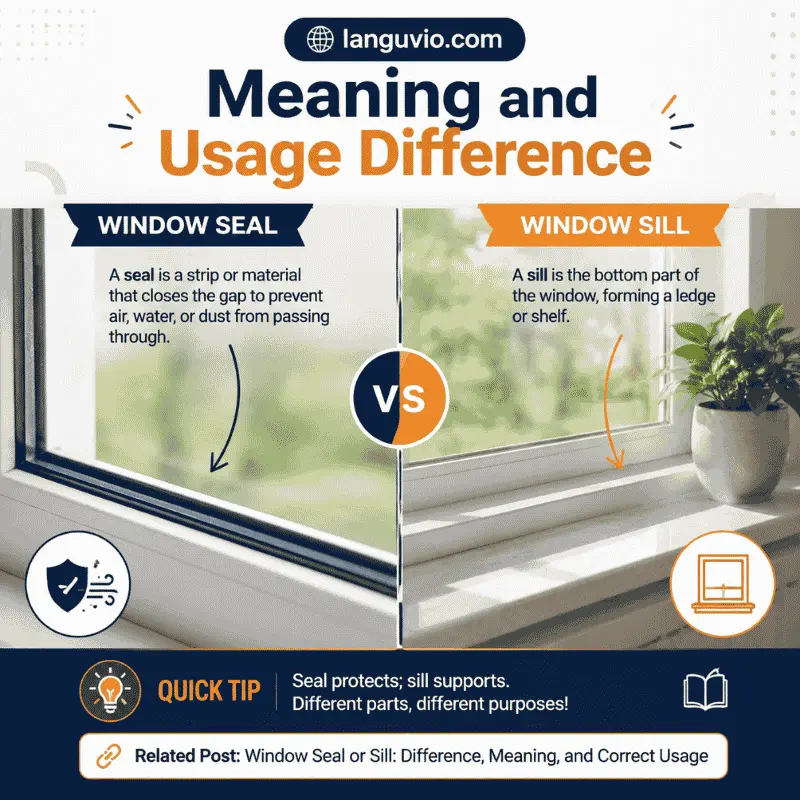
A window seal refers to a sealing material or sealed area that helps prevent unwanted air or water movement. It may involve materials placed around window components to create a tighter barrier.
Examples:
- “The window seal is damaged, and cold air is entering the room.”
- “The contractor replaced the old window seal to reduce drafts.”
A sill refers to the lower part of a window frame. It can be inside a home as a ledge or outside as part of the window structure.
Examples:
- “She placed a small plant on the window sill.”
- “The wooden sill needs repair because moisture damaged it.”
The two terms may appear together in repair discussions, but they identify different parts.
Proper window sealing helps improve energy efficiency by reducing drafts and unwanted air leakage. Homeowners can learn more about improving window efficiency from ENERGY STAR — Efficient Windows and Doors.
Tone, Context, and Formality
Both terms are standard words used in everyday American English. Neither is more formal than the other.
Window seal commonly appears in conversations about:
- Home improvement
- Repairs
- Energy efficiency
- Weather protection
- Maintenance
Sill commonly appears in conversations about:
- Home design
- Construction
- Architecture
- Interior decoration
For example, a homeowner may say, “The window seal is leaking,” while an interior designer may discuss “the marble window sill.”
Which One Should You Use?
Choose window seal when you mean the part responsible for blocking gaps or preventing leaks.
Use it for:
- Draft problems
- Moisture entering around the window
- Damaged sealing material
- Weather protection
Choose sill when you mean the bottom surface of the window.
Use it for:
- A decorative ledge
- The lower window frame section
- A structural window component
| Context | Best Choice | Why |
| Cold air enters around a window | Window seal | The issue involves protection from air movement |
| A plant sits beside a window | Sill | It describes the ledge surface |
| Water damages the bottom frame | Sill | The physical lower section is affected |
| Replacing material around the window edges | Window seal | The repair involves closing gaps |
When One Choice Sounds Wrong
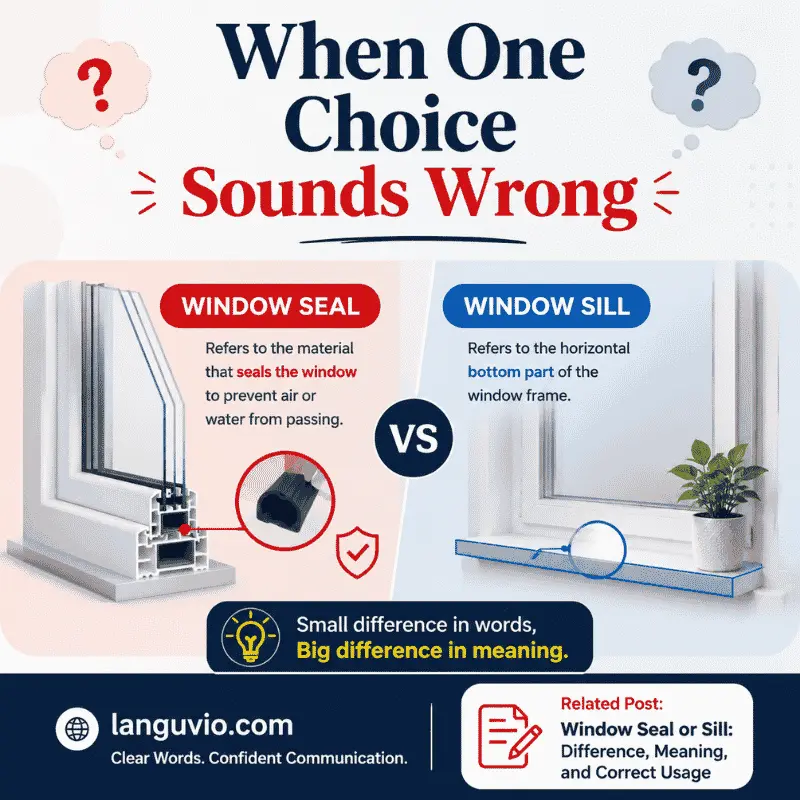
Using window seal when you mean the ledge below a window sounds incorrect because a seal does not describe a surface where objects sit.
Incorrect:
- “I put flowers on the window seal.”
Correct:
- “I put flowers on the window sill.”
Using sill when discussing air leaks can also create confusion.
Less accurate:
- “The sill is letting cold air inside.”
More precise:
- “The window seal is letting cold air inside.”
The best word depends on the exact part or problem being described.
Common Mistakes (and Quick Fixes)
One common mistake is using “seal” and “sill” as if they are alternate spellings. They are different words with different meanings.
Another mistake is assuming the entire bottom window area is called a sill. The sill is only the structural ledge, while seals may appear around several window parts.
Quick fixes:
- Talking about leaks? Choose window seal.
- Talking about a ledge? Choose sill.
- Talking about decoration placement? Choose sill.
- Talking about insulation or drafts? Choose window seal.
Everyday Examples
- “The window seal broke, so rainwater started entering during storms.”
- “The cat likes sitting on the window sill in the afternoon.”
- “We hired someone to replace the damaged window seal.”
- “The wooden sill needs painting after years of exposure.”
- “The new windows have improved seals to reduce air loss.”
- “She cleaned dust from the marble window sill.”
These examples show that both words can appear in the same conversation while referring to different things.
Dictionary-Style Word Details
Verb
- Window seal: Not commonly used as a verb in standard US English. The phrase usually functions as a noun describing a sealing component or condition.
- Sill: Not commonly used as a verb in standard US English.
Noun
- Window seal: A noun referring to a barrier, material, or sealed area that helps prevent air or moisture from passing through.
- Sill: A noun referring to the horizontal bottom part of a window frame.
Synonyms
- Window seal: Closest plain alternatives include “window gasket,” “sealant,” or “weather seal” when they match the specific material or function.
- Sill: Closest plain alternatives include “ledge” or “bottom frame,” depending on the context.
Exact synonyms are not always interchangeable because these terms describe specific window parts.
Example Sentences
- Window seal: “The technician checked the window seal before replacing the glass.”
- Sill: “The wooden sill showed signs of water damage.”
Word History
The terms come from different areas of construction vocabulary. “Seal” relates to closing or protecting an opening, while “sill” refers to a supporting horizontal base or threshold-like structure.
No simple shared origin makes the two words interchangeable.
Phrases Containing
- Window seal: window seal repair, window seal replacement, broken window seal, damaged window seal.
- Sill: window sill, stone sill, wooden sill, interior sill.
FAQs
Sill is the correct term for a window ledge. A sill describes the horizontal surface at the bottom of a window where items may rest. A window seal does not describe a ledge or surface area.
No, window seal and sill do not mean the same thing. A seal protects against air and moisture movement, while a sill is a physical part of the window structure located at the bottom.
Window seal is usually the better term for a leaking window caused by gaps or failed protection. However, if the water has damaged the bottom frame section, the sill may also need attention.
No, sill can refer to other horizontal supporting structures, but window sill is the most common everyday use. The word generally describes a base or ledge rather than a protective barrier.
Yes, a window can have multiple sealing areas. Different seals may help prevent air leaks, water entry, or gaps between window components.
Use window seal repair when fixing drafts or leaks around the window. Use sill repair when repairing the physical bottom section, such as damaged wood, cracks, or deterioration.
Conclusion
Window seal and sill describe two different parts of a window, and choosing the correct word depends on what you mean. A window seal protects against air, moisture, and outside elements, while a sill is the bottom horizontal structure or ledge of the window.
If you are discussing leaks, drafts, or insulation, choose window seal. If you are describing a ledge, design feature, or lower window frame section, choose sill.
Knowing this difference makes home improvement conversations clearer and helps you describe window problems more accurately.


