

“Beloved” and “loved” both describe strong feelings of affection, but they do not create exactly the same impression. The main difference is that loved is the more common everyday word, while beloved often suggests deeper admiration, special importance, or a more emotional connection.
You can say that a person is loved by their family, friends, or community. However, calling someone beloved often adds a feeling of being treasured or highly valued.
Both words are correct, but the better choice depends on your sentence, audience, and tone. In casual American English, “loved” usually sounds natural. In emotional writing, formal messages, memorials, literature, or descriptions of someone deeply admired, “beloved” often fits better.
Understanding this difference helps you choose the word that matches the feeling you want to express.
Quick Answer
Loved is the general word for receiving affection or care. It works naturally in everyday conversations, relationships, and ordinary descriptions.
Beloved means deeply loved, cherished, or greatly admired. It carries a stronger emotional tone and often sounds more formal, respectful, or heartfelt.
Examples:
- “She is loved by her family.”
- “She was a beloved teacher who inspired generations of students.”
Both are correct, but “beloved” usually expresses a deeper sense of appreciation.
Why People Confuse Them
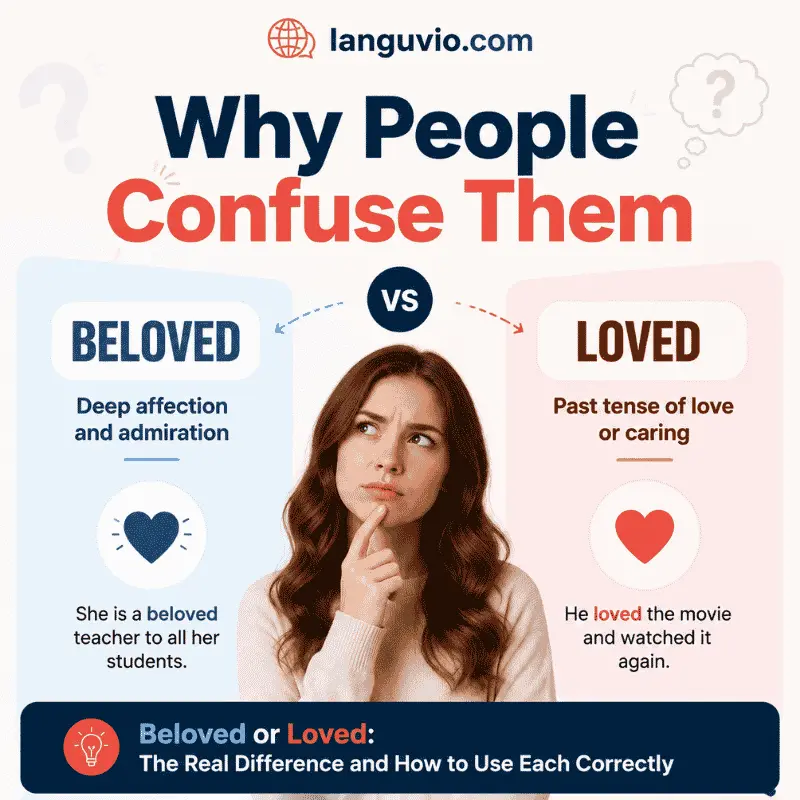
People confuse “beloved” and “loved” because both words describe positive feelings toward someone or something. They share the same basic idea of affection, which makes them appear interchangeable.
The confusion usually happens because many people focus only on the dictionary meaning and miss the difference in tone.
“Loved” focuses on the fact that affection exists. It simply tells the reader that someone receives love.
“Beloved” focuses more on the special place someone or something holds in people’s hearts. It suggests admiration, attachment, or importance.
Compare:
- “My grandfather was loved by everyone in the neighborhood.”
- “My grandfather was a beloved member of the neighborhood.”
The first sentence highlights affection. The second highlights his valued role and emotional importance.
Key Differences At A Glance
| Feature | Loved | Beloved |
| Main meaning | Receiving affection or care | Deeply cherished or highly valued |
| Common use | Everyday speech | Emotional, formal, or meaningful contexts |
| Tone | Simple and direct | Warmer and more expressive |
| Grammar role | Mainly adjective or past participle | Adjective and noun |
| Example | “A loved family member” | “A beloved family member” |
| Context | Best Choice | Why |
| Talking casually about relationships | Loved | It sounds natural in conversation |
| Describing someone greatly admired | Beloved | It adds emotional weight |
| Writing a tribute | Beloved | It sounds respectful and heartfelt |
| Everyday statements | Loved | It is the more common choice |
Meaning and Usage Difference
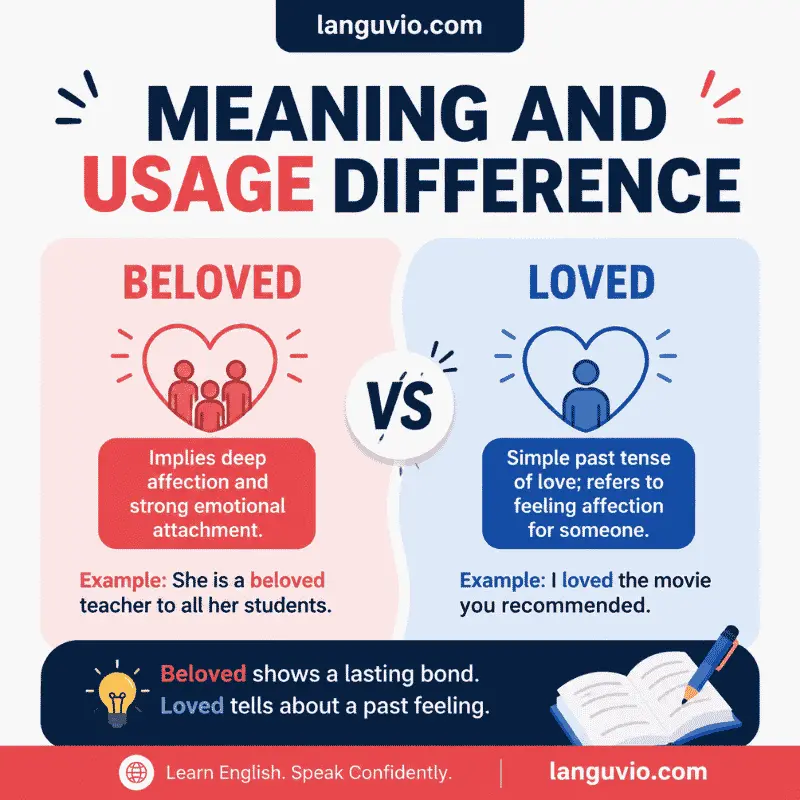
The word loved describes a person, object, or activity that receives love or affection. It is broad and flexible.
Examples:
- “This is my loved family tradition.”
- “She felt loved and supported.”
The word beloved goes beyond simple affection. It suggests that someone or something is especially dear, treasured, or admired.
Examples:
- “The beloved actor was remembered by fans.”
- “Their beloved hometown holds many memories.”
In many situations, replacing “loved” with “beloved” changes the emotional level of the sentence.
Compare:
- “A loved pet” means a pet that receives care and affection.
- “A beloved pet” suggests a pet that has a very special emotional place.
Neither word is automatically better. The choice depends on the feeling you want to communicate.
Tone, Context, and Formality
“Loved” is usually neutral and conversational. Americans use it frequently in daily speech:
- “I feel loved by my family.”
- “This is my most loved recipe.”
“Beloved” often sounds more elevated. It appears frequently in speeches, books, tributes, announcements, and emotional writing.
Examples:
- “The beloved community leader was honored at the ceremony.”
- “Her beloved grandmother shaped her childhood.”
Using “beloved” in a casual conversation is not wrong, but it can sound more dramatic or formal than necessary.
For example:
- “My beloved friend helped me move yesterday.”
This is grammatically correct, but many speakers would choose “my dear friend” or “my close friend” in normal conversation.
Which One Should You Use?
Choose loved when you simply want to say that someone receives affection.
Use it for:
- family relationships
- personal feelings
- everyday conversations
- simple descriptions
Choose beloved when you want to emphasize emotional importance.
Use it for:
- tributes
- memorial writing
- admired people
- meaningful places or traditions
- formal appreciation
A quick guide:
- “My dog is loved.” → The dog receives affection.
- “My dog is beloved.” → The dog is deeply cherished.
When One Choice Sounds Wrong
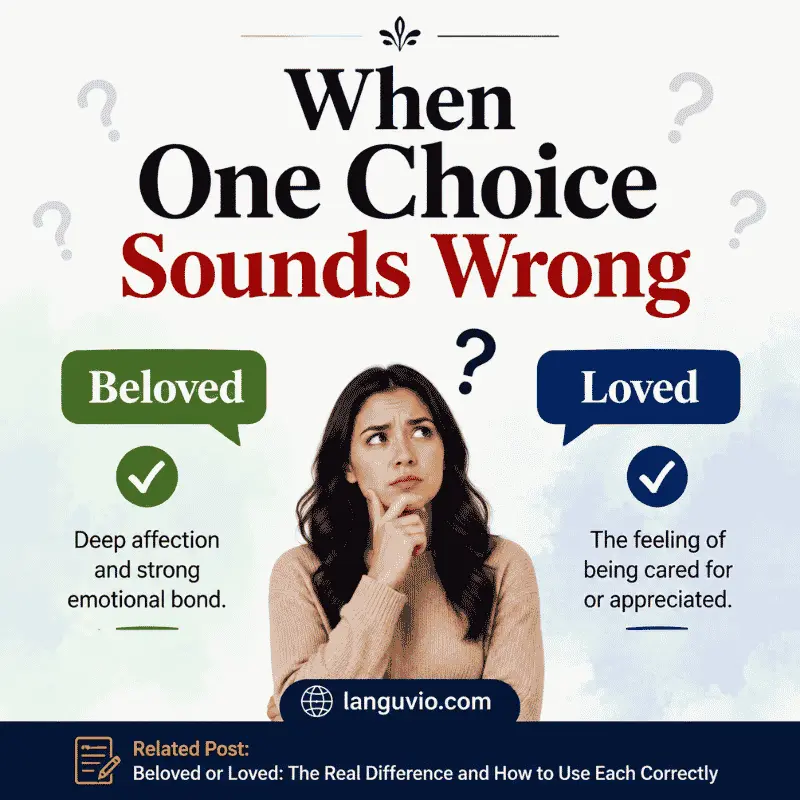
“Loved” rarely sounds incorrect because it is a common and flexible word. However, it may feel too plain when describing someone who is greatly admired.
Example:
- “The loved author received an award.”
This is understandable, but “beloved author” sounds more natural because it expresses admiration.
“Beloved” can sound unusual when used for ordinary situations where a simpler word fits better.
Example:
- “My beloved sandwich is my favorite lunch.”
This is grammatically possible, but it sounds exaggerated unless the speaker is being playful.
The issue is usually not correctness. It is whether the emotional level matches the situation.
Common Mistakes (and Quick Fixes)
A common mistake is assuming “beloved” and “loved” always create the same meaning.
Incorrect assumption:
- “They are exactly the same in every situation.”
Better understanding:
- “Loved” shows affection.
- “Beloved” emphasizes deep attachment or admiration.
Another mistake is using “beloved” in every sentence because it sounds stronger.
Example:
- “I loved this movie.”
- “I beloved this movie.” ❌
“Beloved” is not the past tense of “love.” It cannot replace the verb “loved.”
Use:
- “I loved this book.”
- “This is my beloved book.”
Everyday Examples
- Family
Loved:
- “She feels loved by her parents.”
Beloved:
- “Her beloved grandmother taught her many life lessons.”
- Places
Loved:
- “This is one of my loved vacation spots.”
Beloved:
- “The beach remains a beloved destination for locals.”
- People
Loved:
- “He is loved by his friends.”
Beloved:
- “He became a beloved figure in his community.”
- Objects and traditions
Loved:
- “This recipe is loved by my family.”
Beloved:
- “This beloved recipe has been passed down for generations.”
Dictionary-Style Word Details
Verb
- Loved: Used as the past tense and past participle of “love.” It describes having affection for someone or something.
Example: “She loved the book.” - Beloved: Not commonly used as a verb in standard US English. It is mainly an adjective or noun.
Noun
- Loved: Not commonly used as a noun in standard US English.
- Beloved: Can function as a noun meaning a person who is deeply loved.
Example: “He lost his beloved.”
Synonyms
- Loved: Closest plain alternatives include cared for, valued, cherished, and appreciated, depending on context.
- Beloved: Closest plain alternatives include cherished, treasured, dear, and adored.
Valid antonyms depend on context, but words expressing dislike, rejection, or neglect may contrast with both terms.
Example Sentences
- Loved: “The child felt loved and accepted by the family.”
- Beloved: “The beloved coach inspired many young athletes.”
Word History
Both words come from the long history of the English word “love.” “Loved” developed from the verb form, while “beloved” developed as a way to describe someone or something held especially dear.
Phrases Containing
- Loved: loved one, well-loved, much-loved
- Beloved: beloved friend, beloved family member, beloved tradition
Both words come from the long history of the English word “love.” “Loved” developed from the verb form, while “beloved” developed as a way to describe someone or something held especially dear. For a more detailed definition, pronunciation, and usage information, you can check the dictionary entry for “beloved” from Merriam-Webster. Merriam-Webster Dictionary – Beloved Definition
FAQs
Beloved often feels stronger than loved because it suggests deep affection, admiration, or special importance. However, the strength depends on context. “Loved” can describe very powerful emotions, while “beloved” adds a sense of being treasured.
Loved and beloved can overlap in meaning, but they are not always interchangeable. Loved works better in everyday statements, while beloved usually adds emotional or respectful emphasis.
Beloved is not incorrect in casual speech, but it can sound more serious or expressive. Many speakers choose loved, dear, or close when talking naturally with friends.
Yes, beloved can be used as a noun to refer to someone deeply loved. For example, “She remembered her beloved.” This use is less common in ordinary conversation.
The choice depends on the message. Use loved for simple, direct writing. Use beloved when writing tributes, emotional descriptions, or formal expressions of admiration.
The biggest mistake is treating beloved as a replacement for the verb loved. Beloved describes someone or something cherished, while loved is the past form of the verb love.
Conclusion
“Beloved or loved” is not a question of right versus wrong. Both words are correct, but they communicate different levels of feeling.
Loved is the everyday choice for expressing affection and care. Beloved adds emotional depth and suggests that someone or something is especially treasured.
For normal conversations, “loved” will usually sound natural. For heartfelt writing, honors, memories, and descriptions of deep admiration, “beloved” often creates the stronger impression.
Choosing between them becomes easier when you focus on the feeling you want your words to carry.


