

“Copy that” and “roger that” are two short phrases people often hear in movies, radio communication, workplaces, and casual conversations. Because both phrases acknowledge a message, many speakers wonder whether they mean exactly the same thing.
The answer is that they overlap, but they do not focus on the same idea. “Copy that” usually emphasizes receiving and understanding information. “Roger that” traditionally emphasizes receiving a message or acknowledging what was said.
In casual US English, people sometimes use them interchangeably. However, knowing the difference helps you choose the phrase that fits the situation and avoids sounding unclear or overly dramatic.
Quick Answer
“Copy that” is usually the better choice when you want to show that you understand information or instructions.
“Roger that” is usually used to acknowledge that you received a message, especially in radio-style, military-style, or playful situations.
Both phrases can mean “I got it,” but “roger that” often carries a stronger communication or command-style feeling.
| Context | Best Choice | Why |
| A coworker gives an update | Copy that | Sounds natural and confirms understanding |
| Radio-style communication | Roger that | Matches communication language |
| Casual teamwork | Copy that | Feels modern and direct |
| A humorous military-style reply | Roger that | Creates a dramatic tone |
Why People Confuse Them
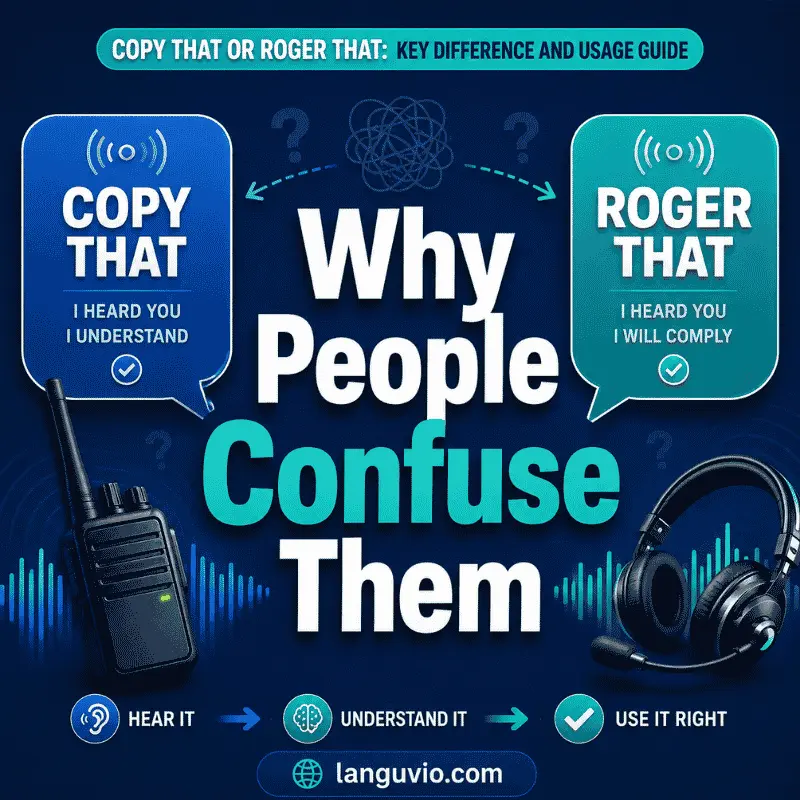
People confuse these phrases because both are short acknowledgments. They appear in similar situations where one person sends information and another person responds.
Movies, television, and games also use both phrases as quick ways to show that a character understood a message. This makes the difference less obvious in everyday conversation.
Another reason for confusion is that neither phrase normally means “yes” by itself. They acknowledge communication rather than automatically showing agreement, approval, or a promise to complete a task.
Key Differences At A Glance
| Feature | Copy That | Roger That |
| Main idea | Message understood | Message received |
| Common feeling | Direct and practical | Radio-style and firm |
| Typical setting | Work, teamwork, casual speech | Radio, military-style speech, humor |
| Modern everyday use | More common | Less common but familiar |
The difference is about emphasis, not a strict rule that prevents overlap.
Meaning and Usage Difference
“Copy that” means that the speaker received and understood the information. It works well when someone gives an update, instruction, or detail that needs acknowledgment.
Example:
“Your appointment moved to Friday morning.”
“Copy that.”
The response shows the information was received and understood.
“Roger that” comes from communication language where “roger” indicated that a message had been received. Today, it is often used to acknowledge a message with a firm or official tone.
Example:
“Proceed to the next checkpoint.”
“Roger that.”
The speaker confirms receipt of the message.
Copy That means “I heard and understood your message.” This phrase is commonly used in radio communication, workplaces, and everyday conversations. For more detailed word meanings and usage explanations, readers can also explore trusted language resources like Merriam-Webster.
Tone, Context, and Formality
“Copy that” generally sounds neutral, practical, and modern. It can fit workplace conversations, team chats, and informal situations.
“Roger that” often sounds more formal, tactical, or playful because many people connect it with pilots, military scenes, and radio communication.
Neither phrase is automatically more correct. The better choice depends on the setting.
For a normal office message, “Copy that” may sound more natural. For a joking command-style response with friends, “Roger that” may fit better.
Which One Should You Use?
Use “copy that” when you want to say:
- I received the information.
- I understand what you said.
- I have the details.
Use “roger that” when you want to say:
- I received your message.
- I acknowledge the communication.
- I am using a radio-style expression.
If the situation requires a clear promise of action, add a direct statement instead of relying only on either phrase.
When One Choice Sounds Wrong
“Copy that” may sound unusual in very formal writing because it is a spoken acknowledgment rather than a traditional formal phrase.
“Roger that” may sound too dramatic in ordinary conversations if the situation does not involve a command, radio-style exchange, or playful tone.
For example, replying “Roger that” to a simple email update might feel humorous or exaggerated depending on the workplace culture.
Common Mistakes (and Quick Fixes)
One common mistake is assuming “roger that” always means “I will do it.” It mainly acknowledges a received message.
Another mistake is treating “copy that” as a promise that an action has already happened. It usually confirms understanding, not completion.
Quick fixes:
- Need to confirm understanding? Use “copy that.”
- Want a radio-style acknowledgment? Use “roger that.”
- Need to promise action? Say what action you will take.
Everyday Examples
Example 1:
Manager: “The meeting starts at 2 PM instead of 3 PM.”
Employee: “Copy that.”
The employee confirms the schedule change.
Example 2:
Team leader: “Move to the next location.”
Team member: “Roger that.”
The response has a command-style tone.
Example 3:
Friend: “I sent you the address.”
Friend: “Copy that.”
The phrase sounds natural and casual.
Dictionary-Style Word Details
Verb
- Copy that: Not commonly used as a standard verb phrase. “Copy” can function as a verb in other meanings, but “copy that” works mainly as an acknowledgment phrase.
- Roger that: “Roger” can function as a verb in some dictionaries, but “roger that” is mainly used as an interjection or fixed phrase.
Noun
- Copy that: Not commonly used as a noun.
- Roger that: Not commonly used as a noun phrase in modern standard US English.
Synonyms
- Copy that: Closest plain alternatives include “got it,” “understood,” and “I understand.”
- Roger that: Closest plain alternatives include “received,” “understood,” and “message received.”
Exact synonyms depend on the situation because these phrases carry different tones.
Example Sentences
- Copy that: “The delivery time changed to noon.” “Copy that, I updated my schedule.”
- Roger that: “The signal is clear.” “Roger that, we received your message.”
Word History
“Roger” has a history connected with radio communication, where it was used to represent a received message. “Copy” developed from the idea of receiving and recording information.
The exact everyday meanings have expanded over time, and both phrases now appear outside technical communication.
Phrases Containing
- Copy that: Usually appears as the complete phrase “copy that.”
- Roger that: Usually appears as the complete phrase “roger that.”
Both phrases are commonly recognized as short acknowledgments.
FAQs
Not exactly. “Copy that” usually focuses on understanding information, while “roger that” focuses on receiving and acknowledging a message. In casual speech, many people use them the same way because both show that communication was received.
“Roger that” often sounds more formal, tactical, or radio-like, but it is not always more formal in every situation. Its tone depends on context. In everyday workplace conversations, “copy that” often sounds more natural.
Yes, you can use “copy that” in everyday conversations. It works well when confirming details, instructions, plans, or updates. Some speakers use it casually because it sounds short, clear, and cooperative.
No, “roger that” does not automatically mean agreement or a promise. It mainly acknowledges that the message was received. If action or agreement matters, state that separately to avoid confusion.
Yes, “copy that” can work in professional settings, especially in quick conversations or team communication. However, some formal workplaces may prefer more traditional responses such as “understood” or “confirmed.”
“Copy that” usually sounds more natural for everyday US communication. “Roger that” remains familiar but often carries a radio, military, or playful feeling. The best choice depends on the audience and situation.
Conclusion
“Copy that” and “roger that” both acknowledge communication, but they carry slightly different feelings.
“Copy that” is usually the practical choice for showing understanding. “Roger that” is better when you want a radio-style acknowledgment or a firmer tone.
The phrases can overlap, but choosing based on context makes your communication clearer and more natural.


