
Both job and work are correct English words, but they are not freely interchangeable.
A job usually means a specific position you hold or a particular task you need to complete. Work is broader. It can mean the activity, effort, duties, or employment involved, and it is also a common verb.
For example, you can get a job, have work to finish, or work at a hospital. Choosing the right word depends on what you mean and how the sentence is structured.
Quick Answer
Use job when referring to a specific position, role, or countable task.
“She got a new job in Chicago.”
Use work when referring to activity, effort, duties, or employment in general.
“I have a lot of work today.”
As a verb, work is the normal choice for performing duties or being employed.
“I work for a small company.”
A useful starting rule is: a job is something specific you have or do, while work is the broader activity involved. However, both words have additional meanings, so context still matters.
Why People Confuse Them

The words overlap because a job involves work. Someone may have a job at a hospital, for example, and the duties performed there are that person’s work.
The grammar is different, though. In its common employment meaning, job is countable. You can have a job, two jobs, or several jobs.
By contrast, work is normally uncountable when it means general activity, duties, or employment. We say some work, much work, or a lot of work, not normally a work or three works in that meaning.
That difference explains many common mistakes.
Key Differences At A Glance
- Job: usually a specific position, role, or individual task.
- Work: usually activity, effort, duties, or employment in a broader sense.
- Job: commonly countable — a job, two jobs.
- Work: commonly a noun and a verb — hard work, I work here.
These differences matter more than formality. Both words are common in everyday American English.
Meaning and Usage Difference

A job can mean a particular position someone holds to earn money.
“She accepted a job at the university.”
It can also mean a specific task, responsibility, or piece of work.
“My job is to check the final report.”
“Cleaning the garage was a big job.”
Work has a wider meaning. As a noun, it can describe the activity or effort needed to accomplish something.
“This project requires a lot of work.”
It can also refer generally to employment.
“She is looking for work.”
As a verb, work means to perform duties, make an effort, or carry out an activity.
“He works from home three days a week.”
The verb has other common meanings as well. A machine can work, and a plan can work when it functions or succeeds.
Tone, Context, and Formality
Neither job nor work is inherently more formal. Both are standard, neutral words used in conversation, business, education, and everyday writing.
The real difference is usually specificity.
When discussing one position, job is more precise:
“I applied for a job at the bank.”
When discussing employment generally, work often sounds more natural:
“I’m looking for work.”
Context also controls common expressions. Americans naturally say at work and go to work when talking about the workplace or working day.
“She’s still at work.”
“I go to work at eight.”
Using job in those fixed patterns usually sounds unnatural.
Which One Should You Use?
Use this table as a practical guide.
| Context | Best Choice | Why |
| A specific employment position | Job | It identifies one particular role or position |
| General employment | Work | It refers broadly to employment or working activity |
| A countable task | Job | Individual tasks can be counted as jobs |
| General duties or workload | Work | The activity is treated as a whole |
| Performing employment duties | Work | Work is the normal verb |
| Talking about your workplace | Work | Standard expressions include “at work” and “go to work” |
| Praising how a task was completed | Job or work | “Good job” praises a result; “good work” praises the quality of the work |
Compare:
“I found a job.”
This means you found a particular position.
“I found work.”
This means you obtained employment or paid activity more generally.
Both sentences can be correct, but they present the situation differently.
When One Choice Sounds Wrong
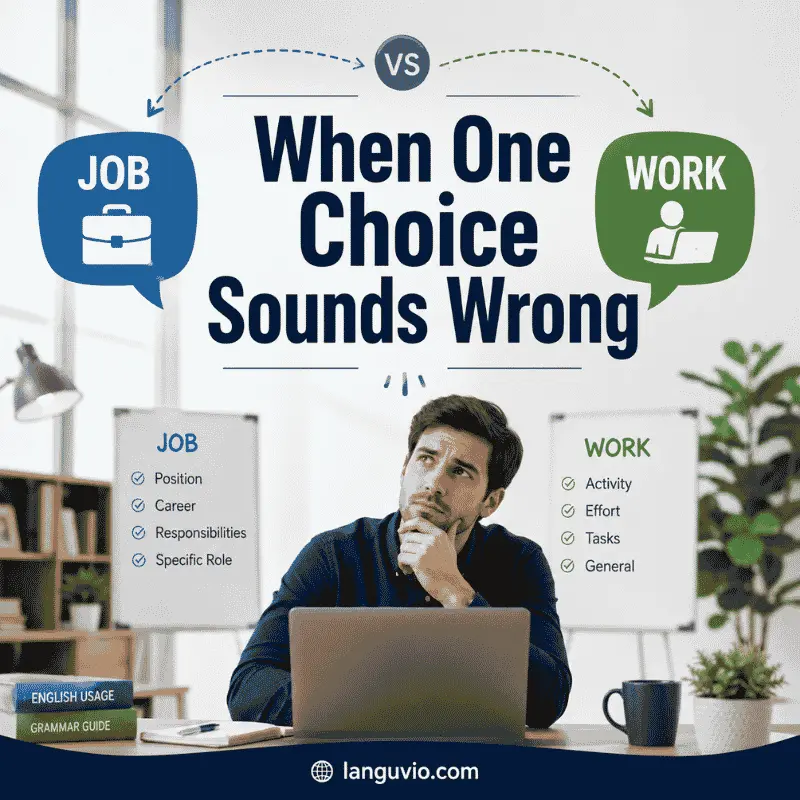
Some sentence patterns strongly favor one word.
“I have a work at a software company” sounds wrong when you mean an employment position.
Say:
“I have a job at a software company.”
Or:
“I work at a software company.”
Similarly, “She is at job” is not natural standard English. Say:
“She is at work.”
Another common problem appears with workloads:
“I have many works to finish.”
When you mean general tasks or duties, say:
“I have a lot of work to finish.”
However, works can be correct in special meanings, such as separate works of art or literature. That does not make it the normal plural for everyday tasks.
Common Mistakes (and Quick Fixes)
A frequent mistake is using an article before work when referring to general employment.
Wrong: “I’m looking for a work.”
Better: “I’m looking for work.”
Also correct: “I’m looking for a job.”
Another mistake is treating job as the normal verb for employment.
Wrong in ordinary employment English: “I job at a hospital.”
Natural: “I work at a hospital.”
Be careful with plurals as well.
Correct: “She has two jobs.”
Correct: “She has too much work.”
Finally, do not assume that every task must be called a job. A specific assignment can be a job, while the combined activity and effort involved are usually work.
Everyday Examples
Maya started a new job at a marketing company last Monday.
She enjoys the work, but some weeks are extremely busy.
Her job includes meeting clients and preparing presentations.
She often has extra work before a major campaign launches.
Her brother is looking for work after moving to Denver.
He recently applied for three jobs in customer service.
On Saturday, Maya had several small jobs to do around her apartment.
After finishing them, she said, “That was a lot of work.”
These examples show the central pattern: job often identifies a position or individual task, while work describes the broader activity or effort.
Dictionary-Style Word Details
Verb
Job: The verb job exists, but it is not the normal verb for saying that someone is employed. It has specialized senses, including doing occasional pieces of paid work or arranging work by separate contracts. In ordinary employment sentences, use work instead.
Natural everyday example: “She works at a hospital.”
Work: Commonly used as a verb. It can mean performing duties, making an effort, being employed, functioning correctly, or producing a successful result.
Example: “I work in accounting.”
Example: “The new printer finally works.”
Noun
Job: Usually a countable noun meaning a specific paid position, role, responsibility, task, or piece of work.
Examples: “a new job,” “two jobs,” “a difficult job.”
Work: Usually an uncountable noun when referring to general activity, effort, duties, or employment.
Examples: “hard work,” “some work,” “a lot of work.”
In other meanings, work can sometimes be countable, especially when referring to separate creative productions, such as literary or artistic works.
Synonyms
Job: Depending on the meaning, close alternatives include position, post, task, duty, and assignment. These are not interchangeable in every sentence.
Work: Depending on context, close alternatives include employment, labor, effort, activity, and duties.
Neither word has one single antonym that works naturally across all of its meanings.
Example Sentences
Job: “Carlos got a job at a local hospital.”
Job: “You did a great job on the presentation.”
Job: “Fixing the fence turned into a bigger job than expected.”
Work: “I have plenty of work to finish before Friday.”
Work: “Nina works for a financial services company.”
Work: “The repair should work for now.”
Word History
Job: The origin of the everyday noun is uncertain. Early evidence connects it with the idea of a piece or portion of work. Its later meanings expanded to include tasks, duties, and positions of employment.
Work: The word has very old roots in English. Earlier English forms referred to activity, action, or something accomplished through effort.
The two words therefore did not develop as simple duplicate names for exactly the same idea.
Phrases Containing
Job: get a job, find a job, job interview, job market, day job, desk job, on the job, do a good job.
Work: at work, go to work, hard work, get to work, line of work, work from home, out of work, get back to work.
Notice the fixed patterns. We normally say go to work, not “go to job,” but we say get a job, not normally “get a work” when referring to one employment position.
FAQs
A job usually means a specific paid position, role, or task. Work is broader and refers to activity, effort, duties, or employment in general. For example, you can have a job at a hospital and do a lot of work there.
Job is normally a countable noun. You can say a job, two jobs, or several jobs. For example, “She applied for three jobs.” This is different from work, which is usually uncountable when it refers to general activity or employment.
Usually not when work means general employment, effort, or duties. Say “I have a lot of work,” not “I have a work.” However, a work can be correct when referring to a creative production, such as a work of art or literature.
Both can be correct, but they mean slightly different things. “I have a job” means you hold a specific position. “I have work” usually means you have tasks or employment available to do.
No. The natural expression is “I go to work.” English commonly uses phrases such as at work, go to work, and get to work. Use job when referring to a specific position, as in “I got a new job.”
Not always. They overlap in meaning, but grammar and context differ. You can say “She found a job” or “She found work,” but you cannot freely replace one word with the other in expressions such as go to work or apply for a job.
Conclusion
The difference between job vs work becomes easier once you separate a specific thing from a broader activity.
Use job mainly for a particular employment position, role, or countable task:
“She found a new job.”
Use work for general activity, effort, duties, or employment, and use it as the normal verb:
“She has a lot of work.”
“She works downtown.”
The words sometimes describe related situations, but grammar and common expressions determine which one sounds natural. Remember the most useful distinction: you can have a job, do work, and work at your job.


