
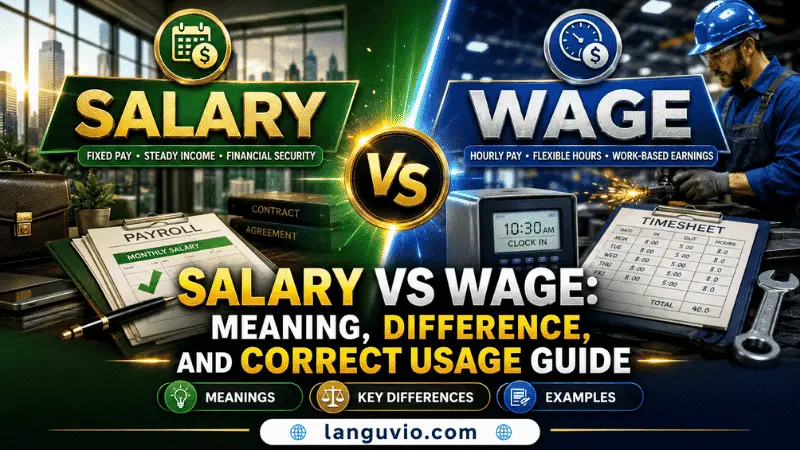
Both salary and wage are correct words for money earned from work, but they are not always used in the same way.
In everyday US English, a salary usually means a fixed amount of compensation paid regularly, often stated as a yearly figure. A wage usually refers to pay calculated according to hours worked, days worked, or another unit of work.
The distinction is useful, but it is not absolute in every legal, tax, or statistical context.
Quick Answer
Use salary when talking about fixed, regular compensation attached to a job or position.
- “Her annual salary is $68,000.”
- “The company offered him a higher starting salary.”
Use wage when the pay is expressed as a rate or depends directly on time or work completed.
- “The job pays an hourly wage of $22.”
- “Workers asked for higher wages.”
A simple practical distinction is:
- Salary: usually a fixed amount for a position.
- Wage: usually a rate or amount tied to hours, days, or units of work.
However, wages can also be used broadly for employee earnings, especially in formal employment, tax, and economic contexts.
Why People Confuse Them
The terms overlap because both describe compensation for work.
In ordinary conversation, people may also use pay, earnings, or even wages as broader terms without focusing on how the money is calculated.
Another source of confusion is the phrase annual wage. Although wage is strongly associated with hourly pay, a worker’s hourly earnings can be converted into an annual wage figure for comparison or reporting.
Likewise, receiving a salary does not automatically tell you whether someone qualifies for overtime. Pay method and employment classification are related issues, but they are not identical.
Key Differences At A Glance
| Context | Best Choice | Why |
| Fixed compensation of $72,000 per year | Salary | The amount is set for the position |
| Pay of $24 for each hour worked | Wage | The compensation is expressed as an hourly rate |
| Talking about a new professional job offer | Salary | Job offers often state a fixed annual salary |
| Discussing minimum legal hourly pay | Wage | “Minimum wage” is the established expression |
| Talking broadly about workers’ earnings | Wages | The plural can refer collectively to employee pay |
| Discussing pay that changes with hours worked | Wage | Total earnings depend directly on work time |
The core contrast is not simply yearly versus weekly.
A salary describes a fixed compensation arrangement. A wage usually describes compensation calculated according to a rate or amount of work.
Meaning and Usage Difference
Salary is mainly a noun meaning fixed compensation paid regularly for services.
You might say:
Maria earns a salary of $75,000 a year.
The yearly figure can then be divided across weekly, biweekly, semimonthly, or monthly paychecks. The payment schedule does not change the basic meaning of salary.
Wage as a pay term is also a noun. It usually describes compensation calculated by an hourly, daily, or piecework rate.
For example:
The position offers a starting wage of $19 per hour.
The plural wages commonly refers to the money someone earns from work:
His wages increased after the new contract took effect.
So, salary focuses more naturally on a fixed compensation amount, while wage often focuses on a rate or work-based calculation.
In the United States, salary and wage arrangements may be subject to federal rules on minimum wage and overtime pay. For authoritative information about these requirements, see the U.S. Department of Labor’s Fair Labor Standards Act guidance
Tone, Context, and Formality
Both words are standard and neutral.
Salary is especially natural in job offers, professional employment discussions, compensation negotiations, and phrases such as:
- annual salary
- base salary
- starting salary
- salary range
Wage is especially natural when discussing hourly rates, labor issues, employment standards, or broad economic topics:
- hourly wage
- minimum wage
- living wage
- wage growth
Neither word is automatically more polite or more formal.
Also, do not assume that salary always means a higher-status job or that wage always means manual labor. Those associations may occur in some situations, but they are not reliable definitions.
Which One Should You Use?
Choose the word that matches how the compensation is being described.
Use salary for a fixed amount attached to a position:
I accepted the job because the salary was competitive.
Use wage for a rate tied directly to work time or output:
The warehouse raised its starting wage to $23 an hour.
Use wages when referring collectively to money earned by workers:
Rising wages helped employees manage higher living costs.
For a job posting, use the form actually offered by the employer. A position advertised at “$65,000 per year” would naturally be described as having a salary. A position advertised at “$25 per hour” would naturally have an hourly wage.
When One Choice Sounds Wrong
Some combinations are grammatically possible but unnatural in ordinary US English.
“I earn a salary of $20 per hour” sounds awkward because an hourly rate is normally called a wage or hourly pay.
Better:
I earn a wage of $20 per hour.
Or:
I make $20 an hour.
On the other hand:
My wage is $80,000 a year.
This can be understood, and annual wage appears in formal reporting, but in normal conversation salary is usually more natural for a fixed annual amount:
My salary is $80,000 a year.
Context matters more than treating the words as rigid opposites.
Common Mistakes (and Quick Fixes)
Mistake: Assuming salary means monthly pay.
A salary is not defined by being paid monthly. It is fixed compensation that can be distributed on different payroll schedules.
Fix: Say annual salary when referring to the full yearly amount.
Mistake: Assuming every wage must be paid weekly.
A wage describes how compensation is calculated, not necessarily how often the paycheck arrives.
Fix: Focus on the rate: an hourly wage of $18.
Mistake: Assuming every salaried worker is automatically exempt from overtime.
Salary describes a method of compensation. Overtime status depends on applicable employment rules and job circumstances.
Fix: Keep salaried and overtime-exempt as separate concepts.
Mistake: Treating salary and wage as perfectly interchangeable.
They overlap, but ordinary usage favors different contexts.
Fix: Use salary for fixed compensation and wage for rate-based compensation unless a broader technical context calls for different wording.
Everyday Examples
A nurse might say:
“My hourly wage increased after I earned another certification.”
An office manager might say:
“I negotiated a higher salary before accepting the position.”
A restaurant posting might state:
“The starting wage is $18 per hour plus tips.”
A corporate job posting might state:
“The salary range is $70,000 to $85,000 per year.”
A worker discussing total earnings might say:
“My wages were higher this week because I worked more hours.”
Someone comparing job offers might say:
“One job offers a $60,000 salary, while the other pays an hourly wage.”
These examples show why the words are related without being identical in everyday use.
Dictionary-Style Word Details
Verb
salary: Not commonly used as a verb in standard modern US English. It is normally used as a noun, while salaried is the common adjective.
Example:
She is a salaried employee.
wage: Can function as a verb meaning to carry on or conduct something, especially a war, battle, or campaign.
Example:
The organization waged a campaign for change.
This verb meaning is separate from the noun meaning related to employee pay.
Noun
salary: Fixed compensation paid regularly for work or services.
Example:
His annual salary is $64,000.
wage: Compensation usually calculated according to an hourly, daily, or piecework rate. The plural wages often refers to earnings from employment.
Example:
She earns a wage of $21 per hour.
Synonyms
salary — closest plain alternatives: pay, compensation.
These are broader terms and are not exact substitutes in every sentence.
wage — closest plain alternatives: pay, earnings.
Again, the meaning depends on context. Earnings can include more than a basic wage.
There is no useful direct antonym for either word in the employment-pay sense.
Example Sentences
salary:
The company increased her salary after the annual review.
He asked about the salary range before applying.
Her new position comes with a higher base salary.
wage:
The store offers a competitive hourly wage.
His weekly wages depend on the number of hours he works.
Employees negotiated for higher wages.
Word History
salary: The word came into English through French from Latin salarium, a term connected historically with official compensation and ultimately related to the Latin word for salt. The popular claim that Roman soldiers were simply “paid in salt” should not be treated as established historical fact.
wage: The noun entered English through Anglo-French forms connected with the ideas of a pledge, recompense, or payment. Its later employment sense developed into the familiar meaning of compensation for labor or services.
The two words therefore have different histories even though their modern meanings overlap in the area of employee pay.
Phrases Containing
salary:
- annual salary
- base salary
- starting salary
- salary range
- salary increase
wage:
- hourly wage
- minimum wage
- living wage
- wage increase
- wage earner
The fixed phrases also show the practical difference. Americans naturally say starting salary for fixed position-based compensation but minimum wage when discussing a minimum rate of employee pay.
FAQs
A salary is usually a fixed amount of compensation paid regularly, often expressed as an annual figure. A wage is usually based on an hourly, daily, or piecework rate. Both refer to money earned from employment, but they describe different ways of calculating pay.
Neither is automatically better. A salary may provide more predictable income, while hourly wages may allow earnings to increase when more hours are worked. The better option depends on the job, schedule, overtime rules, benefits, and the worker’s personal priorities.
Yes, in some cases. Being paid a salary does not automatically mean an employee is exempt from overtime. Overtime eligibility depends on applicable employment laws, job duties, pay requirements, and other classification rules.
No. Wages are commonly calculated hourly, but they can also be based on days worked, pieces produced, or other units of work. In broader formal contexts, the word wages can also refer generally to compensation earned by employees.
Yes. A salary is often stated as an annual amount, but employers may distribute it through weekly, biweekly, semimonthly, or monthly paychecks. The payment schedule does not change the fact that the compensation is salaried.
Use salary when referring to fixed compensation for a position, such as “an annual salary of $70,000.” Use wage when referring to rate-based pay, such as “an hourly wage of $22.” In general discussions about worker earnings, the plural wages is also common.
Conclusion
Both salary and wage are correct, but the best choice depends on how the pay is structured and discussed.
Use salary for fixed compensation paid regularly, especially when a job’s pay is stated as an annual amount. Use wage when compensation is calculated by the hour, day, piece, or another unit of work. The plural wages can also refer more broadly to employee earnings.
The safest everyday distinction is simple: a salary is usually a fixed compensation amount, while a wage is usually rate-based pay. Just remember that formal tax, labor, and economic usage can use wages more broadly, so the two words are not absolute opposites in every context.