Many English learners — and plenty of native speakers — mix up “assure” and “ensure.” The words sound similar and both relate to certainty, but they are not used the same way.
The easiest way to remember the difference is this:
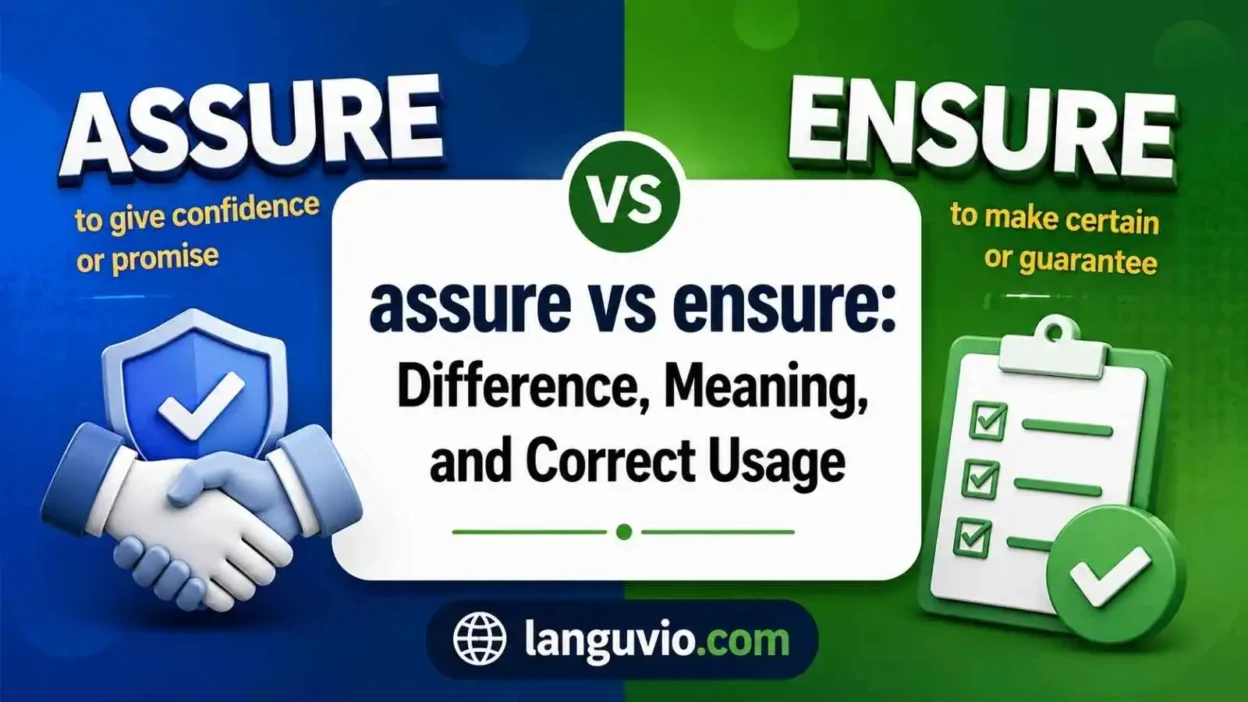
- “Assure” usually involves giving confidence to a person.
- “Ensure” usually means making certain that something happens.
That small difference changes how each word fits into a sentence.
Quick Answer
Use “assure” when you are reassuring someone.
Use “ensure” when you are guaranteeing a result, condition, or outcome.
Examples:
- “I assure you the package was sent.”
- “We checked the address twice to ensure delivery.”
In modern US English, “assure” is commonly person-focused, while “ensure” is result-focused.
Why People Confuse Them
The confusion happens because both words involve certainty and confidence.
They also sound alike:
- assure → uh-SHOOR
- ensure → en-SHOOR
Their meanings overlap slightly, especially in formal writing. But most American English style guides still separate them by function.
People also confuse them because both are verbs and often appear in professional or academic writing.
Key Differences At A Glance
| Context | Best Choice | Why |
| Reassuring a person | assure | Focuses on giving confidence |
| Guaranteeing a result | ensure | Focuses on making something happen |
| “I ___ you…” | assure | Natural person-directed structure |
| Safety or accuracy checks | ensure | Refers to outcomes or conditions |
| Emotional comfort | assure | Human-centered meaning |
| Procedures or compliance | ensure | System or process-centered meaning |
Meaning and Usage Difference
“Assure” and “ensure” are both verbs, but they point in different directions.
“Assure” points toward people.
Example:
- “The doctor assured the patient that the surgery was routine.”
The goal is reassurance or confidence.
“Ensure” points toward results or conditions.
Example:
- “The hospital follows strict procedures to ensure patient safety.”
The goal is certainty that something happens correctly.
A useful shortcut:
- assure + person
- ensure + thing/result
That shortcut is not perfect in every historical example, but it works well in modern American English.
Small Comparison Block
- assure → calm fears, give confidence, reassure someone
- ensure → make certain, guarantee an outcome, prevent failure
Tone, Context, and Formality
Both words work in formal and informal English, but they often appear in different settings.
“Assure” sounds more personal and conversational.
Examples:
- “I assure you everything is under control.”
- “She assured her parents she arrived safely.”
“Ensure” sounds more procedural or practical.
Examples:
- “Please ensure all doors are locked.”
- “The update will ensure better security.”
In business, legal, technical, and academic writing, “ensure” appears more often because those situations focus on outcomes and compliance.
Which One Should You Use?
Choose “assure” when a person receives reassurance.
Choose “ensure” when an action guarantees a result.
Here is a quick test:
Ask yourself:
“Am I comforting a person, or making something certain?”
If you are comforting or reassuring someone, use “assure.”
If you are guaranteeing a condition or outcome, use “ensure.”
Correct:
- “I assure you we’ll fix the problem.”
- “We took extra steps to ensure quality.”
Less natural:
- “I ensure you we’ll fix the problem.”
That sentence sounds awkward because “ensure” usually does not take a person as its direct object in standard US usage.
When One Choice Sounds Wrong
Some sentences immediately sound unnatural to American English speakers.
Awkward:
- “She ensured me that everything was okay.”
Natural:
- “She assured me that everything was okay.”
Why? Because the sentence is about reassurance, not guaranteeing an outcome.
Another example:
Awkward:
- “The company assured customer privacy.”
Better:
- “The company ensured customer privacy.”
Here, the company is guaranteeing a condition, not comforting customers emotionally.
Common Mistakes (and Quick Fixes)
One common mistake is using “ensure” with a person.
Incorrect:
- “He ensured me the report was finished.”
Correct:
- “He assured me the report was finished.”
Another mistake is using “assure” for systems, rules, or procedures.
Less natural:
- “These rules assure workplace safety.”
Better:
- “These rules ensure workplace safety.”
Quick reminder:
- people → assure
- outcomes → ensure
That guideline solves most cases correctly.
Everyday Examples
Here are realistic examples from everyday American English.
Using “assure”
- “I assure you I locked the car.”
- “The teacher assured the students that the test would be fair.”
- “She assured her friend that the mistake was minor.”
- “The manager assured employees that no layoffs were planned.”
Using “ensure”
- “Please ensure the form is complete.”
- “Backup systems ensure the website stays online.”
- “The recipe ensures consistent results.”
- “We arrived early to ensure good seats.”
Dictionary-Style Word Details
Verb
assure:
A verb meaning to reassure, calm, or give confidence to someone.
Example:
- “He assured me everything would be fine.”
ensure:
A verb meaning to make certain that something happens or exists.
Example:
- “The contract ensures payment.”
Noun
assure:
Not commonly used as a noun in standard US English.
ensure:
Not commonly used as a noun in standard US English.
Synonyms
assure:
Closest plain alternatives:
- reassure
- comfort
- convince
- calm
Possible opposite ideas:
- worry
- alarm
- unsettle
ensure:
Closest plain alternatives:
- guarantee
- secure
- confirm
- make certain
Possible opposite ideas:
- risk
- endanger
- prevent
Example Sentences
assure:
- “I assure you this information is accurate.”
- “The airline assured passengers that the delay would be short.”
ensure:
- “Double-check the locks to ensure security.”
- “The training program ensures consistent service.”
Word History
assure:
Comes from older French and Latin roots connected to making someone confident or secure.
ensure:
Developed from similar roots connected to certainty and security.
The two words have overlapping histories, which partly explains why people still confuse them today.
Phrases Containing
assure:
- assure someone
- assure confidence
- assure a customer
- assure voters
ensure:
- ensure compliance
- ensure safety
- ensure accuracy
- ensure success
FAQs
Is “assure” the same as “ensure”?
No. “Assure” usually means giving confidence to a person, while “ensure” means making certain that something happens.
- “I assure you we’ll help.”
- “We took steps to ensure safety.”
Do you assure someone or ensure someone?
In standard US English, you usually “assure” someone.
Correct:
- “She assured me everything was okay.”
Less natural:
- “She ensured me everything was okay.”
When should I use “ensure”?
Use “ensure” when talking about results, systems, conditions, or outcomes.
Examples:
- “Please ensure the door is locked.”
- “The update ensures better performance.”
When should I use “assure”?
Use “assure” when calming fears or giving confidence to a person.
Examples:
- “I assure you the payment went through.”
- “The coach assured the team they were prepared.”
Can “assure” and “ensure” ever overlap?
Sometimes the meanings feel close, especially in formal writing, but modern American English usually keeps them separate by function.
- assure → reassurance for people
- ensure → certainty for outcomes
Is “I ensure you” grammatically correct?
It is not usually considered natural in modern US English.
Most speakers would say:
- “I assure you…”
because the sentence is about reassurance, not guaranteeing an outcome.
Which word is more common in business writing?
“Ensure” is more common in business, technical, legal, and academic writing because those contexts focus on procedures, accuracy, and results.
Examples:
- “Ensure compliance”
- “Ensure data security”
Are “assure” and “ensure” both verbs?
Yes. Both words are primarily used as verbs in standard English.
What is the easiest way to remember the difference?
A simple memory trick is:
- assure → person
- ensure → result
That rule works for most everyday situations.
Is “ensure safety” correct?
Yes. “Ensure safety” is a very common and natural phrase because safety is a condition or outcome.
Example:
- “These regulations help ensure workplace safety.”
Conclusion
“Assure” and “ensure” are close in meaning, but they are not fully interchangeable.
Use “assure” when reassuring a person.
Use “ensure” when making certain something happens.
That distinction keeps your writing natural, clear, and professional in modern American English.