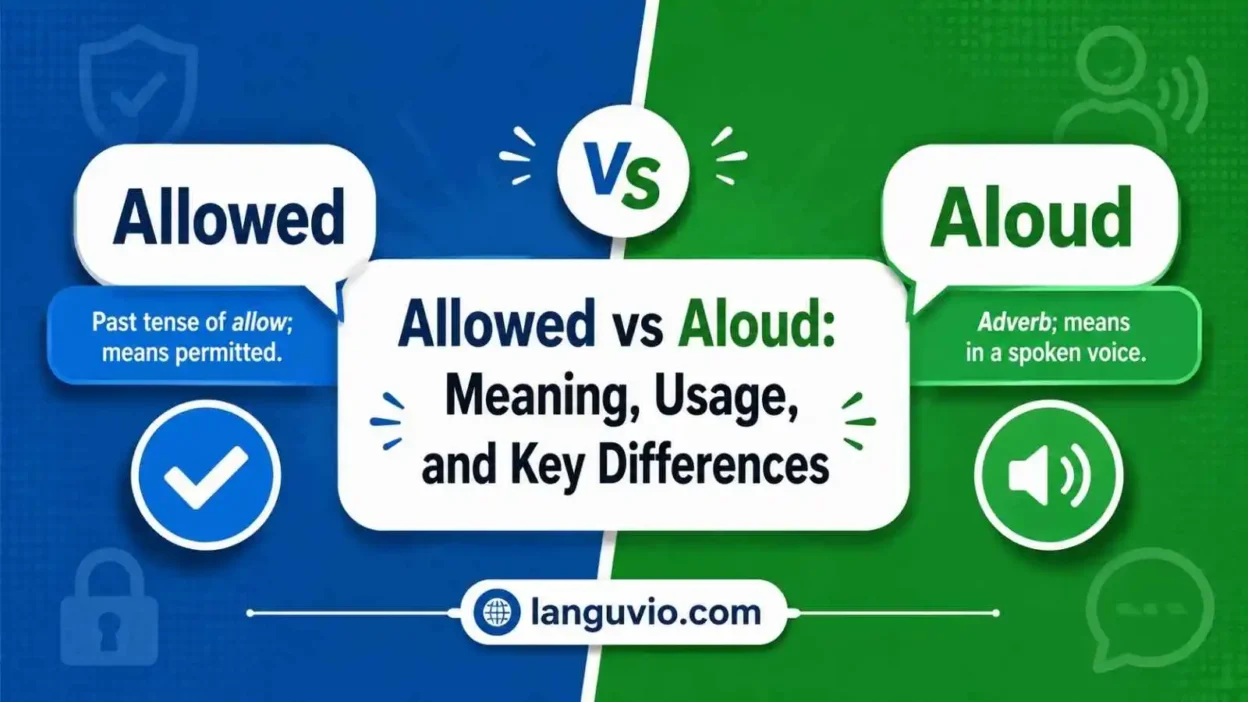
“Allowed vs aloud” often confuses writers because both words sound exactly the same in spoken English. Despite that similarity, their meanings are completely different. One connects to permission, while the other describes how something is spoken.
Many mistakes happen in writing, especially when people rely on sound instead of meaning. Since both spellings are correct words, tools rarely catch the error. Understanding the difference makes it easy to choose the right one every time.
This guide breaks everything down clearly so you can avoid confusion and write with confidence.
Quick Answer
- Allowed means permitted or given permission.
- Aloud means spoken out loud so others can hear.
Use allowed for rules or permission.
Choose aloud when describing speech that can be heard.
Why People Confuse Them
The biggest reason behind this confusion is pronunciation. Both words sound identical: uh-LOUD. Because of that, many people rely on how the word sounds instead of what it means.
Another factor is writing speed. While typing quickly, it is easy to pick the wrong spelling without thinking about context. Since both versions exist, errors slip through unnoticed.
Focusing on meaning instead of sound solves the problem.
Key Differences At A Glance
| Context | Best Choice | Why |
|---|---|---|
| Talking about permission | allowed | Refers to rules or approval |
| Speaking so others hear | aloud | Describes how something is spoken |
| Asking for approval | allowed | Linked to permission |
| Describing spoken words | aloud | Linked to sound |
Meaning and Usage Difference
The term allowed comes from the verb allow, which means to permit something. It often appears in passive forms such as “is allowed” or “was allowed.”
- Example: You are allowed to bring snacks.
In contrast, aloud works as an adverb. It describes speech that can be heard rather than kept silent.
- Example: She read the instructions aloud.
A simple memory trick helps:
- Allowed = permission
- Aloud = sound
Tone, Context, and Formality
Both words fit comfortably in formal and informal settings. However, each belongs to a specific type of context.
Situations involving rules, authority, or permission call for allowed. Policies, instructions, and decisions often include this word.
Speaking or reading situations call for aloud. Whenever sound or voice is involved, this is the correct choice.
Because their meanings differ completely, one cannot replace the other.
Which One Should You Use?
Choose allowed when a sentence involves permission or rules. This applies when someone can or cannot do something.
Pick aloud when describing speech that others can hear. Reading, speaking, or calling out all fall into this category.
A quick test can help:
- Replace with permitted → use allowed
- Replace with out loud → use aloud
When One Choice Sounds Wrong
Incorrect usage creates sentences that feel off.
❌ She read the story allowed.
✔ She read the story aloud.
❌ Are we aloud to leave early?
✔ Are we allowed to leave early?
Even if spoken, the mistake might go unnoticed. In writing, however, the error becomes clear.
Common Mistakes (and Quick Fixes)
Mistake 1: Confusing permission with speaking
- ❌ Talking is not aloud here.
- ✔ Talking is not allowed here.
Mistake 2: Using “allowed” when you mean speaking
- ❌ He said the answer allowed.
- ✔ He said the answer aloud.
Choosing based on pronunciation
- Fix: Always check the meaning before writing
Everyday Examples
Allowed:
- Visitors are not allowed after 9 PM.
- Students are allowed to use notes during the test.
- Is parking allowed here?
Aloud:
- Please read the paragraph aloud.
- She laughed aloud at the joke.
- He called her name aloud across the room.
Dictionary-Style Word Details
Verb
- Allowed: Past tense of allow, meaning permitted or approved
- Aloud: Not commonly used as a verb in standard US English
Noun
- Allowed: Not commonly used as a noun
- Aloud: Not used as a noun
Synonyms
- Allowed: permitted, authorized, approved
- Aloud: out loud, audibly
Antonyms (when helpful):
- Allowed: forbidden, prohibited
- Aloud: silently
Example Sentences
- Allowed: Employees are allowed to take breaks during shifts.
- Aloud: The teacher asked him to read the answer aloud.
Word History
- Allowed: Derived from “allow,” meaning to permit
- Aloud: Comes from earlier English meaning “out loud”
(Exact historical detail is not required for correct use.)
Phrases Containing
- Allowed: “not allowed,” “be allowed to,” “strictly allowed”
- Aloud: “read aloud,” “say aloud,” “laugh aloud”
FAQs
Allowed means something is permitted or given permission, while aloud means speaking or reading something so it can be heard.
They sound exactly the same when spoken, but they have completely different meanings, which causes spelling mistakes in writing.
No, the correct phrase is “read aloud,” because it refers to speaking words out loud, not permission.
No, they cannot be swapped because one refers to permission and the other refers to sound or speech.
Allowed is mainly used as a verb form meaning “permitted,” often in passive constructions like “is allowed.”
Aloud is an adverb that describes how something is spoken—out loud rather than silently.
“Is it allowed?” is correct because it asks about permission, not speech.
If you can replace it with “permitted,” use allowed. If you can replace it with “out loud,” use aloud.
Conclusion
Understanding allowed vs aloud becomes simple once you focus on meaning rather than sound. One word deals with permission, while the other relates to speech that can be heard.
A quick check—permission or sound—usually leads to the correct choice. With that habit, mistakes become rare and writing becomes clearer.